

Technical Documentation: telegramdesktop/tdesktop
ℹ️ Provenance: Multi-Tier Ingestion · CodeWiki Reference
Overview (`README.md`)
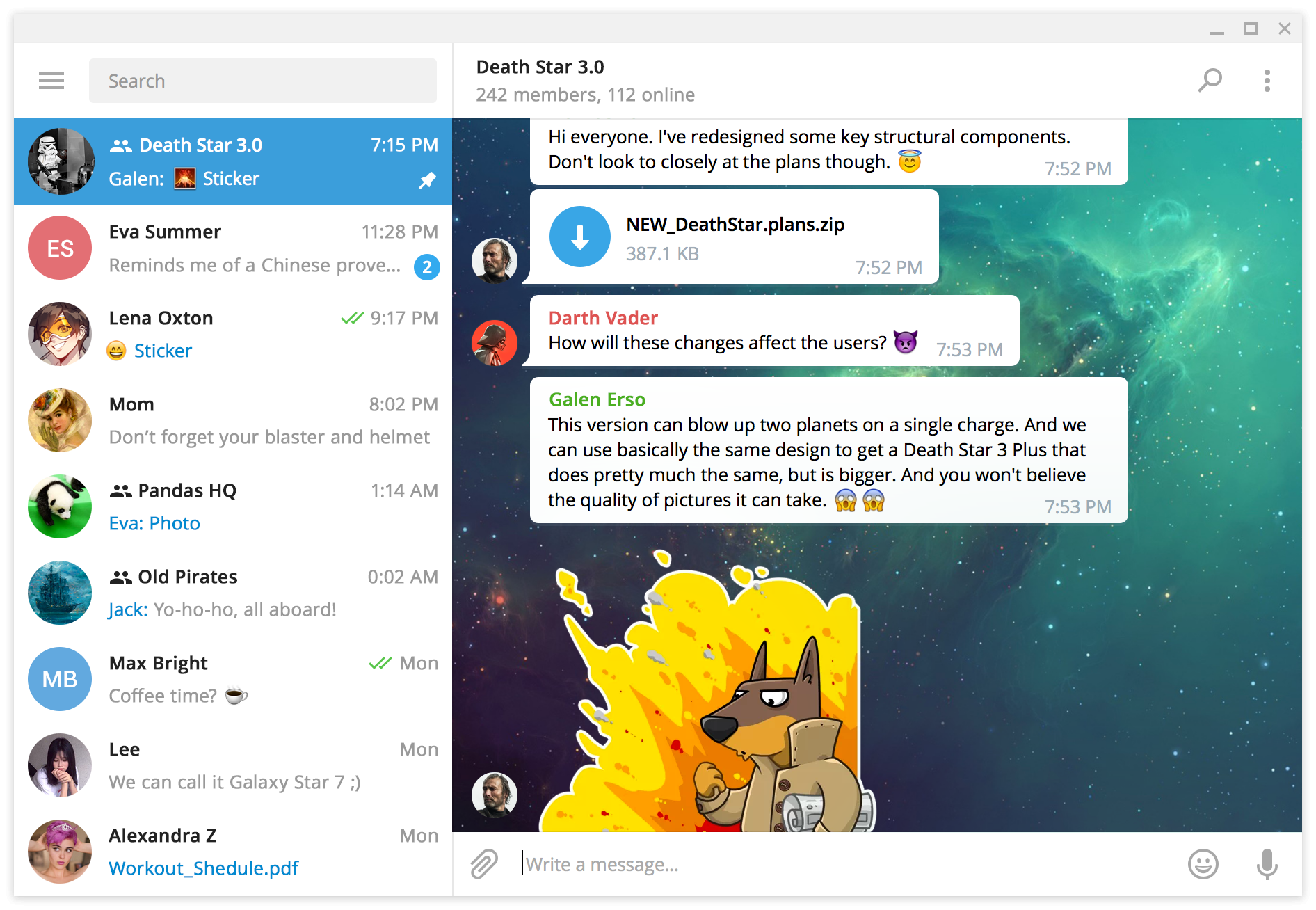
[Telegram Desktop][telegram_desktop] – Official Messenger
This is the complete source code and the build instructions for the official Telegram messenger desktop client, based on the Telegram API and the MTProto secure protocol.
The source code is published under GPLv3 with OpenSSL exception, the license is available here.
Supported systems
The latest version is available for
- Windows 7 and above (64 bit) (portable)
- Windows 7 and above (32 bit) (portable)
- macOS 10.13 and above
- Linux static build for 64 bit
- Snap
- Flatpak
Old system versions
Version 4.9.9 was the last that supports older systems
Version 2.4.4 was the last that supports older systems
Version 1.8.15 was the last that supports older systems
Third-party
- Qt 6 (LGPL) and Qt 5.15 (LGPL) slightly patched
- OpenSSL 3.2.1 (Apache License 2.0)
- WebRTC (New BSD License)
- zlib (zlib License)
- LZMA SDK 9.20 (public domain)
- liblzma (public domain)
- Google Breakpad (License)
- Google Crashpad (Apache License 2.0)
- GYP (BSD License)
- Ninja (Apache License 2.0)
- OpenAL Soft (LGPL)
- Opus codec (BSD License)
- FFmpeg (LGPL)
- Guideline Support Library (MIT License)
- Range-v3 (Boost License)
- Open Sans font (Apache License 2.0)
- Vazirmatn font (SIL Open Font License 1.1)
- Emoji alpha codes (MIT License)
- xxHash (BSD License)
- QR Code generator (MIT License)
- CMake (New BSD License)
- Hunspell (LGPL)
- Ada (Apache License 2.0)
- zxcvbn-c (MIT License)
- FrequencyWords by Hermit Dave (Creative Commons Attribution-ShareAlike 4.0)
Build instructions
Thanks to
CI infrastructure sponsored by Depot — fast GitHub Actions runners.
Overview (`tools/clangtidy/README.md`)
clang-tidy for tdesktop
python3 tools/clangtidy/compile_db.py               # after each configure
git diff -U0 HEAD | clang-tidy-diff.py -p1 -path out/clang-tidy -j 10 -quiet
run-clang-tidy -p out/clang-tidy -j 10 -quiet <files>
Both runners ship with LLVM, under share/clang. Needs clang-tidy 20 or
newer: an older one ignores CustomFunctions without a word.
The commit hook, once per clone, submodules included; its tests run withpython3 tools/rules/test_hook.py:
for repo in . $(git config -f .gitmodules --get-regexp path \
        | awk '{print $2}' | grep -v ThirdParty); do
    hooks=$(git -C "$repo" rev-parse --git-path hooks)/pre-commit
    printf '#!/bin/sh\nexec python3 %s/tools/rules/hook.py --staged\n' \
        "$PWD" > "$hooks" && chmod +x "$hooks"
done
Overview (`Telegram/Resources/zxcvbn/README.md`)
zxcvbn frequency lists
The two word lists in this directory are unmodified copies of third-party
frequency lists. They are read only at build time: the rules inTelegram/cmake/lib_zxcvbn.cmake transliterate them and compile the result
into the zxcvbn-c password dictionary behindTelegram/SourceFiles/ui/passcode_strength.cpp. No built artifact contains
these files: they are build-time inputs to a generated header. They are
tracked, so every source distribution of Telegram Desktop ships them
verbatim, and the attribution below covers those copies as well as the
dictionary compiled from them.
Provenance
- Title: FrequencyWords
- Creator: Hermit Dave
- Repository: https://github.com/hermitdave/FrequencyWords
- Upstream commit:
f8a65e6ddc17e0baa2e366a909986798d8dbe55b(2019-02-15,
"Additional languages including pl, pt and zh variants", the last upstream
commit touching either file) - Derivation: generated by the upstream author from the OpenSubtitles2018
corpus (http://opus.nlpl.eu/OpenSubtitles2018.php); oneword count
pair per line, separated by a single space, in descending order of count;
50,000 lines each, all lowercase, LF line endings, no BOM.
| Tracked file | Upstream path | Bytes | Lines |
|---|---|---|---|
ru_50k.txt |
content/2018/ru/ru_50k.txt |
998,861 | 50,000 |
uk_50k.txt |
content/2018/uk/uk_50k.txt |
887,259 | 50,000 |
sha256 digests, equal to the GitHub raw files at the pinned commit (verified
2026-09-06):
6095f507cc167488ec66ada5a85ac50433503a08ad24a07c6eabdf54352c4e7f  ru_50k.txt
881686fe66a168b79f6a9ee2f6cbbf944cfb12bfb7040913ef535cb29bd86ec9  uk_50k.txt
.gitattributes pins Telegram/Resources/zxcvbn/*.txt to text eol=lf, so
the digests hold on a Windows checkout as well.
Licence
Upstream's README.md states, under "License", at the upstream head525f9b560de45753a5ea01069454e72e9aa541c6 (2022-02-07) — head on
2026-09-06, the day these copies were taken:
MIT License for code.
CC-by-sa-4.0 for content.
The licence version in that statement has changed exactly once. At the
pinned commit f8a65e6ddc17e0baa2e366a909986798d8dbe55b (2019-02-15, the
only commit that ever touched either list) the section readMIT License for codes. / CC-by-sa-3.0 for contents.; commit0c6a7e40cfd8c645f9e91ff70cd94d7aa8c85c09 (2019-02-15) reworded it toMIT License for code. / CC-by-sa-3.0 for content., leaving the
version at 3.0; and commit 34bb6447a96d4434dc2d4b24e0cf946c523090b3
(2020-08-11, "Update README.md") replaced CC-by-sa-3.0 withCC-by-sa-4.0 in that one line, since when the section has read as quoted
above.
The word lists are content, not code, and the licence that governs these
copies is the Creative Commons Attribution-ShareAlike 4.0 International
licence (CC BY-SA 4.0), https://creativecommons.org/licenses/by-sa/4.0/,
through the licensor's standing offer at head — not through the pin, and
not merely because the bytes are unchanged. A public licence is an offer
made when the material is made available, and a licensor may add a new offer
over unchanged files without withdrawing the old one (CC BY-SA 3.0 §7(b),
CC BY-SA 4.0 §6(c)). The pin fixes which bytes are tracked, and the digests
above stay pinned to it; it does not fix which offer they were taken under.
The earlier 3.0 offer is perpetual and remains available, but it is not
relied on here. Were the 4.0 offer ever disputed, 3.0 alone would still
reach CC BY-SA 4.0, because 3.0 §4(b)(ii) permits distributing an Adaptation
under "a later version of this License with the same License Elements"; it
would not reach the GNU GPL directly, because Creative Commons records that
"Currently, no non-CC licenses have been designated as compatible with BY-SA
3.0".
The repository's LICENSE file (MIT, "Copyright (c) 2016 Hermit Dave")
covers the generator code only. Upstream supplies no separate copyright or
disclaimer notice for the content beyond the licence line quoted above.
Changes made
The lists are used as build-time input only: the word column is kept, each
word is transliterated to Latin letters by zxcvbn_translit, words that are
still non-ASCII or shorter than two letters are dropped, four OpenSubtitles
subtitle-markup strings (chffffff, fntahoma, b1, i0) are dropped,
and the result is compiled into the zxcvbn dictionary; the tracked files are
unmodified copies.
The count column only orders the words: the generated dictionary keeps a
word's rank, not its count.
Compatibility with the application licence
Telegram Desktop is distributed under the GNU General Public License, version
3 or (at your option) any later version (/LICENSE, /LEGAL), with the
OpenSSL linking exception. CC BY-SA 4.0 content may be adapted into a GPLv3
project on this basis:
- Creative Commons, "Compatible Licenses",
https://creativecommons.org/share-your-work/licensing-considerations/compatible-licenses/:
"GPLv3: The GNU General Public License version 3 was declared a
'BY-SA–Compatible License' for version 4.0 …" and "Note that compatibility
with the GPLv3 is one-way only, which means you may license your
contributions to adaptations of BY-SA 4.0 materials under GPLv3, but you
may not license your contributions to adaptations of GPLv3 projects under
BY-SA 4.0." (declared 2015-10-08). - Creative Commons wiki, "ShareAlike compatibility: GPLv3",
https://wiki.creativecommons.org/wiki/ShareAlike_compatibility:_GPLv3:
"When someone creates an adaptation of a BY-SA licensed work and includes
it in a GPLv3-licensed project, both licenses apply and downstream users
must comply with both licenses. However, Section 2(a)(5)(B) of BY-SA 4.0
allows anyone who receives the adapted material downstream to satisfy the
conditions of both BY-SA and GPLv3 (i.e. attribution and ShareAlike) in
the manner dictated by the GPLv3." and "this compatibility determination
only allows movement one way, from BY-SA 4.0 to GPLv3." - Free Software Foundation, "Various Licenses and Comments about Them",
https://www.gnu.org/licenses/license-list.html#ccbysa: "CC BY-SA 4.0 is
one-way compatible with the GNU GPL version 3: this means you may license
your modified versions of CC BY-SA 4.0 materials under GNU GPL version 3,
but you may not relicense GPL 3 licensed works under CC BY-SA 4.0. Because
Creative Commons lists only version 3 of the GNU GPL on its compatible
licenses list, it means that you can not license your adapted CC BY-SA
works under the terms of 'GNU GPL version 3, or (at your option) any later
version.' However, Section 14 of the GNU GPL version 3 allows licensors to
specify a proxy to determine whether future versions of the GNU GPL can be
used. Therefore, if someone adapts a CC BY-SA 4.0 work and incorporates it
into a GNU GPL version 3 licensed project, they can specify Creative
Commons as their proxy …"
Consequence for this repository — an owner decision this file records but
cannot make. Creative Commons declared only GPL version 3 a
BY-SA-Compatible License, and the wiki page quoted above instructs adapters:
"You must specify version 3 of the GPL when redistributing a GPL project
into which BY-SA 4.0 content is adapted." Telegram Desktop's own offer is
broader: /LEGAL — and every source file header that points at it — says
"either version 3 of the License, or (at your option) any later version".
Once the dictionary compiled from this corpus is linked in, that broader
offer cannot be made for the combined work unless the Program itself names a
proxy under GPL §14 ("If the Program specifies that a proxy can decide which
future versions of the GNU General Public License can be used…"). This file
is not the Program's licence statement and cannot make that designation. The
repository owner has to pick one:
- (a) add a GPL §14 proxy designation naming Creative Commons
(https://creativecommons.org/compatiblelicenses) to/LEGAL, after
which "or any later version" works again for the combined work as and when
Creative Commons declares a later GPL version compatible; - (b) accept that builds containing this dictionary are offered under GPL
version 3 only, and qualify/LEGALaccordingly; - (c) drop this corpus — no BY-SA content, no constraint.
Until (a) or (b) is recorded in /LEGAL, this component and the tree's "or
any later version" offer are in tension. The in-app statement,lng_about_text2, already reads "licensed under the GNU GPL version 3". The
tracked lists themselves remain verbatim copies under CC BY-SA 4.0.
Reproducing the dictionary
The build performs these steps itself; run them by hand from the checkout
root after a Debug build to check that the generated header is reproducible.<dir> is any scratch directory outside the checkout.
out/Telegram/Debug/zxcvbn_translit \
    Telegram/Resources/zxcvbn/ru_50k.txt <dir>/ru_50k-latin.txt
out/Telegram/Debug/zxcvbn_translit \
    Telegram/Resources/zxcvbn/uk_50k.txt <dir>/uk_50k-latin.txt
out/Telegram/Debug/zxcvbn_dictgen -o <dir>/dict-src.h \
    Telegram/ThirdParty/zxcvbn/words-eng_wiki.txt \
    Telegram/ThirdParty/zxcvbn/words-female.txt \
    Telegram/ThirdParty/zxcvbn/words-male.txt \
    Telegram/ThirdParty/zxcvbn/words-passwd.txt \
    Telegram/ThirdParty/zxcvbn/words-surname.txt \
    Telegram/ThirdParty/zxcvbn/words-tv_film.txt \
    <dir>/ru_50k-latin.txt \
    <dir>/uk_50k-latin.txt
cmp <dir>/dict-src.h out/Telegram/zxcvbn_gen/dict-src.h
The input order matters: the generator interleaves its inputs by rank, so
the six upstream lists come first, in the order lib_zxcvbn.cmake lists
them, followed by the Russian and then the Ukrainian intermediate. cmp
must report no difference.
Overview (`Telegram/SourceFiles/test/README.md`)
Telegram Desktop task-test harness
This directory contains the permanent Debug-only infrastructure used byperform-task overlays. Read this catalog before designing or recovering a
scenario. The overlay should add only task-specific fixtures, production
entry points, checks, and captures; do not recreate facilities already here.
The default is one packed scenario and one app launch. Put all compatible
checks, themes, values, interactions, and captures into that execution. Plan
another launch only when you can name an incompatible process-lifetime
requirement, such as a startup-only setting or persisted state that the first
flow necessarily contaminates. “The scenario is large” and “a smoke run is
simpler” are not reasons to split it. After a TEST_FLAW, repair every flaw
visible in the run together and rerun the packed scenario.
Cite code by symbol, never by line number, here and in harness comments:Runner::finish() in test_runner.cpp, not test_runner.cpp:NNN or:NNN-MMM. Line numbers drift with every edit, including the next harness
task's, and nothing updates them. A failure-diagnosis row names the
functions, constants and macros on its causal path, in product, submodule
and Qt sources alike. Quoted log or crash text stays verbatim.
The stage contract
Runner executes each Stage as three distinct operations:
| Member | Contract | Must not do |
|---|---|---|
run |
One action whose prerequisites were established by an earlier stage. | Dereference an object that this stage is supposed to wait for. |
until |
A pure, repeatable readiness observation. | Click, mutate state, emit a PASS/FAIL, or encode the expected product result. The one documented exception is the Test::ForceWindowActive re-assertion in the activation row under Failure diagnosis. |
then |
Assertions and the next action after readiness succeeded. | Resolve an unguarded replacement for the object that readiness accepted. |
timeoutDetails |
Return the latest observed values and identities. | Repeat only “not ready”; omit the values needed to diagnose why. |
skipReason |
Return why this stage does not apply, or an empty string when it does. A non-empty reason writes TEST_RESULT: N/A: <stage> - <reason>, skips run, until and then, and moves on in the same turn. |
Decide the product outcome. A gate that reads a measurement instead of a precondition turns a would-be FAIL into a silent N/A. |
A stage timeout is a harness failure unless the readiness condition itself is
the behavior under test. Keep expected geometry, text, pixels, counts, and
other falsifiable outcomes in then or captureAndInspect, not in until.
Otherwise a real product mismatch is mislabeled as an opaque timeout.
Use Runner::actOnWidget when an action depends on a widget that may appear
asynchronously. It polls the resolver and optional readiness predicate, keeps
a QPointer to the exact accepted object, and invokes the action once. This
removes both the eager-.run crash and the “resolve again in .then” race.
The same rule is built into the harness's widget-carrying readings:Test::BoxShellButtons, Test::WindowMappedCapture,Test::PaintingLayerRootResult, Test::ToastSubtreeReading andTest::ContextMenuReading hold QPointer<QWidget>, so a reading kept
across a stage boundary answers matched() / resolved() false (a
context-menu reading's menu reads null) once its subject is destroyed and
still prints its counts, labels, identity and refusal; format aWidgetDescription of the pointer while the reading is still matched,
because there is nothing to format afterwards.
The generic startup waits are opt-in:
waitEvent("launch_finished")is the normal first gate.waitForSessionReady()is needed only when the scenario consumes a
session.waitForChatsLoaded()is needed only when the tested setup consumes the
chats list; it is non-fatal and records whether loading completed.waitForChatsLoadedStrict()is appropriate only when chats loading is part
of the required fixture or result.
Do not put all three waits in every scenario preamble. An injected box,
helper oracle, or direct production seam often needs none of the account or
chats gates.
Exact objects and actions
Telegram custom widgets generally do not declare Q_OBJECT. Never callfindChildren(); Qt may return unrelated widgets blindly
cast to that type. FindAll<T>, FindFirst<T>, and FindVisible<T> enumerate
real QWidget descendants and apply C++ RTTI safely.
FindVisible means only QWidget::isVisible(). It does not prove that the
widget belongs to the current layer, is unobscured, has non-empty mapped
geometry, or is the latest instance. Add those task-specific conditions, or
publish the exact object from its construction seam.
For layer-owned objects, repeated boxes, async replacements, and footer
callbacks with no returned pointer, use the live publication helpers:
// In an inventoried Debug overlay hunk at the real construction seam.
Test::PublishLiveWidget(u"gift.composer"_q, composer);
Test::PublishLiveAction(
	u"gift.confirm"_q,
	box,
	[=] { confirm(); });

// In test_scenario.cpp.
runner->actOnWidget(
	u"open current composer"_q,
	[] { return Test::ReadLiveWidget(u"gift.composer"_q).widget; },
	[](QWidget *widget) { Test::Click(widget); },
	[](QWidget *widget) {
		return widget->isVisible() && widget->isEnabled();
	},
	Test::kDefaultStageTimeout,
	[](QWidget *widget) {
		return u"visible=%1 enabled=%2 size=%3x%4"_q
			.arg(widget->isVisible())
			.arg(widget->isEnabled())
			.arg(widget->width())
			.arg(widget->height());
	});
Each publication advances a generation. A destroyed context makes its widget
or action unavailable. Actions are one-shot by default; pass true only for
a production callback that is intentionally retryable. UseReadLiveAction() to wait for a specific generation and invocation count,
then InvokeLiveAction() in an action/assertion stage. This is preferable to
guessing which RoundButton belongs to a presentation wrapper.
Drive a top-level Ui::RpWindow through that static type, never through aQWidget* or a QPointer<QWidget>. Ui::RpWindow (rp_window.h)
declares setMinimumSize(), setFixedSize(), setGeometry(),showFullScreen(), showNormal() and close() without virtual and
forwards each to its Ui::Platform::BasicWindowHelper (rp_window.cpp).
The QWidget members of the same names are non-virtual too, so these six
only hide them and the static type picks the function: through aQWidget* the call compiles, runs the QWidget member and silently skips
lib_ui's platform window helper. Keep the type the product hands out —Calls::Group::Panel::window(), Calls::Panel::window() andCalls::Window::window() return not_null — and hold it
across stages as QPointer. A window found throughQApplication::topLevelWidgets() or QWidget::window() is a QWidget*:dynamic_cast it before the call, and treat a null cast of
the window a stage means to drive as a fixture gate, never as a reason to
call through the QWidget*. Every other Ui::RpWindow forward, such assetTitle() or setStaysOnTop(), has no QWidget namesake, so aQWidget* call to it does not compile; a member Ui::RpWindow does not
declare, such as showMaximized(), windowState() or geometry(), is
the same QWidget member through either type. The full-screen row under
“Failure diagnosis” gives the skip's measured consequence on Windows.
Resolving a chat's message list
A chat's message list is not necessarily HistoryWidget / HistoryInner.
The legacy main-chat stack is HistoryWidget (history/history_widget.h)
plus HistoryInner (history/history_inner_widget.h); the modern stack isHistoryView::ChatWidget (history/view/history_view_chat_section.h) plusHistoryView::ListWidget (history/view/history_view_list_widget.h); and the
admin log is a third stack again, AdminLog::InnerWidget, which implementsHistoryView::ElementDelegate itself and constructs no ListWidget.ChatWidget already backs replies threads, forum topics and both monoforum
and Saved Messages sublists (both are Data::SavedSublist); scheduled
messages, pinned messages, welcome messages and the chat preview popup each
construct their own ListWidget.
A scenario that assumes one named widget renders every chat fails opaquely.
Publishing a live widget from HistoryWidget's construction seam and then
walking the window logged RENDER_ROUTES: published=0 walked=0 chain=[none]
against 403 root descendants — the HistoryInner was never constructed, and
the walk found none either — while the window grab plainly showed the chat
painting the row.
The rule is therefore about resolution, not about a name, and stays true as
the migration proceeds. Resolve the list from the section that constructs it
and prove the candidate owns the message:
- publish the exact live object at the statement that constructs the list —
_inner = _scroll->setOwnedWidget(object_ptr<ListWidget>(inhistory/view/history_view_chat_section.cpp— throughTest::PublishLiveWidget; - keep
Test::FindVisible<HistoryView::ListWidget>as an independent
cross-check and log both answers; - accept a candidate only when its own lookup answers for the exact message:
list->viewByPosition(item->position())must return anElementwhosedata()is that item and whosedelegate()is that same list; - scroll with the product's own entry points,
showThreadand then the list'sshowAtPosition; decide where the row sits with the list's publicelementIntersectsRange(view, from, till), and frame it withTest::CaptureMappedRect.
item->mainView() is not the Element the visible section owns, so it is
neither a readiness gate nor a geometry oracle. For a row a ListWidget was
painting it answered view=1 with viewHeight=0 and itemTop=-3; use the
list's own viewByPosition for both jobs instead.
The parent chain a resolved ListWidget produced, as the shape to expect, wasListWidget < Ui::ElasticScroll < ChatWidget < MainWidget < Ui::RpWidget < Ui::RpWidget < MainWindow.
Input helpers
All input helpers synchronously dispatch real Qt events and drainUi::PostponeCall work after each event. They lifetime-guard the target and
stop if it is destroyed. AppendClipboardRoundTrip sits beside DropText
below because the two answer the clipboard question from opposite sides, but
it is a stage, not an event helper: it yields to the event loop between its
attempts.
On macOS a default workspace.py test-run launch of an app bundle's main
executable does not activate the client: it launches the bundle through
LaunchServices in the background, with Qt's own launch activation switched off
(.agents/shared/test-loop.md, Launch activation; the report readslaunch_method: "background"). The client starts as an inactive application
and its windows open behind the frontmost application's. A window shown
already covered reads isExposed() true until the window server first reports
a change for it, so exposed=1 is no proof that it is on screen; after such a
change a covered window reads unexposed and gets no paints. Drive focus-routed
actions with ForceWindowActive, keep a window a stage needs painted exposed
with KeepWindowExposed either way, and use test-run --activate when
genuine OS activation is the subject. Product flows that raise or activate a
top-level window - Ui::PopupMenu, Ui::SeparatePanel::showAndActivate(),Window::Controller::activate(), DropText into a shown field - still
request activation of the client on macOS, and so do the not-marking-read,
separate-panel-walk and popup-menu self-tests. After a background launch the
window server may grant or refuse that request: on this host it granted it
about 11 s after launch in two default runs and refused it about 20 s after
launch in a third, under a condition those runs did not establish
(2026/10/08/launch-the-testagent-client-without-activating-it, Runs 4, 8 and
9). A granted request takes the key window from the frontmost application.
After a refused one the client stays inactive and the frontmost application
keeps its key window, but the client's window may still be ordered in front of
the frontmost application's window by the request's own window ordering: in
Run 9 above the primary window stayed covered after its restore, while with an
overlay that made the client's own application-activation calls no-ops,
reproducing that refusal under another stage sequence, the inactive primary
window was in front for about 4 s after the not-marking-read self-test's
restore through Window::Controller::activate(), until a later request put it
behind again
(2026/10/09/keep-background-testagent-runs-on-macos-unthrottled-and-painting,
Runs 0 and 3). So the scenario's own activation is no reliable route to OS
activation under the default. A client the launch did not activate is a
background application, which macOS may nap and whose timers it may coalesce:
in background runs on this host without a hold, a sampler's heartbeat gaps
grew to 100-290 ms after about 15 s of normal cadence
(2026/10/01/animate-gram-card-sending-and-settle-effects, Run 1), and a 4 ms
precise sampler ticked every 50-1000 ms from about the 80th second
(2026/10/02/show-the-input-method-composition-in-the-gram-send-amount, Run
1). On a locked console macOS napped such a client without a hold, from about
30 s after process start
(2026/10/09/keep-background-testagent-runs-on-macos-unthrottled-and-painting,
Runs 0 and 4), but another application's window covering the client did not
guarantee it: on an unlocked console, a client without a hold that the
frontmost application's window covered kept an exact 16 ms timer cadence over
60 s and over 300 s (Runs 1 and 2). Those runs did not establish what made
macOS nap the client. So on macOS the harness holds one user-initiated,
latency-critical NSProcessInfo activity
(NSActivityUserInitiatedAllowingIdleSystemSleep | NSActivityLatencyCritical;
idle system sleep stays allowed) for the whole -testagent run:Test::ApplyStartupOverrides() (test_agent.cpp) begins it early inApplication::run(), before Test::Start(), and never ends it, so it lasts
until the process exits, a watchdog or stage-timeout ending included. The log
says once which case a run is in: a held run readsNOTE: TDESKTOP_TEST_APP_NAP=[] applied: hold=active ..., and a run without
the hold reads hold=off with the reason. An overlay no longer holds an
activity of its own: the per-overlay BeginLatencyActivity of the2026/10/07/animate-the-sending-row-for-a-collectible-transfer overlay is
history, and a second activity is harmless but redundant. A campaign whose
subject is background scheduling itself (App Nap, timer coalescing,
throttled-timer behaviour) launches withtest-run --env TDESKTOP_TEST_APP_NAP=allow, and its log then readshold=off source=environment; any other non-empty value is logged as
rejected and the hold is kept. Off macOS nothing readsTDESKTOP_TEST_APP_NAP and nothing is held.
| Helper | Use |
|---|---|
Click |
Left press and release at the center or a supplied local point, then a QEvent::Leave to that same widget, so Ui::AbstractButton::isOver() is false on it and a RoundButton repaints its normal textBg. Send it the widget that accepts the press — an ignored press propagates to the ancestor that takes it and the leave does not, so a click aimed at a non-accepting child leaves that ancestor hovered. |
TypeText |
Key press/release per Unicode grapheme; surrogate pairs and joined emoji stay intact. Send it to the widget that owns the key route: for a Ui::InputField that is rawTextEdit(), never the wrapper. |
CommitText |
One QInputMethodEvent commit when insertion, custom emoji, or IME semantics matter more than physical keys. Same target rule as TypeText, and the fallback when key events left the field empty. |
DropText |
Hand a text to a Ui::InputField the way a paste does, with no system clipboard: a QMimeData carried by a QDragEnterEvent and then a QDropEvent, both sent to rawTextEdit()->viewport(), which ends in canInsertFromMimeDataInner / insertFromMimeDataInner and so in the field's setMimeDataHook (or its own insertion when the hook leaves it), the insertion Ctrl+V ends in. The drop is sent only when the field's own editor accepted the enter. An ignored enter climbs to the first enabled ancestor that accepts drops, such as a chat's file-drop area, so for the pair an application filter withholds every drag event Qt would hand any other widget, and the returned TextDrop lists them in shielded. It settles once after the pair, not after each event. A miss is a named refusal: viewport-refuses-drops, enter-not-accepted or drop-not-accepted. The text goes in at the caret and does not replace a selection. It does not exercise the clipboard read of a Paste accessory or of Ctrl+V. InputField::dropEventInner raises and activates the field's window afterwards (on macOS this asks for the app to come forward, which the window server may grant or refuse after a default background test-run launch; a never-shown top level is unaffected). TextDropDetails never prints the text. Confirm with test_text_drop.h. |
AppendClipboardRoundTrip |
A check whose subject is the system clipboard itself - a copy entry's result, or a Paste accessory's or Ctrl+V's own read - first needs a host whose clipboard reads back. One stage (test_clipboard.h) writes a sentinel carrying the caller's label (one token, no spaces) and reads it back, up to 10 times 300 ms apart across event-loop turns, logging every attempt as a CLIPBOARD_ROUND_TRIP_ATTEMPT row; read the returned ClipboardRoundTrip from a later stage: succeededAt, or a named refusal saying what the last read held (read-empty, read-stale-sentinel, read-foreign). Judge a product copy afterwards with ReadClipboard(expected), one classified reading (expected / empty / harness-sentinel / foreign) with its owns reading, never a wait. Text the harness did not write is never printed, measured or hashed, and the owner's clipboard is overwritten and never saved or restored. For what a field does with pasted text, DropText stays the route. Confirm with AppendClipboardRoundTripSelfTest. |
PressKey |
Escape, Return, arrows, shortcuts, and other key behavior. Send to the widget that owns the event route, often the raw editor (Ui::InputField::rawTextEdit()) or the top Ui::BoxLayerWidget, not a wrapper. |
Drag |
Left-button press, interpolated moves with buttons()==LeftButton, and release, then the same QEvent::Leave as Click. |
AppendQueuedStartDrag |
A drag whose start the target queues - both message lists, the shared-media list and the chats list's drag onto a folder queue performDrag() with InvokeQueued, Ui::FlatLabel's link and selection drag queues executeDrag() the same way, and Drag releases before that call runs (Failure diagnosis). One stage (test_queued_drag.h) resolves the target and its two points when it begins, delivers the press and the interpolated moves exactly as Drag does, posts an InvokeQueued marker to the target and a crl::on_main marker, yields to the event loop until both ran - so every normal-priority queued call and every crl::on_main call posted on the main thread while the press and moves were handled has run - and only then delivers the release and the same QEvent::Leave. It is a stage, not an event helper. Its wait is bounded (kQueuedStartDragBound, 3000 ms, inside the stage's timeout), and a miss is a named refusal on the returned QueuedStartDrag, read from a later stage: no-target, target-destroyed (no release is sent) or bound-expired (the release and the leave are still sent, so nothing stays pressed). A call those calls post in turn, a timer and a network answer still need a condition wait. It intercepts no platform drag, and every queued start that reaches QDrag::exec() starts a real drag that drops at the real cursor: before launching a scenario, hook the function whose QDrag::exec() its queued start reaches - Window::MainWindow::launchDrag() or Ui::FlatLabel::executeDrag() - as its first statement, returning before new QDrag, as the Failure diagnosis row and the header say. Drag itself is unchanged. Confirm with AppendQueuedStartDragSelfTest. |
Wheel |
A real wheel event at the named widget's local point (QPoint(0, -120) is one conventional downward step). A stack-built QWheelEvent is not spontaneous, so Qt 6 does not propagate it; the helper re-sends up parentWidget() until a widget handles and accepts — the scroll area's viewport, never the QAbstractScrollArea itself — honouring isWindow() and Qt::WA_NoMousePropagation. Returns WheelDelivery; a miss is a named refusal, not a silent no-op. Confirm with test_wheel.h. |
OpenContextMenu |
A context menu (test_menu.h): deliver a QContextMenuEvent (Mouse by default, Keyboard allowed) at a point in the receiving widget's coordinates and, in the same call, read the Ui::PopupMenu it built - its ordered non-separator action texts and its lifecycle at build and after the postponed calls settled - as a ContextMenuReading, or a named refusal: no-menu, several-menus, receiver-gone. The snapshot spans the whole application, so a menu the handler parents to another widget is found, and the reading holds the menu as a QPointer, so it stays printable after the menu dies. The helper does not hover: hover first when the product's handler reads the hovered link. On a chat list - HistoryInner or HistoryView::ListWidget - read with OpenChatListContextMenu (the next row) instead: in an inactive window this helper alone may read a menu the list built for another message. TriggerContextMenuAction(reading, text) triggers the one entry with exactly that text and delivers its queued Ui::Menu::CreateAction callback before it returns, without hiding the menu; it refuses menu-gone, no-such-action, several-actions, action-disabled and submenu-entry. Neither grabs pixels: a frame stays with CapturePopupMenu while the menu is still open. Never poll for a menu on later turns, and count a no-menu reading only beside a positive control the same helper built in the same widget (Failure diagnosis). Confirm with AppendContextMenuReaderSelfTest. |
OpenChatListContextMenu |
A context menu on a chat list (test_chat_menu.h), attributed to its target message: OpenChatListContextMenu(list, target, point) takes a HistoryInner or HistoryView::ListWidget, the target HistoryItem and a point in the list's coordinates, and returns a ChatListMenuReading that is built() only when the menu was built while the list resolved exactly that message - otherwise a named refusal, never a reading whose texts merely look valid. Both lists resolve the point in mouseActionUpdate(), which returns at once while !_mouseActive && !window()->isActiveWindow() (on HistoryInner also while hasPendingResizedItems()), so in an inactive window OpenContextMenu alone reads a menu built for whatever message the list resolved last (Failure diagnosis). The reader activates no window - activation can mark the shown messages read - and opens the gate's other operand for its own call only: a QEnterEvent to the list inside Settle (enterEventHook sets _mouseActive and resolves the real QCursor::pos(), which is never attributed), then OpenContextMenu with an at-build observer that reads the list's resolution inside the delivery, after showContextMenu's own mouseActionUpdate(e->globalPos()) and before any postponed call drained, then always a QEvent::Leave while the list survives, after which _mouseActive must read false. Each ChatListResolution - before the enter, after it, at build and after the leave - holds the resolved view's message and identity (Element::Moused() / _overElement), Element::Hovered() and Element::HoveredLink() on HistoryInner, the exact item (_dragStateItem / _overItemExact), the message the menu takes its entries from, mouseActive, activeWindow, pendingResize and the gate, read through file-private read-only accessors. A reading is accepted only when the gate was open at delivery, at build the resolved view is the list's own view of the target and every one of those candidates names the target or nothing, and the fresh menu is the list's own _menu. Refused before anything is sent: no-list, not-a-chat-list (also a ListWidget with no window controller, the chat preview's), no-target, foreign-target, outside-viewport, pending-resize (in a window that gets no paints, the minimized one KeepMainWindowNotMarkingRead keeps, nothing recounts that layout until the next Data::Session::sendHistoryChangeNotifications(), and History::addNewItem leaves one waiting: process it first, outside any until and only while the window cannot mark read, with notifyHistoryChangeDelayed(history) and sendHistoryChangeNotifications(), which HistoryWidget::handleHistoryChange answers by recounting it, as the self-test does) and ambiguous-target (an album, or a selection already in the list); after the delivery: list-gone, target-gone, menu-refused, unresolved, wrong-target (the resolved message is in the details), ambiguous-target, foreign-menu and mouse-still-active. A refusal after the delivery hides the one menu this call built and clears reading.menu.menu, so TriggerContextMenuAction(reading.menu, text) refuses menu-gone; trigger only from a built() reading, in the same turn, where "Select" selects exactly the target. After the leave Element::Moused() and _overElement keep the last resolved view: that is not hover, and nothing claims to clear them. ChatListMenuDetails prints the reading; neither function Notes or Fails. Confirm with AppendChatListMenuSelfTest. |
Settle |
Wrap programmatic mutations such as InputField::setText; drains postponed fixups after the action. |
ForceWindowActive |
Inject window activation through the QPA seam before any focus-routed action, and re-assert it on every poll of a bounded wait. On a locked console, or on macOS after a default test-run launch until something activates the client, the window is never active in Qt's sense, so setFocus() never reaches QApplication::focusWidget() and every hasFocus()/isActiveWindow() branch silently reads false. |
KeepMainWindowNotMarkingRead |
Minimize the primary window and poll until MainWindow::markingAsRead() is false with the window minimized and not hidden, or until kNotMarkingReadBound returns a named refusal. Call it again after Window::Controller::activate() or any showHistory that is not anim::activation::background, which clear the minimized bit. A control that cannot read true within kNotMarkingReadBound - a still-unexposed window, or a locked console that keeps it false - must not be reported as success; the self-test exposes the primary window itself with KeepWindowExposed from its control until its restore stage. Confirm with test_marking_read.h. |
KeepWindowExposed |
Stack a covered top-level window above ordinary windows - on macOS Qt::WindowStaysOnTopHint on its QWindow, never QWidget::setWindowFlag - without activating the app, changing the focus window or taking focus, so a window another application covers is exposed and paints again. It never waits: wait for ReadWindowExposure(...).exposed (isExposed()) in a pure until. Undo with RestoreWindowExposure before teardown. It refuses a minimized window by name (stacking cannot expose it), so it cannot undo KeepMainWindowNotMarkingRead; off macOS it is a no-op that still returns its reading. Confirm with test_window_exposure.h. |
ClickBoxButton |
Click a box's shell footer button by label. addButton re-parents the button onto the Ui::BoxLayerWidget, so a content-rooted FindAll never sees it; this roots the search at Test::PaintingLayerRoot(box), keeps only its direct children, and refuses by name when nothing matches. |
The harness has no pointer. No helper leaves a hover behind, and every
measurement is taken as if no cursor exists — assert a hovered state by
setting it deliberately, not by relying on a click's residue. The one
helper that enters a widget, OpenChatListContextMenu, does so only for
its own call: its QEnterEvent sets the chat list's _mouseActive (the
list's enterEventHook also resolves the real QCursor::pos(), which the
reader never attributes), and its closing QEvent::Leave clears_mouseActive, the active click handler and, on HistoryInner,Element::Hovered() again, while Element::Moused() and _overElement
keep the last resolved view, which is not hover. A press also
starts a RippleButton ripple that decays over its style'sshowDuration + hideDuration; finish it with finishAnimating() or wait
it out before measuring a fill.
Timers, queued invokes, animations, network callbacks, and reactive streams
still require condition waits. Settle is not a replacement for readiness.
Capture and visual assertions
Choose the narrowest helper that captures the real paint owner:
| Need | Helper |
|---|---|
| Static visible widget or local rect | CaptureWidget / CaptureRect |
| Rect expressed in a child or offscreen content widget's coordinates | CaptureMappedRect |
| Complete mapped target visible in painted owner and scroll viewport before that capture | ReadMappedTarget / MappedTargetReady / PreparedWidgetCapture::prepare(owner, origin, rect) / CaptureMappedTarget |
| Full box, layer owner, animation, or asynchronously populated surface | Runner::captureWidget |
| Animating owner whose product paints can run back to back (several animations at once, especially in Debug), sampled right after each of them instead of on a timer | PostPaintSampler (test_post_paint.h) |
Short Ui::Animations-driven product animation (a slide transition, a reveal) captured at chosen elapsed times after one synchronous action or click handler, whether or not the target receives compositor paints (a minimized window, a never-shown widget) |
RunClockedFrames (test_animation_clock.h) |
| Whole box inside a layer (title + footer shell) | PaintingLayerRoot + Runner::captureWidget, or CaptureBoxLayer |
| Box content cropped inside a layer | CaptureInLayerRoot |
Open Ui::PopupMenu |
CapturePopupMenu, a supplementary frame taken only while the menu is still open; its action texts and lifecycle come from OpenContextMenu (test_menu.h), which reads the menu in the turn that built it and grabs no pixels |
| Toast whose frame must not compose the product surface painted beneath it | CaptureToastSubtree |
Other widget that paints no opaque background of its own: a fade-in wrapper that is a child widget, such as Ui::ImportantTooltip |
CaptureViaWindow |
A Ui::Tooltip, which is RpWidget(nullptr) and so its own top-level window that CaptureViaWindow refuses |
Find it in QApplication::topLevelWidgets() (dynamic_cast, visible only), read its text from accessibilityName(), capture it with CaptureWidget |
| Exact accepted frame plus numeric/raster assertions | Runner::captureAndInspect |
| Small target comparison | Crop, Zoom, ContactSheet |
| Foreground colour, contrast, or painted-band measurement | MeasurePaintedInk and the helpers in test_ink.h |
| Rounded corner of a media or bubble against a twin or reference: the background beyond the corner, arc coverage across twins whose media colours differ, containment, chrome inside the patch | ReadCornerBackground / CompareCornerCoverage / ReadCornerContainment / GateCornerChrome (test_corner_patch.h) |
| Day or night palette variant of the same surface, whatever the current night mode and whether the theme follows the system dark mode | AppendPaletteSwitch (test_palette.h) in a stage before the captures, judged by its settled live palette sample, and AppendPaletteRestore in a stage after them, which puts back the night mode and the system-follow setting the switch found; a bare Window::Theme::ToggleNightMode() is silently refused while the theme follows the system (Failure diagnosis). Confirm with AppendPaletteSwitchSelfTest. |
CaptureInLayerRoot crops to the box content's own rect. That is not the
whole box: Ui::BoxLayerWidget::setTitle creates _title parented to the
shell, and addButton re-parents each footer button onto the shell, so
both live outside box->rect(). CaptureBoxLayer grabs that shell.
captureWidget and captureAndInspect reject missing, hidden, empty,
near-uniform, and invalid transparent-root frames. Their readiness predicate
should identify current content: model id, generation, title, child count,
paint generation, or settled animation state. It must not assert that the
result has the expected height or colour.
captureAndInspect saves the accepted image before it runs assertions, so a
failure still has decisive evidence:
runner->captureAndInspect(
	u"gift_composer_150"_q,
	[] { return Test::ReadLiveWidget(u"gift.composer"_q).widget; },
	[](QWidget *widget) {
		return widget->property("contentGeneration").toInt() > 0;
	},
	[](QWidget *widget, const QImage &image) {
		Test::Note(u"composer image=%1x%2"_q
			.arg(image.width())
			.arg(image.height()));
		const auto content = widget->childrenRect();
		Test::Check(
			widget->rect().contains(content),
			u"composer contains its child geometry"_q,
			u"owner=%1,%2 %3x%4 children=%5,%6 %7x%8"_q
				.arg(widget->rect().x())
				.arg(widget->rect().y())
				.arg(widget->rect().width())
				.arg(widget->rect().height())
				.arg(content.x())
				.arg(content.y())
				.arg(content.width())
				.arg(content.height()));
	});
If a child grab exposes the harness background, capture the ancestor that
paints the background. If a row is clipped by a scroll viewport, grab the
content widget and map the row rect with CaptureMappedRect; do not treat a
partial screenshot as product evidence.
For a capture whose subject is the currently visible mapping — a card, row,
or child rectangle that must appear whole in the painted owner — the caller
supplies that origin widget, the painted owner, and the exact origin-local
rectangle to ReadMappedTarget / MappedTargetReady. Readiness is
whole-rectangle containment in the owner and the relevant viewport
(Ui::ElasticScroll itself, because its viewport() is Dummy and returns
the inner content; QAbstractScrollArea::viewport() otherwise). It never
intersects, clips, or reframes the requested rect. Origin-local containment
alone is not visibility: a HistoryInner-local card rect can sit fully
inside the inner widget while a negative scroll offset leaves part of it
outside HistoryWidget. CaptureMappedTarget refuses that unready reading
and then composes CaptureMappedRect, which still independently refuses a
rect that is not fully inside the grabbed widget. A nonpainting owner whose
geometry fits is still not capture-ready (PreparedWidgetCapture::prepare).PaintingLayerRoot resolves boxes inside layers specifically; it is not a
history/list paint-owner resolver. Callers still own semantic navigation
and exact item identity.
Sample an animating owner whose product paints can run back to back —
several animations at once, especially in Debug — with PostPaintSampler
(test_post_paint.h) instead of a timer-driven sampler. In Attempt 1 Run 1
of 2026/10/05/play-gram-card-read-animations-one-after-another a one-shot
16 ms base::Timer sampler of a chat list had a 52 ms gap, from grab 25
(hi 44159) to grab 26 (lo 44211), while three product paints ran back to
back (frames 44159, 44173 and 44193, about 16-20 ms each in Debug), and the
product's own precise timer reported arrive due=44159 late=52; the boundvstart(B2).hi - turn <= 50 spanned that gap, read 75 and stayed undecided.
Hand the sampler a name for its rows, the owner whose own paintEvent
paints the measured surface (a child's paints are not seen), one action —
normally one Test::GrabRect of an owner-local rect — andsampleDuring(from, till) windows in crl::now() milliseconds; outside
every window it is idle. A product paint received inside a window posts at
most one queued sample, which runs after that paint returned; a paint
arriving while one is pending shares it. Each sample is one row and one log
line, NOTE: <name>: kind=post seq=<n> paint=<ms> last=<ms> covered=<k> lo=<ms> hi=<ms>: paint and last are the receipt times of the first and
the last product paint it covers, covered counts them, and lo / hi arecrl::now() taken by the sampler itself right before and right after the
action. Read rows through mark(), taken immediately before the action
under test, and samplesSince(mark), and key images by the seq the action
receives, never by position. A sample's lo never precedes the end of the
paint it follows, so a bound from that paint's start shorter than the paint
plus one action cannot be decided with it.
grabFreeDuring(from, till) declares a window in which no sample runs. Its
lead is the longest action so far, at least 40 ms: a paint received fromfrom minus the lead until till posts nothing and joins no pending
sample, a queued sample that would start there is dropped without a row and
counted in dropped=, and sampling resumes with the first product paint
received at or after till. The recursion guard ignores every paint
received during the action: a grab delivers QEvent::Paint to the owner
through QWidget::render, so a sample never posts another, while an owner
that requests a repaint from every paint keeps being sampled because it
keeps painting. Any other grab of the owner or of an ancestor taken inside a
sampling window looks like a product paint: route it through the action or
take it outside the windows. There is no timer fallback, so nothing is
sampled without a product paint; a frame of an idle surface is a plain grab
taken outside the windows. The owner is held weakly. When it is destroyed, a
pending sample does nothing and the sampler logs one kind=stop reason=owner-destroyed row with its pending=, samples=, paints=,ignored= and dropped= counts; when the sampler is destroyed first, its
queued call does nothing, and its destructor logs nothing, so read the rows
before releasing it. The stop row is NOTE: <name>: kind=stop reason=owner-destroyed seq=<n> pending=<0|1> samples=<n> paints=<n> ignored=<n> dropped=<n> (PostPaintStopText). Both rows print ordinary
integers until Test::RequestTelemetryNumbers() (test_log.h); a row
formatted after it prints every one of its numbers as a TelemetryNumber
instead, for example kind=post seq=4821p paint=37645p last=37693p covered=59p lo=61482p hi=61537p and kind=stop reason=owner-destroyed seq=4821p pending=1p samples=3764p .... A judge reads a value of either
grammar with float(v.replace('p', '.')). PostPaintSampleText andPostPaintStopText also take an explicit NumberFormat, so a self-test
reads both formats. details() and the empty-window note (NOTE: <name>: ignored an empty sampling|grab-free window from=<ms> till=<ms>) keep
ordinary integers either way. Confirm withAppendPostPaintSamplerSelfTest.
Capture a short Ui::Animations-driven animation — a slide transition, a
reveal, a button or card animation of a few hundred milliseconds — at chosen
elapsed times with Test::RunClockedFrames (test_animation_clock.h), not
at whatever runner tick comes next. Its value changes only on an
animation-manager tick: in Run 2 of2026/10/06/round-rich-message-edge-media-like-ordinary-media twelve 200 ms
transitions sampled at the next 50 ms runner tick were already over. AClockedRequest names its rows (name) and carries exactly one of anaction or a handler with its context, strictly increasing elapsed
times in milliseconds after the action, an optional animationEnd and a
synchronous render. The helper starts a probe Ui::Animations::Basic of
its own, runs the action inside Test::Settle with crl::now() stamped
right before the action and right after its postponed calls were drained,
and calls a handler's onClick(context) directly, never throughActivateClickHandler(), whose crl::on_main call would run only after the
stage returned. For each time it sleeps on the main thread until then,
drains the postponed calls — Manager::update() skips while the manager's
own schedule() callback is pending, and the drain runs it — callsCore::App().animationManager().update() once, its only manager call, and
renders. The probe proves each tick and supplies its time: a tick that did
not reach it is refused as manager-did-not-tick, a render that did asrender-advanced-the-manager, each a TEST_RESULT: FAIL: fixture gate: <name>: frame <k> at <ms> ms row, and that frame is not taken. An animation
started inside the action or in a postponed call it posted stands, at a tickT, somewhere in the reached bounds[T - actionFinished, T - actionStarted], so judge a painted value against
the transition at both bounds. A time at or after the declared
end, or a frame whose upper bound reached it, is a first-class TEST_RESULT: N/A: <name>: frame <k> at <ms> ms - <reason> gate with nothing rendered,
never a FAIL; a malformed request is one TEST_RESULT: FAIL: fixture gate: <name>: clocked frames refused row, and nothing runs. Each taken frame is
one row, NOTE: <name>: kind=frame index=<k> requested=<ms> reached=[<lo>,<hi>] tick=<ms> waited=<ms> probeTicks=<n> renderTicks=<n>
(ClockedFrameText). Every number in these rows is an ordinary integer
until Test::RequestTelemetryNumbers() (test_log.h) and aTelemetryNumber after it, read once per call, so one call's rows share a
format: the frame row (index=37p requested=4821p reached=[3764p,4829p] tick=37645p ...), the frame 37p at 4821p ms subject, the gate and
refusal reasons (requested 4821p ms is at or after the declared animation end 3764p ms, the tick reached [5937p,6148p] ms, probe calls 59p before and after it, 7293p ms after the action started, waited 8352p ms, called 41p time(s) during the render) and the request refusal's details
(exactly one of action and handler must be set (action=1p handler=1p),elapsed times must be non-negative and strictly increasing, read 4821p,3764p). A judge reads a value of either grammar withfloat(v.replace('p', '.')). ClockedFrameText, ClockedFrameSubject,ClockedEndGateText, ClockedReachedGateText, ClockedNoTickText,ClockedRenderTickText and ClockedRequestRefusal also take an explicitNumberFormat; a gate or refusal text kept in a ClockedFrame orClockedRun keeps the format it was formatted in. The caller's elapsed
times and animationEnd are among those numbers, so under the request they
print in a format that hides digits from the secrecy scan: they must never
be a fixture secret or a number read from one.
Render with Test::GrabWidget / Test::GrabRect,
which are QWidget::render, never with repaint() or processEvents();
keep the render cheap and save images after the run: Run 4 of the same
campaign took a ~140 ms pair capture per frame, and its +100 / +160 ms ticks
landed at 181 / 324 ms. Gate anim::Disabled(), which makes the first tick
jump to the end, and scale times by anim::SlowMultiplier(). Choose by the
subject: when the product's own paint sequence is measured — back-to-back
paints, a bound from a paint — use PostPaintSampler, which samples only
after real product paints and so needs a shown, exposed, painting window
(Test::KeepWindowExposed keeps one that another application covers
exposed without activating anything);
when a Ui::Animations value at a known elapsed time is measured, use the
clock, which awaits no paint and so runs the same in a minimized window or
on a never-shown widget. Neither advances a streamed video player, which
paces itself with its own base::Timer (see the failure row for an inline
video or GIF that stays on one frame). Confirm withAppendAnimationClockSelfTest, which clocks a 200 ms linear bar started
from a click handler on a never-shown child of the primary window.
Compare a rounded corner of a media or bubble with a twin or a reference
through test_corner_patch.h, not through pixels read by hand. Each reading
takes a CornerPatch: a device-pixel QImage cropped at a namedPatchCorner inside the media's bounding box, aboutUi::BubbleRadiusLarge() + 2 logical px square so that its corner-most
pixel lies beyond the arc and its opposite corner inside the media, and a
media colour sampled inside the media away from the arc and from any chrome;
a coverage map assumes that colour is locally uniform near the arc.ReadCornerBackground reads the background at the patch's own corner-most
pixel (CornerMostPixel) and keeps only the 4-connected component of pixels
exactly that colour, so a background-coloured glyph the media encloses is
never background. ReadCornerCoverage maps each pixel's media share on the
channel where media and background contrast most. CompareCornerCoverage
compares two patches of one corner by those maps, both read against the
reference's background, so capture both twins over one base: twins whose
media colours differ but whose arcs match compare equal, while another
radius, a square corner or a one-pixel arc shift does not, and the worst
pixel, its delta and the count over the tolerance are printed on both
verdicts. Pass kCoverageSameKind (0.03) within one media kind andkCoverageCrossKind (0.06) across kinds. ReadCornerContainment checks
that every background pixel of the reference stays background in the
subject; a second reference with another media colour widens the mask by the
zero-coverage pixels both share that stay connected to the corner, such as a
shadow. Chrome — a corner-status badge, an enlarge badge — is left out only
through GateCornerChrome, gated on a twin or reference that does not draw
it: the gate refuses a region touching an arc or background pixel there, and
the compare and the containment refuse a chrome the gate did not accept
instead of applying it. A reading that cannot be made is refused by name,
its predicate is false and every value it did not measure prints none:ReadCornerBackground refuses empty-patch, media-missing,media-at-corner and background-reaches-inner-corner;ReadCornerCoverage empty-patch, background-missing, media-missing
and contrast-too-low; GateCornerChrome region-empty,region-outside-patch, gate-background, gate-coverage,chrome-touches-arc and chrome-touches-background;CompareCornerCoverage corner-mismatch, size-mismatch, reference,chrome-refused, chrome-mismatch, subject andsubject-background-differs; ReadCornerContainment size-mismatch,second-reference-size-mismatch, reference, chrome-refused,chrome-mismatch and empty-mask. The hand-written readings it replaces
produced false FAILs in Runs 1 and 5 of2026/10/06/round-rich-message-edge-media-like-ordinary-media (the three
corner-patch rows under Failure diagnosis). Confirm withAppendCornerPatchSelfTest, over synthetic patches rounded with the
product's own Images::CornersMask at both bubble radii.
Measurements cross three coordinate systems, and each has a fixed contract.CaptureWidget / CaptureRect / CaptureMappedRect take widget LOGICAL
rects; the image they produce — like every Ui::GrabWidgetToImage grab —
holds logical-size × style::DevicePixelRatio() DEVICE pixels, so Crop
and any direct QImage sampling index device space. Multiply logical values
by the image's devicePixelRatio() exactly once, at the sampling boundary.TDESKTOP_TEST_SCALE is a third, independent multiplier: it scales the
logical style metrics themselves, so derive expected geometry from the live
scaled tokens, never from literals recorded at 100%. Rects from different
widgets never share an origin by accident — map both through one declared
frame (Ui::MapFrom, mapToGlobal) before comparing, cropping, or
clicking.
Helper catalog
| Module | Facilities |
|---|---|
test_agent.h |
Runtime gate, startup scale override, the macOS App Nap hold (ApplyStartupOverrides() begins one NSActivityUserInitiatedAllowingIdleSystemSleep | NSActivityLatencyCritical NSProcessInfo activity early in Application::run(), before Test::Start(), and holds it until the process exits, logging one NOTE: TDESKTOP_TEST_APP_NAP=[<value>] applied: hold=<active|off> source=<default|environment> - <reason> row; TDESKTOP_TEST_APP_NAP=allow leaves it off and any other value is rejected; nothing off macOS), sticky named events, scenario start, account fixture secrets (TwoStepPassword() reads 2svpassword.txt, GramAccount() reads test_gram_account.txt, RewriteGramAccountWords() rewrites the live and golden copies at the rotated wallet's address after a confirmed rotation, StageGramAccountLiveWords() stages a proper prefix of the live copy's own words for a self-test and RestoreGramAccountLiveWords() lengthens such a staged copy back to the words it was cut from, neither touching the golden sibling; GramAccountLivePath() / GramAccountGoldenPath() name the two copies for metadata-only checks). |
test_runner.h |
Stages, bounded waits, exact-widget actions, prepared capture/inspection (captureAndInspect takes an optional trailing skipReason for its stage), first-class gated skips (skipReason), onFinish release hook (and its finish-release self-test), watchdog (TDESKTOP_TEST_WATCHDOG in seconds) and termination. |
test_gated_stage.h |
The first-class gated skip's own self-test: a stage whose skipReason returns a reason, writing one TEST_RESULT: N/A: row and skipping run, until and then without waiting - its never-ready until under a one-second timeout is the falsifier - beside a stage whose gate returns an empty string and runs normally in the tick that begins it. |
test_log.h |
Absolute flushed logs, steps, notes, checks whose details are printed on the passing verdict as well as the failing one, tolerances, geometry, completion markers, N/A rows for stages that did not apply, and their count. One LogRaw call always writes exactly one physical line, whatever it is handed: every character Python's str.splitlines() breaks on - U+000A, U+000B, U+000C, U+000D, U+001C, U+001D, U+001E, U+0085, U+2028, U+2029, and so a CRLF pair as its two code points - is written as a visible \uXXXX escape, so a record carrying a break stays one row the external readers' line grammar reads whole and cannot mistake for a completion, while text with no separator is passed through byte for byte and the escape adds no trailing whitespace. LogGeometry(name, rect) writes GEOMETRY: <name>: x=<x> y=<y> w=<w> h=<h> - so do CaptureWidget, CaptureRect, CaptureViaWindow, CaptureToastSubtree and a saved PreparedWidgetCapture - and CheckNear(actual, expected, tolerance, what) writes TEST_RESULT: PASS: <what> (actual <a>, expected <e> ±<t>), or the same FAIL row with - out of tolerance appended. Their numbers are ordinary integers (x=-4821 y=3764 w=5937 h=6148, actual 4826, expected 4821 ±37), and TelemetryNumbers in a row formatted after RequestTelemetryNumbers() (x=-4821p y=3764p w=5937p h=6148p, actual 4826p, expected 4821p ±37p); a judge reads a value of either format with float(v.replace('p', '.')). GeometryText (the whole GEOMETRY: row) and CheckNearText (the check text without its verdict prefix) are the pure formatters, taking an explicit NumberFormat. CheckNear's actual, expected and tolerance are the caller's numbers and print in the requested format too, which hides digits from the secrecy scan, so they must never be a fixture secret or a number read from one. |
test_log.h (TelemetryNumber, RequestTelemetryNumbers) |
The number format for telemetry printed into a scanned log, from 2026/10/08/give-overlay-telemetry-a-number-format-the-secrecy-scan-cannot-count, and the one request that makes the shared helpers print their own numbers in it. TelemetryNumber(value, decimals) prints - for a value below zero, the integer digits, p and exactly decimals fraction digits (decimals defaults to 0, and a negative one counts as 0), rounding as QString::number(value, 'f', decimals) does, and nan, inf or -inf for a non-finite value: 42p, 16p31, -4821p75. Every digit run touches the p, so under the scan's bounded rule no digit run of a formatted number is ever counted. The grammar is an optional -, digits, p and optional digits, or nan, inf or -inf; a judge script reads a value with float(v.replace('p', '.')), and a judge that matches a value with a regular expression takes the p and the fraction digits too (-?\d+(p\d*)?), since -?\d+ alone silently stops at the p. Format only numbers an overlay, or a converted helper under the request, measured or computed, never a fixture secret or a number read from one, and choose decimals per quantity, never from a secret. A TelemetryNumber is a word to the phrase matcher - it ends a word run where a bare number is neutral - so never print one as a list index or between words copied from product or fixture text; keep such text out of telemetry rows. RequestTelemetryNumbers() is one explicit, process-wide, one-way and idempotent ask that the converted shared helpers print the numbers they themselves measure, count or time as TelemetryNumbers. It takes no argument and reads nothing, so it cannot depend on a secret: a campaign calls it unconditionally at its first stage, before any row it may scan, never under a condition and never from code that read a fixture secret. The first call logs exactly TELEMETRY_NUMBERS: requested; a later call does nothing and logs nothing, and there is no undo. HelperNumberFormat() answers NumberFormat::Ordinary until then and NumberFormat::Telemetry after it. A converted helper formats each row through a pure formatter taking a NumberFormat, which its logging path calls with HelperNumberFormat(), and prints each number through HelperNumber(value, format) (QString::number(value) or TelemetryNumber(double(value))) or, in an .arg chain that already substituted caller text, ArgNumber(text, value, format), which under Ordinary is the same integer QString::arg call as before, so a row printed without the request stays byte-identical for any caller text. Every converted quantity is an integer - pixels, counts, ordinals, 0/1 flags, crl::now() milliseconds - and prints with decimals 0: 4821p, -12p, 0p. The converted rows: GEOMETRY: (LogGeometry); the CheckNear verdict; the PostPaintSampler kind=post and kind=stop rows; the RunClockedFrames kind=frame row, its frame <k> at <ms> ms subject, its gate and refusal reasons and its request refusal; the Probe window bounds, checkCountSince's counts and the round-trip tallies and times; and the DiscriminatingScan examined= tally row and its refusal, the secrecy scan's SECRECY: <class> reports among them. Their grammars in both formats are in the rows of test_log.h, test_probe.h, test_post_paint.h and test_animation_clock.h and under Capture and visual assertions. Not converted, ordinary in both modes: caller text and detail lists (a probe row, a check's what, a scan's subject or control name and its details, a self-test's own numbers), PostPaintSampler::details(), the sampler's empty-window note, the scan's SECRECY_* rows and its three check rows, test_runner's rows, and every other module, such as test_capture's own readings, test_ink, test_corner_patch or test_wallet_intercept. In every converted row a helper-written word sits on at least one side of each converted number, so a number never splits a word run made only of caller text. A judge splits test_log.txt at the first line equal to TELEMETRY_NUMBERS: requested: a converted row before it holds ordinary integers and one after it TelemetryNumbers, and a log without that line never asked. A text a helper formatted before the ask and a caller prints after it, such as a kept RoundTrip::observation or ClockedRun::refusal, stays ordinary; asking at the first stage avoids that. Its proofs are two stages of AppendSecrecyScanSelfTest: secrecy_self_telemetry for the format, and secrecy_self_helper_numbers for the converted rows, which reads each of them through the helper's own formatter for fixed synthetic values - without the request it prints today's text, and under it the same text with only a p after each number; the ordinary text's digit runs, as synthetic short secrets, fail the scan at that row, while the requested row holds none bounded and scans clean; and a synthetic phrase in its caller text gives the same word runs in both formats - and never asks the request itself. |
test_log_lines.h |
The one-physical-line guarantee's own self-test: one LogRaw-family call driven with each of the eleven separator forms in turn, with one payload mixing them all, with a trailing separator and with a separator-only payload, each read back out of test_log.txt by byte offset and asserted to have added exactly one physical line under an independent transcription of str.splitlines() - beside a separator-free control that must read one line under any writer, and a last stage whose payload's middle line would be byte-equal to TEST_COMPLETE and which asserts no produced line is. |
test_text_reads.h |
Space-class-normalizing text comparison: Test::NormalizeSpaces maps U+00A0 and U+202F to U+0020 and changes nothing else, Test::CheckTextReads compares a read-back against an expectation through it and prints both raw strings and their whitespace code points on either verdict; with its own self-test, in which a real Ui::FlatLabel's narrow-no-break-space read-back is accepted beside two deliberate FAIL negative controls - a different minute and a different day - that keep the check from becoming permissive. |
test_lang_pack.h |
Install synthetic key/value overrides into the RUNNING language pack and take them back down symmetrically: Test::InstallLangPack freezes the pack identity, the serialize() snapshot and one LangFrozenValue per key before applying one Instance::applyDifference, whose two Expects it holds by construction, and LangPackFixture::remove() restores through switchToId + fillFromSerialized and then one EMPTY difference purely to deliver Lang::Updated(), so a key that was default before the install comes back and an already-painted reactive label re-reads with no interaction. frozen(key) is the only value-returning read, so an expectation taken after the install — the one that passes vacuously — is not expressible through it; checkRestored compares live against frozen on both the value and the non-default axis and prints every reading on the passing verdict. checkInstalled certifies the caller's requested override: with no placeholder the expectation is that text and the reading is getValue; with a placeholder the expectation is the QString Instance::ParseStrings returns for that requested text — the encoding applyValue stores — and the reading is still getValue, so getNonDefaultValue stays only the non-empty axis. A placeholder ParseStrings omits (unknown, not accepted by that key, repeated, or malformed) is not certified: checkInstalled FAILs by name and the verdict quotes the raw non-default value and whether getValue stayed at the frozen reading. A #custom pack, an empty override list, a key GetKeyIndex answers kKeysCount for (a plural phrase's base name included), an empty override value, a frozen() miss, an oracle on a fixture that never installed and an out-of-order remove() are seven named refusals rather than silences. With its own arm-selectable self-test, whose two LangRestoreFault arms deliberately leave one key installed or suppress the notification, and whose placeholder arm on lng_dlg_search_from shows a {user} install PASS and a deliberate {amount} install FAIL. |
test_probe.h |
Append-only observation records read only through a declared window, each carrying the time it was recorded; keyed issue/answer rows correlated into one round trip by key rather than by list position, refusing every reading it cannot positively pair; and scans that must match a control before a zero counts as absence. record(row) logs NOTE: <name>: <row> and recordIssue / recordAnswer log NOTE: <name>: <row> role=issue|answer key=<key>: caller text only, holding no helper number. Every check's details are probe=<name> window=[<from>,<till>) rows=<rows> (ProbeWindowText: the window's rows joined by ; , or <none>); checkCountSince's are expected=<n> actual=<n> <window> (ProbeCountText); and checkRoundTripSince prints the round trip's observation, key=<key> state=<state> issues=<n> answers=<n> dropped=<n> preIssues=<n> preAnswers=<n> issueAtMs=<ms> answerAtMs=<ms> roundTripMs=<ms> discarded=<rows> <window> (RoundTripText, which roundTripSince builds into RoundTrip::observation). DiscriminatingScan::report() writes NOTE: <name>: examined=<n> subject(<subjectWhat>)=<n> control(<controlWhat>)=<n> (tallyText), then the caller's details as NOTE: <name> subjects: ... and NOTE: <name> controls: ..., then the check <name> discriminates, whose FAIL details are the walk matched no <controlWhat>, so its <subjectWhat> count of <n> over <n> examined items cannot tell absence from an enumeration that never reaches the subject (refusalText). The numbers the helper itself counts or times there - window bounds, counts, tallies and times - are ordinary integers (window=[4821,5937), expected=6148 actual=6148, issues=41 ... roundTripMs=48, examined=4821), and TelemetryNumbers in a text formatted after Test::RequestTelemetryNumbers() (window=[4821p,5937p), expected=6148p actual=6148p, issues=41p ... roundTripMs=48p, examined=4821p); a judge reads a value of either format with float(v.replace('p', '.')). ProbeWindowText, ProbeCountText, RoundTripText, tallyText and refusalText are pure and take an explicit NumberFormat. checkCountSince's expected is the caller's number and prints in the requested format too, so it must never be a fixture secret or a number read from one. Caller text - a row, a key, a probe or scan name, a subject or control name, a detail - prints exactly as given, and a timedRowsSince time or a RoundTrip field that a caller prints itself is the caller's number to format. |
test_widgets.h |
Safe typed discovery, live object/action publication, input, postponed-call settlement, QPA-injected window activation, wheel delivery along Qt's parent ladder with a named WheelDelivery refusal, and clipboard-free text drop into a Ui::InputField with a named TextDrop refusal. |
test_wheel.h |
The wheel helper's own self-test: a covering Ui::AbstractButton inside a Ui::ScrollArea whose subject wheel moves the area and names the viewport, beside the same wheel aimed at the viewport (today's working target), a wheel aimed at the QAbstractScrollArea itself that is not certified delivered, and a parentless-window button that refuses by name. |
test_queued_drag.h |
The queued-start drag: AppendQueuedStartDrag(runner, { name, resolve, skipReason, steps, modifiers, bound }) appends one stage, queued-start drag: <name>, built from Test::DragPressAndMoves and Test::DragRelease, the two halves Test::Drag is made of (test_widgets.h), and returns the QueuedStartDrag reading it fills, which the stage Notes as one QUEUED_DRAG: row (QueuedStartDragText); a skipped stage leaves it finished=0, and the helper never Passes or Fails. The header states the consumer's safety hook at Window::MainWindow::launchDrag() and Ui::FlatLabel::executeDrag(), whichever the queued start reaches. With its own self-test, AppendQueuedStartDragSelfTest, over purpose-built probe widgets in a never-shown container on the primary window: a probe whose move handler, once past QApplication::startDragDistance(), posts one InvokeQueued and one crl::on_main call that each record whether the release has arrived reads both before the release under the helper and both after it under Test::Drag, the control; Test::Drag delivers exactly the press, interpolated moves, release and leave its contract names, and the helper delivers the same records; a probe destroyed by a queued call while the helper waits is refused target-destroyed with no release; an absent target is refused no-target; and a probe that swallows the queued calls aimed at it is refused bound-expired after the bound and still gets its release and leave. It needs no session, network or account, and starts no QDrag. |
test_text_drop.h |
The text-drop helper's own self-test: a real Ui::InputField inside a parentless, never-shown container that accepts drops and counts every drag event, where the field's mime hook taking the drop receives exactly the text and leaving it makes the field hold exactly the text, beside three refusal controls - acceptDrops off and a disabled field (viewport-refuses-drops), a read-only editor under the container (enter-not-accepted, preceded by a raw-route premise showing the same enter and drop landing in the container) and an editor made read-only on the drop (drop-not-accepted) - each leg reading the container's counters, QDragManager's current target by pointer and the QClipboard::changed count within the call, never the clipboard itself. |
test_clipboard.h |
The retried clipboard round trip: AppendClipboardRoundTrip(runner, { label, accessor, delay, attempts }) appends one stage, clipboard round trip: <label>, that writes a sentinel harness-clipboard:<label>:<serial>:a<k> and reads it back, up to kClipboardRoundTripAttempts (10) times kClipboardRoundTripDelay (300 ms) apart: attempt 1 in the stage's run, every later one from a Qt::PreciseTimer base::Timer across event-loop turns, never a main-thread sleep, and a pure until on finished. Each attempt is one CLIPBOARD_ROUND_TRIP_ATTEMPT: label=<label> ... row (read=sentinel, empty, stale-sentinel:<held> or foreign, then owns, yielded, atMs, writeMs), so keep the label one token without spaces, and the stage's then Notes the CLIPBOARD_ROUND_TRIP summary. The returned ClipboardRoundTrip, read from a later stage, carries succeededAt or a refusal naming what the last read held - read-empty, read-stale-sentinel, read-foreign - or invalid-bound (fewer than one attempt or a negative delay; nothing written). A read-* refusal's reason also ends with the console-lock reading taken at refusal, ; console at refusal: CONSOLE_LOCK: ... (Test::ReadConsoleLock(), test_console_lock.h) - the host console's state, printed for every accessor, fakes included - so a campaign's own refusal names a locked Windows console with no wiring; a success and invalid-bound carry none. A read is only classified, inside a scope its text never leaves: every sentinel is registered process-wide before it is written and only those are ever printed, foreign text is never stored, printed, measured or hashed, a sentinel from an earlier process counts as foreign, and the owner's clipboard is overwritten and never saved or restored. ReadClipboard(expected, accessor) is a one-shot reading for a product copy, deliberately not a wait: expected, empty, harness-sentinel (naming it) or foreign, with owns (ownsClipboard(), meaningful on Windows, macOS and X11) and the platform name; ClipboardReadingText prints neither the expected nor the read text. On Windows a read while the process owns the clipboard is served in process, so a success there proves the set took, not an OS-level read. ClipboardAccessor (write, read, optional owns) is the injection seam, and SystemClipboardAccessor() the default. Its own self-test, AppendClipboardRoundTripSelfTest, counts rows only from a mark it takes in the test log: an accessor failing three times reads back at attempt 4 with exactly 4 rows; an always-empty one with the shipped defaults is refused read-empty after exactly 10 logged attempts; a stale sentinel is refused read-stale-sentinel naming it, and an injected foreign text read-foreign; ReadClipboard classifies the same fakes; the always-empty refusal carries the console reading and the three-failure success none; one live round trip runs against the system clipboard, and is TEST_RESULT: N/A by name - the lock, the probe row, the refusal and its attempts - instead of failing when Test::ReadConsoleLock() reads a locked Windows console as its judging stage begins and it did not read back, while a judging stage that runs Notes the CONSOLE_LOCK row its gate read; and a Test::DiscriminatingScan finds the foreign text in no line the self-test appended, with the foreign arm's own attempt rows as its control. |
test_console_lock.h |
Whether the console session this process runs in is locked, read at the moment of the call and never cached, on Windows and macOS: Test::ReadConsoleLock(). On Windows it reads the SessionFlags of WTSQuerySessionInformationW(WTS_CURRENT_SERVER_HANDLE, <own session>, WTSSessionInfoEx), the own session taken from ProcessIdToSessionId - the reading Qt's own clipboard takes before it stops retrying OleSetClipboard (QWindowsContext::isSessionLocked(), which reads the active console session instead). WTS_SESSIONSTATE_LOCK reads locked and WTS_SESSIONSTATE_UNLOCK unlocked; any other value, a failed call, a short answer, a level other than 1, and Windows 7 / Server 2008 R2, which report the two flags reversed, read unknown. On macOS it reads a fresh CGSessionCopyCurrentDictionary() per call, released before it returns, and two booleans in it: the undocumented CGSSessionScreenIsLocked - true while the session's lock screen is up, measured absent on an unlocked console on macOS 27 - and kCGSessionOnConsoleKey (the key kCGSSessionOnConsoleKey). In this order: a null dictionary (no window-server session) reads unknown; a CGSSessionScreenIsLocked that is true reads locked, and one that is not a boolean unknown; kCGSessionOnConsoleKey true, with the lock key absent or false, reads unlocked; anything else - a session off the console (fast user switching), whose lock bit does not say whether its screen is shown - reads unknown. So it also sees a console locked before the launch; test-run's screen_locked reads the same two keys out of process through ioreg's IOConsoleUsers, the independent control. Elsewhere it reads not-applicable with source none, and locked is reachable only in the Windows and macOS branches. ConsoleLockText prints the one CONSOLE_LOCK: state=<locked|unlocked|unknown|not-applicable> source=<call> <raw> - <reason> row, naming that source (CGSessionCopyCurrentDictionary().CGSSessionScreenIsLocked on macOS) and its raw values - on Windows session, console session, bytes, level, reported session, session state, flags in hex; on macOS kCGSSessionOnConsoleKey=<1|0|absent|not-boolean> CGSSessionScreenIsLocked=<1|0|absent|not-boolean>, none for a null dictionary - never the user, domain or station name the Windows answer carries, nor the user's short and long names, UID, GID, session UUID or audit and security session ids the macOS dictionary carries. ConsoleLockGate answers locked console: <row> for a locked reading in a Windows build only (Platform::IsWindows() && reading.locked()) and an empty string for every other reading and on every other platform, so it can be (part of) a stage's skipReason; unknown and not-applicable never gate. So the gates keyed on it stay Windows-only - AppendClipboardRoundTripSelfTest's live arm, AppendPopupMenuCaptureSelfTest's across-turn stages and every campaign leg gated the same way - because those are the legs a locked Windows console breaks: no process on its desktop can open the clipboard, and Qt closes a shown popup on ApplicationDeactivate. A locked macOS console did not close the popup: a packed launch with CGSSessionScreenIsLocked true ran AppendPopupMenuCaptureSelfTest with 0 FAIL (2026/10/06/add-a-post-paint-capture-sampler-to-the-harness, work/test.md, Test 2). On macOS the reading is printed in those places and gates nothing; a check that a locked macOS console does break gates on locked() itself, as AppendKeepWindowExposedSelfTest does. Not Core::App().screenIsLocked(), which is not consulted on any platform: a product flag set only by notifications that arrive after the launch (WM_WTSSESSION_CHANGE, the com.apple.screenIsLocked / com.apple.screenIsUnlocked observers, the xdg-desktop-portal Inhibit monitor's screensaver-active), so it reads false on a console already locked at launch; not the input desktop's name (OpenInputDesktop named it Default on a locked Windows 11 console); not an OpenClipboard attempt (the measurement a clipboard check makes). Read by AppendClipboardRoundTrip's read-* refusal, by the gates of AppendClipboardRoundTripSelfTest's live arm and AppendPopupMenuCaptureSelfTest's across-turn stages, by AppendKeepWindowExposedSelfTest's lock N/A and its control's screenLocked=, and into the printed screenLocked of ReadMainWindowMarking and of the animation-clock window reading (test_animation_clock.h); a campaign gates its own clipboard or popup-capture legs on it the same way (its judging stage's skipReason, CapturePopupMenu's skipReason), Windows-only through the same gate. It has no self-test of its own: on Windows those two self-tests' gated and ungated rows, and on macOS the window-exposure lock N/A and the marking-read and animation-clock screenLocked= rows, each beside an independent reading of the console, confirm it. |
test_capture.h |
In-process grabs, paint-root validation, mapped rects, complete-target mapped readiness (ReadMappedTarget / MappedTargetReady / CaptureMappedTarget / PreparedWidgetCapture::prepare(owner, origin, rect)), blank detection, painting-layer-root resolution for boxes inside a layer, CaptureBoxLayer for the whole Ui::BoxLayerWidget (title + addButton footer row, which setTitle / addButton parent onto the shell) versus CaptureInLayerRoot for a frame cropped to the box content, crops, zoom, contact sheets, window-mapped capture for widgets that paint no opaque background of their own; a toast goes to test_toast_capture.h instead, whose frame cannot compose the surface beneath it. |
test_mapped_target.h |
Complete-target mapped readiness measuring itself: a painted owner taller than its Ui::ElasticScroll, a child rectangle that fits the owner while remaining partly outside the scroll, then the same origin/owner/local rect capturable after ordinary scrollToY, plus a sibling Ui::ScrollArea whose clipper is viewport(), overlap-only / empty / hidden refusals, a nonpainting root that geometry would otherwise accept, and PaintingLayerRoot unresolved on the fixture. |
test_post_paint.h |
PostPaintSampler: samples one painted owner right after each of its product paints instead of on a timer. A base::install_event_filter on the owner sees each QEvent::Paint; a product paint inside a sampleDuring window posts at most one queued sample that runs after the paint returned, and later paints share a pending one (covered); a recursion guard ignores the paints the sampler's own action causes; grabFreeDuring windows, with a lead of the longest action so far and at least 40 ms, take no sample and count the queued ones they drop (dropped=); the owner is held weakly and its destruction logs one kind=stop reason=owner-destroyed row; rows are read through mark() / samplesSince() and printed by PostPaintSampleText. Both rows follow Test::RequestTelemetryNumbers() (test_log.h): PostPaintSampleText and PostPaintStopText (over a PostPaintStop) also take an explicit NumberFormat, and a row formatted after the ask prints every number as a TelemetryNumber, while details() and the empty-window note keep ordinary integers. With its own self-test on a harness-owned opaque Ui::RpWidget whose every paint costs 18 ms, needing only a shown, non-minimized primary window, which its fixture stage keeps exposed with Test::KeepWindowExposed until its last stage (a minimized or hidden window still fails the gate once and every later stage is N/A): a timer-only control at a 16 ms cadence over 1500 ms printing its largest gap, missed paints, lateness, the paints started while a tick was overdue and the lateness of ticks with no paint inside, as context; a 1500 ms stressed window of at least 20 back-to-back paints in which every product paint is covered by a sample taken after it returned, within one product paint plus one grab; one product paint yielding exactly one sample and none over an idle window of at least 500 ms although a grab painted the widget; a grab-free window [from + 400, from + 700) holding at least 3 product paints and no sample, with the first paint after it sampled; and the owner destroyed with a sample pending, after which no action runs, the stop is logged and the next stage runs. |
test_animation_clock.h |
RunClockedFrames: captures a short Ui::Animations-driven animation at chosen elapsed times after one synchronous action, or a ClickHandler invoked directly with its context, never through ActivateClickHandler(). The action runs inside Test::Settle with crl::now() stamped right before the action and right after its postponed calls were drained (actionStarted / actionFinished); then, for each strictly increasing requested time, the main thread sleeps in 1 ms steps until that many milliseconds after actionStarted, the postponed calls are drained, Core::App().animationManager().update() runs once - the helper's only manager call - proven by a probe Ui::Animations::Basic of the helper's own, whose received time is the tick, and a synchronous caller render follows. Each frame reports its reached elapsed bounds [tick - actionFinished, tick - actionStarted]. A requested time at or after the declared animationEnd, or a tick whose upper bound reached it, is a first-class TEST_RESULT: N/A gate with nothing rendered; a malformed request (clocked frames refused), a tick that did not call the probe (manager-did-not-tick) and a render that did (render-advanced-the-manager) are named fixture gate: FAIL rows, and the loop goes on. ClockedRequest, ClockedFrame (taken()) and ClockedRun carry the request, each frame and the run; ClockedFrameText prints a frame, and every taken frame is one NOTE: <name>: kind=frame ... row. Its frame, gate and refusal rows follow Test::RequestTelemetryNumbers() (test_log.h), read once per call, through ClockedFrameText, ClockedFrameSubject, ClockedEndGateText, ClockedReachedGateText, ClockedNoTickText, ClockedRenderTickText and ClockedRequestRefusal, each also taking an explicit NumberFormat, and the caller's elapsed and animationEnd print among them, so they must never be a fixture secret or a number read from one. With its own self-test needing only the primary window, as the parent of a never-shown opaque bar widget, and no session, chats or account: a 200 ms anim::linear Ui::Animations::Simple (scaled by anim::SlowMultiplier()) started by a LambdaClickHandler is clocked at 25, 50, 75 and 125 % of its duration in one synchronous stage; the handler runs once inside the action window, each in-progress value read from the rendered pixels lies within the transition at its reached bounds (within 1.5 device pixels), the three values strictly increase, the fourth time is the helper's N/A row with no image, and the bar stays hidden and not visible with no paint outside the renders and one render paint per taken frame, with the bar's and the window's state (minimized, hidden, exposed, and screenLocked from Test::ReadConsoleLock().locked()) printed beside the frames; the window itself is read, never changed. Two stages, eight checks plus that N/A row, and an animation_clock_frames contact sheet. Its Simple lives in the bar's lifetime(), so it needs no Runner::onFinish. |
test_corner_patch.h |
Rounded-corner parity readings over device-pixel corner patches, each a CornerPatch (the image, its PatchCorner, and a media colour sampled away from the arc and chrome). ReadCornerBackground reads the background at the patch's own corner-most pixel (CornerMostPixel), restricted to the 4-connected component of that exact colour, and refuses a corner-most pixel within kCoverageMinContrast (24) of the media (media-at-corner) or a component that reaches the opposite corner (background-reaches-inner-corner); ReadCornerCoverage maps each pixel's media share on the max-contrast channel, unclamped, and refuses contrast-too-low; CompareCornerCoverage compares a subject with a reference of the same corner, both against the reference's background, at a caller tolerance (kCoverageSameKind 0.03, kCoverageCrossKind 0.06), classifies the subject's corner-most pixel as background or media, and prints maxDelta with its pixel and both map values, over/total and excluded on both verdicts; ReadCornerContainment counts the reference-background pixels that changed in the subject, its mask widened by an optional second reference's shared zero-coverage pixels connected to the corner; GateCornerChrome accepts a chrome region only when every pixel of it is full media on a gate patch without the chrome (chrome-touches-arc, chrome-touches-background otherwise), and the compare and containment refuse a chrome that was not accepted (chrome-refused) or was gated on another corner or size (chrome-mismatch). Every reading has a named refusal set and a formatter (CornerBackgroundText, CornerCoverageText, CornerCoverageCompareText, CornerContainmentText, CornerChromeText) that prints none for a value it did not measure. Own self-test over synthetic patches painted with Images::Round and Images::CornersMask at Ui::BubbleRadiusLarge() and Ui::BubbleRadiusSmall(), needing no window, session or account: a Large and a Small arc (N/A when the use-small-msg-bubble-radius option makes the radii equal), a square and a rounded corner, and an arc shifted by one device pixel told apart; colour twins equal by coverage with their worst pixel printed; all four corners read at their own corner-most pixel; media-at-corner and contrast-too-low refusals; an enclosed background-coloured glyph kept out of the background and ignored by containment, which still catches a media pixel beyond the arc; a chrome region touching the arc refused by its gate, a clear one accepted and left out of a compare that differs without it; and a second reference widening the mask by a shared shadow to catch a changed shadow pixel. Nine stages, eighteen checks, a corner_patch_self_test contact sheet. |
test_marking_read.h |
Keep the primary window from marking messages read on an unlocked console. ReadMainWindowMarking / MarkingReadDetails carry markingAsRead, isActive, isMinimized, isHidden, exposed and screenLocked - Test::ReadConsoleLock().locked() (test_console_lock.h), read at each call on every platform, so a console locked before the launch reads 1 on Windows and macOS and every other platform reads 0 - plus the WindowActivation reading, and a refusal. KeepMainWindowNotMarkingRead sets Qt::WindowMinimized (not Controller::minimize(), which tray-hides in WorkMode::TrayOnly, and not QWidget::hide(), which makes CaptureWidget refuse the window) and refuses by name if that lever is not holding within kNotMarkingReadBound. A null controller refuses without searching for another window. The self-test covers a true control, the helper, Controller::activate() undoing the lever, a second call, a non-blank PreparedWidgetCapture of a main-window widget while the lever holds, the null refusal, and showing the window again. From its control until its restore stage it keeps the primary window exposed with Test::KeepWindowExposed, so a window another application covers - the usual state after a default test-run launch - still reads exposed, and its Controller::activate() stages request activation of the client on macOS, which the window server may grant or refuse after a background test-run launch; the self-test passes either way (2026/10/08/launch-the-testagent-client-without-activating-it, Runs 4, 8 and 9). The lock never ends the control's wait on its own: the control waits for markingAsRead true, and only a control still false at kNotMarkingReadBound on an unexposed window or on a console Test::ReadConsoleLock() reads locked ends it, which makes the deciding half a named N/A whose reason names the lock first (the console is locked) - never a pass; an exposed window on an unlocked console that never reads it true runs to the stage timeout. A locked console whose control reads true runs and decides the deciding half: two packed launches on a locked macOS console read 8 PASS (2026/10/04/add-a-local-restored-notify-settings-override-to-the-harness and 2026/10/06/add-a-post-paint-capture-sampler-to-the-harness, work/test.md). |
test_window_exposure.h |
Keep a top-level window that another application covers exposed, without activating anything. ReadWindowExposure(widget) is the pure reading of widget->window()'s QWindow, legal in an until: the target's identity and frame, exposed (isExposed()), active (isActive()), stayOnTop (Qt::WindowStaysOnTopHint in its flags), applied, the application state, the focus window, and a refusal. KeepWindowExposed(widget) returns that reading taken before its call - so exposed, active and stayOnTop are the values before it - and on macOS then sets Qt::WindowStaysOnTopHint on the QWindow (NSModalPanelWindowLevel; no ordering, key-window or activation call, the same call Calls::Window::setPinnedOnTop makes), with applied=1 only when this call set the hint, so a window that already carries it gets nothing applied. It never waits: call it, wait for isExposed() in a pure until, then ask for the repaint you need - a re-exposed window with nothing dirty is only flushed, not painted. Named refusals, returned and never logged, in order: null-widget, minimized (stacking cannot expose a minimized window, so the helper and KeepMainWindowNotMarkingRead exclude each other) and hidden (no QWindow handle - never retargeted at another window -, isHidden(), or a QWindow that is not visible, such as under Qt::WA_DontShowOnScreen). RestoreWindowExposure(reading) clears the hint only when that reading applied it, so it leaves a product's own hint alone; it is idempotent and safe after the window is gone. WindowExposureText prints one window exposure: target=... exposed= active= stayOnTop= applied= stacking= appState= focusWindow= row, with - <refusal> when refused. Off macOS the helper is a documented no-op that still returns its reading (applied=0 stacking=none): Windows and X11 never turn a covered window unexposed and the hint would restyle or recreate the native frame there, and Wayland gives clients no stacking control. Exposing the primary window can make it mark messages read (see the failure row). Own self-test, AppendKeepWindowExposedSelfTest, needing no session, network or account, over two legs - an ordinary parentless top-level window and a Ui::SeparatePanel with the hint cleared before show - each shown without activation (Qt::WA_ShowWithoutActivating before the native window exists, never raise() or showAndActivate()) under a harness-owned opaque titled cover: showing them changes neither the focus window nor the application state; a settle stage puts the cover up only once the target has been shown for 2000 ms, because a freshly shown window gets one more layer display about half a second after it is shown and Qt counts any layer display as an expose, so a target covered sooner reads isExposed() true while the window server still reports it occluded; the control reads the target unexposed under the cover within 3000 ms or writes a named N/A, never a pass, and the leg's deciding stages are N/A with it; the premise shows the covered target, which nothing asks to repaint, staying unexposed with no paint for 500 ms; the helper exposes it within 3000 ms with no repaint requested, isActive(), the focus window and the application state unchanged, and the widget still shown with its own flags unchanged; only then does the self-test ask for one update(), which must paint within 3000 ms; the undo - a second call applies nothing and its undo leaves the hint set, the first reading's undo clears it and activates nothing; the teardown destroys the target and the cover (before=2 after=0), and Runner::onFinish releases them on every path; and a refusal stage that returns null-widget, hidden and minimized without a logged failure. Off macOS, or on a console Test::ReadConsoleLock() reads locked - on macOS the session's CGSSessionScreenIsLocked, so a console locked before the launch too, where a window shown behind the lock screen keeps a stale isExposed() - every leg stage is a named N/A; the lock's N/A ends with the CONSOLE_LOCK row it read (the console is locked, so occlusion and exposure cannot be decided: CONSOLE_LOCK: state=locked ...), and the control's screenLocked= is the same reading. After a default background test-run launch a target that another application's window covers from the moment it is shown cannot be turned unexposed by the harness cover (see the exposure failure row), so that leg is the named N/A, never a pass. |
test_layer_root.h |
The painting-layer-root resolver's own self-test: a plain Ui::GenericBox accepted as its own render root beside one that cleared Qt::WA_OpaquePaintEvent, refused and then captured through its Ui::BoxLayerWidget; CaptureBoxLayer saves the whole shell beside CaptureInLayerRoot's content crop, and MisframedDetails is quoted on a rect outside the layer. |
test_via_window.h |
The window-mapped capture's own self-test: a real Ui::Toast whose bare prepared grab is refused in the turn it is created, beside the window-cropped frame of the same rect that the harness accepts, and a flat fixture region proving a blank frame is a Note and never a FAIL; a sixth stage builds an offscreen Qt::WA_DontShowOnScreen top level, reads it, destroys it inside the same .run, and shows the retained reading answering resolved() false with its identity, mapped rect and refusal intact. |
test_toast_capture.h |
The toast capture whose frame cannot compose the product surface beneath it: the live-toast walk over the top level widgets (Ui::Toast::internal::Manager keeps _toastByWidget private and enumerates nothing), a grab rooted at the toast subtree that Ui::GrabWidgetToImage fills with st::windowBg wherever the toast does not cover, a settled-show readiness term measured against st::toastBg's own blend over that base because _shownLevel is private, named refusals for a root that is not the live toast and for a rect outside the toast's geometry that quote both rects and never reframe, the joined-label text oracle read through Test::CheckTextReads, and its own self-test over a synthetic sentinel surface it paints, which counts sentinel pixels in both saved frames and then hides that surface to show no pixel of the subtree frame depending on it, and which drives both documented ambiguity branches of the resolver — a second live toast shown and taken down inside one stage, and the empty walk its own teardown arranges — showing FindLiveToast() answering nullptr for each, and which measures a default-duration toast live on ToastSubtreeReady inside its lifetime and gone from the walk after it, quoting the live count, the texts and the elapsed time. |
test_hover.h |
The input helpers' own self-test: a clicked-then-dragged and a never-touched Ui::RoundButton measured against the two fills their style names, proving a completed synthetic click and drag leave no hover. |
test_activation.h |
The window-activation helper's own self-test: the application deliberately de-activated and re-activated through the same QPA seam inside one stage, the wrapper-versus-inner hasFocus() contrast and the wrapper-versus-rawTextEdit() typing contrast measured on one real Ui::InputField. |
test_box_button.h |
Click a box's shell footer button by label, rooted at Test::PaintingLayerRoot, with its own self-test: a content-rooted Ui::RoundButton search that reaches none of the footer buttons beside the rooted search that finds and clicks one, a named refusal for a label no shell button carries, a disabled or hidden footer readable as present+disabled/hidden with matched() still false (BoxButtonDisabled / BoxButtonHidden beside BoxButtonReady), box_button_shell saved through CaptureBoxLayer so the frame contains the footer row, and a same-launch hidden-then-ready shell-button reading while the layer show animation runs. ClickBoxButton still Fails on an unusable button. |
test_ink.h |
Derived paint bands, colour separation, ink scans, counts, and contrast reports. DeriveBand names the case where the requested fill is the image's background outside the candidate, distinct from no-rows; MeasurePaintedInk carries that reason in report, and can no longer answer with an empty report on any path. A scan that cannot classify a frame refuses by name as well: InkScanState answers outside-image, no-rows-in-band, candidates-collide, background-collinear, no-ink or classified beside a reason that is never empty on a returned reading, while ok keeps its one meaning — this band was scanned — so only the two states that looked at no pixel are false and every frame-level number on the other five is a real measurement. background-collinear is a candidate within kInkMargin of the segment from the scan's measured modal background to another candidate: the reading is not classified, and countAt refuses every count as count=none instead of returning the zero that candidate can never earn. It loses to candidates-collide and to no-ink, which keep their texts. candidates and counts are filled before either refusal returns, so the two are always the same length, and one candidate's count is read through InkScan::countAt(i), which names the candidate and refuses an index the reading does not have, a reading that classified nothing and a candidate pair that does not separate, instead of indexing past the end of a vector the scan never filled; InkCountDetails prints that refusal as count=none, never as a zero. FormatInkScan starts with FormatInkReport's unchanged text and then names the candidate colours, their counts, CollisionDump's collision and all five thresholds on the passing verdict as well as the failing one. Own self-test over synthetic images. |
test_ink.h (ReadChromaticRaster) |
Where a coloured glyph clusters in a captured band. Given a pen and a fill to exclude, it keeps pixels whose channel spread clears kChromaticFloor and that match neither excluded colour within kSameTolerance, slides a square window across their x range, and reports the densest window's box, matched count, total chromatic count, density and the mean colour of the pixels it matched — never a colour the caller passed in. no-chromatic (the band was scanned and no pixel cleared the floor) and below-density (chromatic pixels exist but no window reaches kChromaticDensityFloor) are named refusals; readBox, readMean and readDensity refuse on both, so an empty box is never a measurement. A band that misses the image is raster-outside-band, distinct from both. FormatChromaticRaster prints the box, both counts, the density and the measured mean on a found reading and names the refusal on the others. Own self-test over synthetic images, registered from AppendDeriveBandSelfTest. |
test_ink.h (ReadGlyphCore) |
Which pen painted a text run, read from its solid glyph cores rather than from nearest-candidate attribution. The band's background is its modal colour. Ink is a pixel at least kInkDelta from that background. A solid core is an ink pixel within kGlyphCoreTolerance (8) of the per-channel extreme away from the background, which is full coverage rather than a fringe or a partial blend. The reported modal colour is the mode of those cores, with its share and the core count; a named pen is only a count of solid cores within the same tolerance and is never copied into the modal. no-paint is a band with no ink. no-solid-core is a band that has ink but no pixel within the tolerance of the extreme, so a fringe colour is not returned as the pen. readModal and solidAt refuse both, and core-outside-band is a band that misses the image. Distinct from background-collinear, which is an attribution refusal, and from ReadChromaticRaster, which is a mark-density reading and not a pen reading. Own self-test over synthetic images, registered from AppendDeriveBandSelfTest. |
test_style.h |
Wait for palette/style samples to stabilize and assert a recorded baseline still holds. |
test_palette.h |
A switch to the day or the night palette, and its restore, that work while the theme follows the system dark mode, where a bare Window::Theme::ToggleNightMode() is silently refused (Failure diagnosis). AppendPaletteSwitch(runner, { name, mode, skipReason, sampleLabel, sample, stableFor, bound }) appends one stage, palette switch: <name>, and returns the PaletteSwitch reading it fills; AppendPaletteRestore(runner, switched, name, skipReason) appends palette restore: <name> for that switch and returns a PaletteRestore; both read everything when their stage runs, never when it is appended. The switch takes the route of Window::Theme::ToggleNightModeWithConfirmation()'s confirmation without its box: only when ChatBackground::nightModeChangeAllowed() reads false, Core::Settings::setSystemDarkModeEnabled(false) and saveSettingsDelayed(); then ToggleNightMode() and KeepApplied(). The platform's reported mode is never synthesized and the OS appearance is never changed. A request for the palette already committed touches nothing and succeeds with needed=0 applied=0. After its action each stage samples its probe on every runner tick until the sample has not changed for stableFor (kPaletteStableFor, 400 ms), or refuses not-settled once bound (kPaletteSettleBound, 4000 ms) has passed; the probe is st::windowBg->c by default (windowBg: day #ffffff, night #17212b) or the caller's, and the restore reads the switch's own probe. applied needs the requested mode committed and a settled sample that differs from the sample before, never IsNightMode() alone. Each reading carries the modes before and after (PaletteModes: night, system-follow, the reported system mode or none, nightModeChangeAllowed(), started, editing; PaletteModesText), both samples, the waited time, the sample count and a named refusal, and is Noted as one PALETTE_SWITCH: or PALETTE_RESTORE: row (PaletteSwitchText, PaletteRestoreText); the helpers never Pass or Fail. The refusals (PaletteRefusalName) are invalid-arguments, not-started, theme-editing, already-switched (another switch's restore is still outstanding; nothing is touched), invalid-sample, route-refused, not-settled and sample-unchanged (the probe cannot tell the two palettes apart, so applied is not claimed), and for the restore also nothing-captured, system-mode-changed, modes-differ and sample-differs. The restore puts the night mode back first, with following paused if it prevents the change, then the follow flag - re-enabling following runs Core::Application::checkSystemDarkMode() at once, and the reading is taken after it - then Core::App().saveSettings(); a later restore of the same switch only verifies. A switch's first change registers a restoration obligation, and one module-owned Runner::onFinish restores every outstanding one, newest first, with the same routine and Notes one PALETTE_CLEANUP: row; it cannot wait for the palette to settle, so it is a backstop for an already failed run, and the normal restore belongs in a stage (the d->allThreads.isEmpty() row under Failure diagnosis). It is no byte-for-byte rollback of the portable data: KeepApplied() writes the settings when the mode changed and, on a first switch, the other mode's theme slot. Its own self-test, AppendPaletteSwitchSelfTest, needs no session, network or chat and turns following on when it was off at entry: the premise (following on, a reported system mode, nightModeChangeAllowed() false, and a bare ToggleNightMode() leaving windowBg and the night mode unchanged at once and over a settled interval; a host that reports no system mode is a named FAIL, never a pass), the switch to the other palette at its shipped windowBg, the restore to the switch's starting values and a second restore that only verifies, a no-op request, a constant probe refused sample-unchanged while a live windowBg shows the palette switched, a second switch refused already-switched while an unfinished one is outstanding, the finish cleanup restoring that unfinished switch and leaving the restored ones alone, a second cleanup that changes nothing, and the palette, the night mode and following left as it found them. Confirm with AppendPaletteSwitchSelfTest. |
test_panel.h |
Distinguish a live Ui::SeparatePanel from its faded/squeezed show-animation cache, and answer which top-level Ui::SeparatePanels exist. Test::WalkPanels(&scan, query) is the one walk eight disposable overlays each wrote by hand: it enumerates them with a caller-supplied exclude of panels the caller already holds — never a type — and a caller-chosen Test::PanelLiveness, where Settled is decided by this module's own ReadPanelShowState and not by isVisible(), so a panel still painting its show cache is not counted as one that opened, while Shown is kept beside it as that reading's control. A mark is simply a previous answer: Test::PanelList is std::vector<QPointer<QWidget>>, so it keeps nothing alive and a panel at a reused address cannot read back as one the mark held, and query.before — or Test::PanelsAdded, the same implementation — reads the difference back as pointers and never as a count. A walk that reached no Ui::SeparatePanel of any kind refuses by name instead of answering a zero, certified through Test::DiscriminatingScan whose control is every panel the walk reached, so "panels reached, none settled" is a certified zero while "no panel reached" is not; and Test::PickPanel refuses an ambiguous identity ask, naming every candidate it saw, in three refusal sentences no two of which read alike. PanelWalkText / PanelListText are the pure, pollable readings and PANEL_WALK the one reporting row. Identifying a panel from its labels is FindAll + CheckTextReads composed at the call site; no label-join idiom is promoted here. Own self-test over a synthetic top-level panel it creates, shows and takes down itself. |
test_menu.h |
Deterministic Ui::PopupMenu capture whose readiness is content identity only, its showingContent reading, and its own self-test. CapturePopupMenu takes an optional trailing skipReason that gates both stages it appends, the opener and the capture; left empty the helper is unchanged. The self-test reads Test::ReadConsoleLock() (test_console_lock.h) right before it pops its menu and when each stage that needs the menu open across turns begins, keeping the first locked reading, so on a locked Windows console the popup_menu_open capture, close, and the popup_menu_reopened opener and capture are TEST_RESULT: N/A naming the lock while open, refusal text and the teardown run and decide. The context-menu reader beside it: OpenContextMenu(receiver, point, reason) snapshots every live Ui::PopupMenu in the application (QApplication::allWidgets(), held as QPointers, so a menu at a reused address never reads as an old one), sends the QContextMenuEvent inside Settle and, in that same call, takes the one menu that was not alive before - a submenu, whose parent is a Ui::PopupMenu, is not counted - into a ContextMenuReading: the ordered non-separator texts (an entry with no text kept in place as an empty string), the action and separator counts, the parent and parentIsReceiver, and a ContextMenuLifecycle at build, inside the settle action right after sendEvent, and again after the postponed calls settled (alive, visible, hidden, activePopupWidget() as self / other / none, geometry, actions, PopupMenuReady, application state, active window, focus window), with the receiver, the menu and its parent held as QPointer<QWidget> and everything else recorded by value. No event-loop turn runs inside the call, though on Windows PopupMenu::showPrepared's synchronous repaint can drain crl::on_main work there. A menu that exists but is hidden or empty is reported, not refused; the refusals are receiver-gone, no-menu (with reshown counting a kept menu shown again) and several-menus (naming every candidate). ReadContextMenuLifecycle is the pure reading a later poll takes, and ContextMenuDetails prints recorded values only. An optional trailing at-build observer, OpenContextMenu(receiver, point, reason, observeAtBuild), is called once, synchronously, inside the settle action after the event was delivered and the fresh menu was collected, immediately before the at-build lifecycle is read - so before any Ui::PostponeCall the delivery queued has drained - only while the receiver is alive (neither receiver-gone refusal calls it), and also when no fresh menu exists; it observes only - no event, no product mutation, no menu popped or hidden, no event-loop turn - and left empty the reader behaves exactly as before. On a chat list - HistoryInner or HistoryView::ListWidget - this reader alone may read a menu the list built for another message: read those with OpenChatListContextMenu (test_chat_menu.h, the next row), which reads the list's resolution through that observer. TriggerContextMenuAction(reading, text) triggers the one entry with exactly that text on the still-live menu and, inside Settle, delivers its queued Ui::Menu::CreateAction callback with QCoreApplication::sendPostedEvents(action, QEvent::MetaCall) - that action's calls and no other receiver's - before returning, without hiding the menu; its refusals are menu-gone, no-such-action (listing the menu's texts), several-actions, action-disabled (Qt 5 would emit triggered for a disabled entry, Qt 6 would not, a user cannot) and submenu-entry (decided by action->menu(), so an entry given a submenu by a bare ensureSubmenu is triggered like an ordinary one), printed by MenuTriggerDetails. Neither grabs pixels, Notes or Fails. Its own self-test, AppendContextMenuReaderSelfTest, runs over hidden harness widgets on the primary window (a missing one is its named fixture gate): a menu built in the receiving widget, the Keyboard reason and a reading that outlives its menu, a menu parented to another widget that a receiver-rooted search misses, no-menu beside those positive controls, the reader and trigger refusals, an entry's callback run when the trigger returns while a marker queued just before it has not, beside a raw QAction::trigger() premise whose callback stays queued, and the at-build observer, which runs exactly once, after the handler ran and before a Ui::PostponeCall marker the handler queued drained, with the marker run by the time the reader returns, and is not called for a receiver destroyed before the call (receiver-gone). |
test_chat_menu.h |
The chat-list context-menu reader, OpenChatListContextMenu(list, target, point) (Input helpers), in a module of its own because it depends on history view types, which test_menu.h does not: ChatListMenuReading (the underlying ContextMenuReading, with its menu pointer cleared on every refusal; the requested message and the list's own view of it; the four ChatListResolutions; enterSent, leaveSent, menuRead, observed, listMenu, menuHidden and attributed; built(), never true on default state), the fourteen refusals ChatListMenuRefusalName names, and ChatListMenuDetails, which prints recorded values only. The private state it reads - _mouseActive, _dragStateItem, _overElement, _overItemExact, the visible message area, _menu and HistoryInner::hasPendingResizedItems() - goes through the test-only explicit-instantiation accessor test_notify_override.cpp uses, confined to test_chat_menu.cpp: no production accessor, no pixel scan, no registry. Its own self-test, AppendChatListMenuSelfTest, in twelve stages, needs a logged-in session and a Saved Messages history whose folder is known. It injects two fixed plain-text outgoing messages A and B there, a private fixture added with History::addNewMessage and ids from Data::Session::nextNonHistoryEntryId() - regular and so selectable, nothing sent, "Select" the only entry ever triggered - and keeps the main window minimized with KeepMainWindowNotMarkingRead from before the injection until both are destroyed. On the legacy HistoryInner, and then on the HistoryView::ListWidget of a HistoryView::ChatWidget opened through the use-new-chat-view option: a premise arm (A resolved last, the mouse outside the list, the window inactive through ClearWindowActive, and an unprotected OpenContextMenu at B's point that the list resolved to A or to none, never to B, read at build through the observer); the protected reading for B under the same conditions, built and attributed to B; "Select" from it leaving exactly B selected (HistoryInner::getSelectedItems(), ListWidget::getSelectedIds()); B requested at A's point refused wrong-target with A in its details, its menu hidden, and "Select" through it refused menu-gone with the selection unchanged; no-list, not-a-chat-list and outside-viewport controls; and an active control through ForceWindowActive, the window still minimized and not marking read, that resolves B. Every ClearWindowActive and ForceWindowActive is undone in the same turn, back to the activation captured at the start. The teardown destroys A and B first and proves that neither id resolves to a message or to a ListWidget view, then restores the option, the chat, the window state and the Qt activation, and the same idempotent release runs from Runner::onFinish. The History::messages() index the ChatWidget leg seeds may stay allocated and keep listing both ids: an id above ServerMaxMsgId lies above every slice's range.till, where SparseIdsList::removeOne cannot reach it, and every reader of the index looks ids up through Data::Session::message() and skips one with no message behind it; its FIXTURE_INDEX row reports what it lists. Confirm with AppendChatListMenuSelfTest. |
test_messages.h |
Lifetime-owned watcher for a matching newly sent server message. |
test_history_fixtures.h |
Inject a caller-supplied service action into a real history as a regular or (negative-control) local item, with a caller-owned lifetime that removes it, and log the menu-gating predicates. |
test_notify_override.h |
A local, restored override of one peer's notify settings, for a campaign that must see a notification delivered on a chat the golden account serves muted: its default user settings are mute_until=2147483647, which 777000 and every private chat without a mute value of its own inherit, so System::computeSkipState answers Skip. Test::OverrideNotify(runner, peer, values) first captures the peer's whole PeerNotifyState (ReadPeerNotifyState / PeerNotifyStateText) - known, value presence, mute_until, sound, silent, show_previews and stories_muted, each with its presence, plus muteUnknown, isMuted, History::muted() and exception membership; value presence is read through an explicit-instantiation accessor confined to the module's .cpp, because public API cannot tell an all-unset value object from none - and then applies the capture with values laid over it through Data::NotifySettings::apply(MTPNotifyPeer, MTPPeerNotifySettings), the exact local call the updateNotifySettings handler makes, which forms no request. The default UnmutedSilentNotify() is mute_until=0 with sound none, so the notification is delivered silent (no sound, no dock bounce); MutedSilentNotify() is its inverse. Two named gates apply nothing and still return the never-null handle: settings-unknown (an apply would make unknown settings known, and no apply can make them unknown again) and already-overridden (an applied, unrestored override of the same peer in the same live session). NotifyOverride::restore() applies the capture back once and then only re-reads and compares on every later call, so it is safe from the window's end, teardown and Runner::onFinish alike; a served writer that replaced the override inside the window (an updateNotifySettings push, History::applyDialog, users.getFullUser, ApiWrap::requestNotifySettings) reads intact=0, and the capture is restored anyway. CheckNotifyRestored prints applied, intact and both whole states on either verdict, and DefaultNotifyStateText reads the three defaults for a campaign's "unchanged" checks. The module registers one Runner::onFinish on the first override, which restores or verifies every handle LIFO. A handle holds a base::weak_ptr to the session and a PeerId only; notify settings are not persisted, so an override also ends with the process. Forum topics and the community fallback are not covered. Test::InterceptNotifyRequest is the request observer the overlay pastes, quoted in the header, as the first statement of MTP::details::Session::sendPrepared: it records every request formed and, under Test::Active(), suppresses every account.updateNotifySettings. Test::AppendNotifyLocalityCheck waits more than 2 s (over kNotifySettingSaveTimeout, 1 s) after the last restore, sends one raw read-only account.getNotifySettings control with no handlers and decides through Test::DiscriminatingScan - subject any account.updateNotifySettings formed from the first override's request mark, control the record carrying the control's own request id and constructor - and is N/A by name without the hook. Own session-backed self-test: AppendNotifyOverrideSelfTest (inverts 777000's, or Saved Messages', served isMuted; both refusals; the restore, a second restore that applies nothing, and the locality check). |
test_custom_emoji.h |
Supply an always-ready Ui::Text::CustomEmoji that fills the large-emoji box with worst-case ink, handed out only for document ids the scenario itself registered. |
test_launch_fuse.h |
Declare and verify operating-system launches while refusing every real launch in test-agent mode. |
test_open_handoff.h |
Inspect and assert the document-open branch without handing anything to the OS. |
test_transfer.h |
Observe document save/failure transitions and assert duplicate or failed transfer behavior. |
test_web_cache.h |
Remove a web document's persistent cache entry before a leg that must reach the network. Data::WebDocumentCacheKey is the SHA-256 of the URL alone - never the access hash - and the marked live portable folder is reused from run to run with its caches, so a URL an earlier run loaded is a local hit that FileLoader finishes with no upload.getWebFile at all. Test::RemoveWebDocumentCache(session, url) removes that key from session->data().cache() - where web documents land - and from cacheBigFile(), which no current writer uses for them and which the removal guards against a future one, and returns a WebCacheRemoval reading written on main only: poll finished() (true only after both databases answered) from a pure until, and judge ok() in then with WebCacheRemovalText as details. It holds only a base::weak_ptr to the session: once the session is gone nothing completes and the text says session=gone. Removing an absent key completes ok(), so a campaign may remove unconditionally. It clears the persistent caches only, not a media object that already holds the bytes in this process. Own self-test over fabricated .example.invalid URLs with synthetic bytes and no network, beside an unrelated key that must survive: AppendWebDocumentCacheSelfTest. |
test_rpc_retry.h |
The permanent MTP resend seam: Test::RecordRpcRetry records one rpc retry code=<code> type=<type> request=<constructor> row for every code-500 or negative-code answer the transport auto-resends without calling the request's fail handler, read through the Test::RpcRetryProbe() accessor; with its own self-test for the recorded 500, the non-500 that reaches .fail() instead, and the answer for a request id this process never sent. Its synthesized rpc_error answers now go through test_rpc_fixture.h rather than a hand-rolled processCallback. |
test_rpc_fixture.h |
Type-safe controlled RPC replies for a registered request. Successful answers take the generated request's boxed ResponseType (tl::boxed), which writes the constructor word; a bare factory such as MTP_messages_messages(...) omits that word and must not be .write()'d into the reply. DiagnoseControlledRpcResult requires a complete decode with no leftover primes (truncation and trailing words included) before MTP::Instance::processCallback. DeliverControlledRpcSuccess / DeliverControlledRpcPrepared also require hasCallback and refuse delivery on a diagnosis so the parser stays registered. DeliverControlledRpcError is the explicit boxed rpc_error route (registered or not). DeliverControlledRpcStale is the explicit canceled/unknown-id success route: it still calls processCallback after a valid boxed body. Own self-test over messages.getMessages (empty and nonempty boxed messages.Messages, bare/truncated/trailing/incompatible rejects, code-400 error, cancel-then-stale). |
test_wallet_ready.h |
Judge one reading of the wallet's freshness stamp — the one applyState() writes when the server's wallet state reaches this client — refuse a stamp that was never written, wait for a stamped state under a bounded deadline that names what it observed, and re-run the instrument's own positive/negative/recovery self-test. |
test_wallet_intercept.h |
The controlled Gram wallet fixture's shared request intercept, so a wallet campaign calls it instead of copying GramIntercept overlay code. The overlay pastes one hook, quoted in the header, as the first statement of MTP::details::Session::sendPrepared: Test::InterceptWalletRequest(_instance, request), returning when it answers true. That is the single main-thread funnel into a session's send map, every Instance::Private resend included, and the module itself adds no production seam. ControlledWalletIntercept() is the process-global WalletIntercept: arm(&session->mtp()) suppresses and records every request of that instance; seal() suppresses wallet.sendTransfer and a provider POST /api/v2/jsonRPC whose JSON method is sendBoc (the product's IsSendBocRequest, here IsWalletTransferRequest) from any instance for the rest of the process; disarm() lets every other constructor pass. Held toncenter.performApiRequest provider calls are released through their real registered callbacks with a controlled rpc_error 400 TIMEOUT, which Wallet::Api::IsTimeoutError classifies as the host's own expiry (kTimeout), from the first drain through every box and press; a campaign turns releasing off only for a deliberate hold and then answers those calls itself, posting from onRegistered. AppendWalletEngineDrain releases everything held, leaves the release on and waits for the pure readiness(): the engine worker idle by the overlay's own counters (an absent worker is an idle reading, a missing reading refuses), no provider call held, and none registered, released or answered for 1500 ms, longer than the 1000 ms comment-recipient retry delay. CheckNoEarlierProviderCallHeld gates the press. A refusal of either is a fixture gate (TEST_FLAW), never a product FAIL. teardown(quiesce) runs seal, stop releasing, release the held provider calls, cancel the other suppressed requests, the caller's quiesce, disarm - the seal before the disarm, because the source run disarmed first and its queued fixture send's routed wallet.sendTransfer reached test DC 2 - and is idempotent from Runner::onFinish. The overlay fixes the fixture route when the send is queued (Test::GramOwns(this) captured before _engine->run), so a fixture send that enters the engine after disarm never takes the real engine path. Own self-test on private intercepts, with no network, no account, no session and no MTP::Instance: AppendWalletInterceptSelfTest. |
test_gram_reconcile.h |
The README's P0 fixture reconciliation ("Account fixture secrets"): ReconcileGramAccount / the one-stage AppendGramReconcile reconcile the golden test_gram_account.txt with the marked live copy's own custody through the product's local reveal and restore only - NoOp, case (b) RewroteFromReveal, case (a) RestoredFromFile, or a refusal by a named GramReconcileGate that writes nothing - and print one public GRAM_RECONCILE: row; GramReconcileResult::phrases and GramCustodySecretTokens hand the secrets to the secrecy scan in memory; GramReconcileDrive is the self-test seam. Its own acceptance on the marked live copy is AppendGramReconcileSelfTest. |
test_publication_identity_scan.h |
Separate public-presentation and launch-log coverage audits: ReadPublicationIdentity / CheckPublicationIdentity check explicit supplied public identities; ReadLaunchLogEnumeration / CheckLaunchLogEnumeration establish controlled coverage only. Fixed PublicationIdentityRows / LaunchLogEnumerationRows contain classifications and counts. Neither proves fixture secrecy. AppendPublicationIdentityScanSelfTest registers six synchronous, session-free stages over synthetic log trees, independently of the eleven strict-secret stages. See the finite grammar and refusals below. |
test_secrecy_scan.h |
Prove that no fixture secret reached the logs: CheckSecrecy takes phrases, short secrets and tokens once, selects the test log, the app log (Logs::full()) and this launch's DebugLogs parts by identity (the day index in the first line, never a last-write time), counts only what the client wrote (plain lines and Send dump entries; Recv hits are reported with their schema site), reports every client-written short-secret hit in a plain line at its <file>|<head>|<field> site (the message head and the name of the field whose whole value the hit is), lets a campaign declare computed fields (SecrecyScanArgs::computedFields, message head and field name) whose exact-value hits are reported in SECRECY_COMPUTED and never decide, carries the MTProto transport's own integer-only DEBUG_LOG lines itself (each format, its source file and which of its numbers the client computes) so that a hit that is exactly a computed number's whole integer is reported there too with no declaration, refuses to certify a zero without a planted nonce, named controls and passing canaries, and prints counts and public identifiers only (SECRECY_SCAN, SECRECY_WINDOW, SECRECY_CLASS, SECRECY_RECEIVED, SECRECY_COMPUTED). Its SECRECY: <class> reports are DiscriminatingScan rows, so they follow the number-format request of test_log.h like every converted helper row, while its SECRECY_* rows and its three checks keep ordinary integers in both modes. Its session-free self-test over synthetic log trees is AppendSecrecyScanSelfTest, which also covers the number format of overlay telemetry, the shared helpers' numbers in both formats and the carried transport lines. |
test_scenario.cpp |
The only permanent overlay slot; the repository version remains a no-op. |
Test::Check's third argument is an observation, not a failure excuse. It is
printed on both verdicts — TEST_RESULT: PASS: <what> - andTEST_RESULT: FAIL: <what> - — so a green log says what each check
was made against and a passing run can be audited without re-running it. Pass
the values the check judged: the measured geometry, the observed identity, the
window and the rows behind the verdict. Text that is only true after a failure
stays conditional at the call site — ok ? QString() : u"out of tolerance"_q —
which leaves the passing line exactly TEST_RESULT: PASS: <what>, the same
line an empty details produces. Do not emit a Note beside a check only to
print a reading that check's own details could carry; that duplication is
what this argument replaces. Where the failure text cannot double as a true
passing observation, the details stay conditional and an adjacent Note
remains the carrier — CheckBlockedLaunchesExactly suppresses its mismatch
text on a pass and keeps its Test::Note(u"blocked launch record: [...]"),
which is what test_launch_fuse.h promises. None of this loosens a refusal:
failure text still has to name what it judged, and an undecidable reading is
still refused rather than printed as a Note a reader would take as a
measurement.
Read the selected module's header before using it; the contracts there are
more precise than the summary above. Search this directory before writing a
new local helper: an overlay that reimplements a shared facility is a test
flaw like any other, because the local copy carries none of the refusals the
shared one accumulated. One overlay rebuilt grab-check-save by hand afterCaptureWidget had already refused blank and hidden targets for months.
Building one reliable packed scenario
- Derive every falsifiable check from the task, visual contract, and retained
diff before writing overlay code. - Choose the most direct fixture that still executes the changed production
code. Publish exact objects/actions at construction and callback seams when
unrelated navigation would be the fragile part. - Arrange nondestructive states first and destructive/closing actions last.
Reuse one live fixture through its empty, rich, long, error, retry, light,
and dark states when those transitions are production behavior. - Put readiness and generation checks in
until; put actual-versus-expected
values inthenorcaptureAndInspect. - Log every value needed to diagnose a failure in the first run. A timeout
should name the last object generation, visibility, geometry, state, and
callback count instead of forcing a speculative second overlay edit. - Save decisive tight captures as the scenario reaches each state. Do not
postpone all visuals to the end, after later actions have replaced them. - Finish with guards: no undeclared OS launch, no real payment/network call
when mocked, expected callbacks exactly once, and no leftover expectation.
Account fixture secrets
The golden test_TelegramForcePortable folder may carry secrets besidetdata. Today those are 2svpassword.txt and test_gram_account.txt.2svpassword.txt is the test account's two-step verification (cloud)
password, which the server demands on wallet.exportSecretPhrase,wallet.replaceWallet and the password route of wallet.disableBackup
(PASSWORD_MISSING without it, SRP_ID_INVALID for a fabricated proof).wallet.enableBackup, which has no password field, and the proof route ofwallet.disableBackup prove key ownership instead of sending the password. A
scenario reads it at runtime throughTest::TwoStepPassword() — whitespace-trimmed, std::nullopt when the file
is absent or blank, always std::nullopt outside test-agent mode — and the
generic Test::FixtureSecret(name) reads any sibling file the same way. Both
look in the live portable folder first and then in the golden sibling, so a
file added to the golden folder after a marked live copy was made is still
found.
Type the value into the product's own PasscodeBox so the real SRP path
computes the proof; never assemble an InputCheckPasswordSRP by hand. When a
selected check needs the password, the file's presence is gated before the
scenario is authored and its absence blocks the task (pipeline.md, Phase 3
step 5); a scenario that still reaches a missing file at runtime refuses with
a named fixture gate (fixture gate: 2svpassword.txt absent), never a
product FAIL, and never substitutes a driven answer for the leg. The value
never leaves the process: no overlay literal, Note, check details,
capture, evidence file, work/ artifact, receipt, prompt, or environment
variable recorded anywhere may carry it. The overlay is published into the
task repository with the result, so a literal there is a leak, not a
convenience.
test_gram_account.txt is the owner's funded golden wallet: the test
account's server-created wallet, recorded by hand and funded at its address.
The format is the word lines until the first empty line, then the address as
the app shows it; never assume a fixed word count, because a confirmed key
rotation lengthens it. A scenario reads it at runtime throughTest::GramAccount() — the live copy first, then the golden sibling — which
returns the words, the address line and addressRaw, the address normalized
through Wallet::CanonicalAddress so either form compares; std::nullopt
when the file is absent, has no word line or no address line, and always
outside test-agent mode. The golden sibling is consulted only when the live
copy is absent or blank — a present but malformed live copy answersstd::nullopt rather than masking a different golden file, because after a
rotation the live copy is the authority. The words are under the same rule as
the password: typed or compared in process only, never in overlay code, aNote, check details, a capture, an evidence file, a work/ artifact, a
receipt or a prompt. Only the COUNT of the words and the address may be
recorded.
A campaign that declares it needs the funded wallet is gated on it at
campaign start, before anything is spent: the file must be present;GramAccount()->addressRaw must equal *wallet.address() onceWalletRefreshSettled accepted the served state — a mismatch FAILS the run
and is never repaired by /wallet_reset, wallet.replaceWallet or a minted
wallet; and the balance must cover every planned live leg plus a margin — a
shortfall refuses with a named fixture gate (fixture gate: golden wallet balance short) and the performer publishes the task-local Block naming the
address and the amount required, never a driven workaround. Campaigns on the
golden wallet never reset it and spend only what a leg needs; state the count
of live legs the run issued. A live leg also satisfies the effectivewallet_transfer_min_nanos floor in force for that account, in addition to
the conservative 0.3 GRAM evidence guidance, which the configured floor does
not replace. No campaign spends a sub-floor amount to observe how the
backend answers: the client's own amount refusal is established from
controlled configuration and local send fixtures, and an at-the-floor
control may stop at fee preview.
After a confirmed key rotation the scenario callsTest::RewriteGramAccountWords(newWords, addressRaw) from the stage that
observed the confirmation, before any later leg can cut the run off. It
rewrites the word lines of every existing copy — the marked live copy AND the
golden sibling — through QSaveFile, keeping the empty line and the address
line; each copy is parsed on its own and rewritten only when its own address
is the rotated wallet's (the scenario passes the served raw address); a copy
naming another wallet is left alone and reported false. It returns which
copies were written; the stage checks both and re-reads Test::GramAccount()
to compare the count and the words in process. The golden write is the one
owner-decided exception to the read-only golden folder; nothing else in the
harness or in a campaign ever writes there.
The golden tdata is never modified while the file is, so a later campaign's
P0 reconciles the two before anything else — in process, after the address
gate has already passed. Do not hand-roll it: call Test::AppendGramReconcile
(one stage) or Test::ReconcileGramAccount (the flow) fromtest_gram_reconcile.h right after the address gate. The two cases remain the
definition: (a) the local custody has FEWER words than the file: the goldentdata predates a confirmed rotation, so restore custody from the file's
words through the product's own import (Wallet::Session::restoreFromPhrase)
before any other stage; (b) the local reveal differs from the file with an
equal or greater count: the live copy was promoted after a chain-confirmed
rotation but the rewrite was cut off, so rewrite the file from the local
reveal.
A phrase qualifies when it signs for the served key (its signing key — words
13-24 of a 24-word phrase, the anchor of a 12-word one — isWallet::Session::publicKey()) and derives the served address (its anchor,
words 1-12, derives *wallet.address()). The helper decides in this order,
and each refusal is a named gate (GramReconcileGate) that writes nothing:
- Preconditions:
NotActive;ServedUnknown(no served address or no
32-byte served key);FixtureAbsent;FixtureOtherWallet;CustodyUnreadable;CustodyBusy(custodyBusy(), a pending rotation,
or a record still awaiting its server key — such a record "signs with" any
served key, so it cannot certify the file). NoOp: the file qualifies and a readable current record exists. Nothing is
written.- Case (a),
RestoredFromFile: the file qualifies, no current record exists,
and the local count is below the file's. The local count is 0 when no
record of the served wallet is held — the fresh golden copy — and otherwise
implied by the held obsolete record's keys: 12 words when its signing key
is its anchor, else 24. It is never read by a local reveal: under the
rotation-following custody model an obsolete record is not the current
record, sorevealPhrasewould fall through to the server'swallet.exportSecretPhrase. The helper restores with the silent Open grant
(no chooser opens), then requires a local reveal equal to the file
(RestoreFailed/ConfirmMismatchotherwise). - The file qualifies but (a) does not apply:
NoReadableCurrentRecord, the
detail naming why — the current record is unreadable, the held obsolete
record is not shorter than the file, or a pre-v4 unresolved record whose
count is unknown (neverrevealParked, whose reveal writes custody). - The file does not qualify:
NoReadableCurrentRecordunlessrevealsLocally();NoOpenGrantwithout a silent grant; otherwise the
local reveal (RevealFailedwhen it fails), thenRevealedNotServedKey,RevealedNotServedAddressorRevealedShorterThanFile. Otherwise case (b),RewroteFromReveal:RewriteGramAccountWords(revealed, served address), thenGramAccount()
is re-read and compared in process (RewriteFailedwhen the live copy was
not written,RereadMismatchwhen the re-read differs).
The stage writes one public GRAM_RECONCILE: row (case, gate, counts,
booleans, public keys and addresses), reports NoOp, (a) and (b) as PASS,
and a refusal as TEST_RESULT: N/A with fixture gate: P0 <gate> - <detail>;
a campaign's funded-wallet legs gate on GramReconcileResult::reconciled().
A fresh golden copy whose keyring is not Open refuses NoOpenGrant (the
detail names the keyring kind) until the protection chooser has been driven
once on that copy. The helper never calls wallet.replaceWallet,wallet.exportSecretPhrase or any other server method that mutates or
reveals the wallet, never resets and never mints. Its GramReconcileDrive
seam fakes only the served identity and the record facts it names, never
writes a fixture file (DrivenWriteSuppressed), and restores only when the
undriven facts show a same-phrase re-import. Its own acceptance isTest::AppendGramReconcileSelfTest, on the marked live copy. Every stage of it
that reaches a reveal or a restore is a fixture gate, NoOpenGrant keyringKind=<N>, without the silent Open grant, and a live copy staged to 12
words that case (b) did not rewrite is put back to its earlier words throughRestoreGramAccountLiveWords (the gram_reconcile_restore_staged stage, and
again when the scenario finishes).
Never delete or reset the marked live copy while a campaign may have left a
rotation in flight or unrewritten: SETUP keeps a marked live copy, and only a
manual wipe or test-account-reset discards it — and with it the only copy of
a not-yet-rewritten signing half.
Public identity and log coverage are separate claims. The helpers intest_publication_identity_scan.h answer two different questions. ALaunchLogEnumerationReading::decided result establishes which declared
launch log classes were read with controls; it has no clean or secret
verdict. A PublicationIdentityReading decides whether supported complete
presentations of explicitly supplied public inputs occur in those bytes.
Its clean result requires decided coverage, valid supplied scope, completed
bounded parsing, passing matcher controls and zero findings. Neither result
proves that fixture secrets were audited. Only ReadSecrecy / CheckSecrecy
with usable supplied fixture secrets can support that claim; an empty secret
set remains undecided and not clean.
A late synchronous campaign stage can use the actual wrappers directly:
Test::CheckLaunchLogEnumeration();
Test::CheckPublicationIdentity({
    .identity = {
        .firstName = u"Ada"_q,
        .lastName = u"Syntheticriver"_q,
        .username = u"synthetic_public_handle"_q,
        .phone = u"+15551234567"_q,
        .userId = u"7"_q,
    },
});
These example identities are synthetic. The helper never discovers an
account identity or reads a credential fixture. Each wrapper plants a fresh
public control through Note, LOG and MTP_LOG, then usesSelectThisLaunchLogs. CheckPublicationIdentity takesPublicationIdentityScanArgs, whose logs member isLaunchLogEnumerationArgs; both wrappers support its optionaltestLogControl, appLogControl, debugLogControl, mtpLogControl andearlierParts. The pure readers instead take an actualSecrecyLaunchLogs, a nonempty planted control and optional enumeration
arguments, without planting or printing anything:
const auto logs = Test::SelectThisLaunchLogs({});
const auto coverage = Test::ReadLaunchLogEnumeration(logs, plantedControl);
const auto identity = Test::ReadPublicationIdentity(
    suppliedIdentity,
    logs,
    plantedControl);
plantedControl must already be present in every required class. The four
mandatory ordered rows are TestLog, AppLog, DebugLog and MtpLog, even
when a class has no source. Coverage reuses the strict reader's accepted
bytes: TestLog file, supplied main-log text, and quarter-hour DebugLogs parts
whose first line is their own day index. Window parts start at their lastNEW LOGGING INSTANCE STARTED!!! banner. No modification time participates.MtpLog requires both Send and Recv headers regardless of source display
name; every required class needs an actual accepted readable source, the
planted control, and any requested named control. Enable DebugLogs for real
campaigns, since absent MTP logging cannot establish coverage.
Only selector metadata marked complete can decide coverage. Invalid or
reversed times, an unspecified/manual selection, the 200-quarter cap,
inconsistent candidate inventories, unreadable sources, absent classes or
controls all refuse by fixed scan/class categories. Exactly 200 quarters is
complete when the next quarter is beyond the end time; 201 quarters is
capped. A missing or foreign window candidate alongside an accepted
controlled part stays visible in counts without claiming its bytes were
examined. Unreadability still refuses. Explicit EarlierParts are scanned
whole and require a valid part name, valid matching day and their own
nonempty present per-part control; they are never inferred from other files.
The identity grammar is finite and applies only to supplied descriptors:
- Profile: a complete multipart display name with Unicode
letter/number/mark/underscore boundaries, or suppliedfirst_nameandlast_namestrings in one recognized TLuserobject. An isolated
one-part name is insufficient; a structured one-part profile also needs a
supplied username, phone or id matched in that same object. Names use NFC,
Unicode case folding and collapsed whitespace, with at most 256 UTF-16
units per supplied component. Objects, siblings, entries and sources do
not share profile fields. - Username/link: the complete supplied username as a bounded token,
@username,t.me/username,http[s]://t.me/username,http[s]://telegram.me/usernameortg://resolve?domain=username.
A complete username path component in screenshot metadata counts too.
Longer handles, partial names and underscore continuations do not count;
overlapping spellings of one occurrence count once. Inputs use ASCII
letters, digits and underscores, include at least one letter, are at most
64 characters and match with ASCII case folding. - Phone: the complete international number, canonical or with ASCII
spaces, balanced nonnested parentheses and hyphens, or full digits at a
plainphonelabel or recognizeduser.phonefield. The descriptor is+and one to fifteen ASCII digits, starting with a nonzero digit.
Candidate-local normalization never joins arbitrary numbers across a log
line. Suffixes, partial numbers and longer digit runs do not count. - User id: an exact canonical positive decimal of at most twenty ASCII
digits, at plainuser_id=<decimal>/user_id: <decimal>, or the TL
owner/field pairsuser.id,userEmpty.id,userFull.id,peerUser.user_id,inputPeerUser.user_id,inputUser.user_id.
The innermost object owns the field. Tiny positive ids still count there;
genericid, wrong-parent fields, request ids, timing, coordinates,
counters and transport integers do not count. Caller-defined schemas and
computed-field exemptions are unavailable.
The TL writer grammar is { constructor, field: value, } with quoted
strings. It decodes \\, \", \n and the logger's visible separator
escapes \u000A, \u000B, \u000C, \u000D, \u001C, \u001D,\u001E, \u0085, \u2028, \u2029 deliberately, without repeatedly
decoding escaped backslashes. Quotes keep braces and apparent fields inside
strings from changing ownership. Each physical TestLog row is an entry;
visible separators can encode a multiline profile within that row. The
additional parser state is bounded to 32 object frames, 4096 decoded UTF-16
units per string and 256 logical lines per open profile. Relevant
unterminated strings/profiles, unsupported escapes, lost object scope and
limit exhaustion refuse with fixed parser categories, including at entry,
source and final EOF boundaries. Empty/unusable supplied scope or any
nonempty malformed/over-limit descriptor refuses, even if another supplied
family is usable. Every usable family also needs its independent positive
and coincidence-negative in-memory matcher controls.
Plain, Send and Recv presentations count for identity publication; server
origin is no exemption. Identity has no computed-field exemptions. These
are bounded claims about the supplied identities and supported shapes,
not a general PII detector or an audit of unread credentials.LOG_ENUMERATION_* and PUBLICATION_IDENTITY_* rows contain only fixed
class/family/selection/refusal names and counts. They never echo identities,
controls, paths, source names or matched lines. Wrapper nonce setup is a
separate PUBLICATION_AUDIT_CONTROL row. Fixed schema words or small counts
may coincide with a supplied tiny name/id; that coincidence is not value
emission. AppendPublicationIdentityScanSelfTest independently exercises
coincidences, presentations, enumeration, accepted selection, claim
separation, parser bounds and actual formatter/wrapper output, without an
account or network.
Proving no fixture secret reached the logs. A funded-wallet campaign proves that no recovery word, 2SV password, custody
record id or secret ref reached the test log, the app log or DebugLogs by
calling Test::CheckSecrecy(args, what) (test_secrecy_scan.h) once, from a
late stage's then, instead of grepping by hand. Hand it, inSecrecyScanArgs::secrets:
phrases:GramReconcileResult::phrases(the file's words and every
revealed phrase), plus any rotated phrase the run produced later;shortSecrets:*Test::TwoStepPassword()when the campaign used it;tokens:Test::GramCustodySecretTokens(session)taken at P0 AND again at
the scan (a restore or rotation mints a new record id), which lists every
record id, secret ref andsecret/storage key of the custody store.
Declare computed fields in SecrecyScanArgs::computedFields only as described
under Declared computed fields below. The MTProto transport's own
integer-only DEBUG_LOG lines need no declaration: the scan carries them
(Plain-line sites).
A campaign that calls CheckSecrecy also callsTest::RequestTelemetryNumbers() (test_log.h) unconditionally at its first
stage, before any row the scan may read, never under a condition and never
from code that read a fixture secret. From then on the shared helpers print
the numbers they measure, count or time - the GEOMETRY:, CheckNear,
post-paint, clocked-frame, probe and scan rows - as TelemetryNumbers, whose
digit runs the scan never counts, so no number such a helper printed can
fail the scan by coincidence (the shared-helper row under Failure
diagnosis); the caller text in those rows stays the caller's to format. The
call logs TELEMETRY_NUMBERS: requested once, and a row formatted before it
keeps ordinary integers.
The values stay in memory: the helper prints counts, public file names, TL
schema identifiers and the heads and field names of plain-line sites only,
never a secret, a field's value, a length or a whole scanned line.
- Classes and identity. It reads five classes:
TestLog
(test_log.txt),AppLog(the main log throughLogs::full(), the text
the logger holds),DebugLogandMtpLog(everyDebugLogs/log_HH_MM.txt
/mtp_HH_MM.txtpart named for a quarter hour in [process start, scan]),
andEarlierParts(only parts named inearlierParts). A part is accepted
only when its first line is its own day index (yyyyMMdd); otherwise it isForeign,MissingorUnreadable. A window part is scanned from its lastNEW LOGGING INSTANCE STARTED!!!banner, so an earlier same-day launch's
lines are not charged to this one. No last-write time takes part anywhere. - Matching. A phrase counts as any ordered adjacent pair of its words
(case-insensitive). Words are letter-and-digit runs: whitespace,
punctuation (commas, quotes, brackets), a dump string's\n,\t,\\and\"escapes, the dump's type tags ([STRING]) and the test
log's\uXXXXescapes all separate them, and a run carries across the
lines of one file. A phrase one word per line, comma-joined, escaped in a
dump string or dumped as a one-element-per-line vector therefore still
counts; a number is neutral, and any other word or an entry header ends
the run. A short secret counts only when bounded — no letter or
digit right before or after it; embedded occurrences are reported and never
count. A token counts on every substring occurrence; a token shorter than 16
characters is refused as "not a token; hand it as a short secret". - Direction. MTP dump entries are classed by the transport's own
Send:/Recv:header. Only what the client wrote — plain lines andSendentries — decides.Recvhits are server-sent content (a received
value that holds a short secret by coincidence, or chat text that happens
to hold two adjacent BIP-39 words) and are reported with their<top>/.<field>schema site inSECRECY_RECEIVED, never deciding. - Plain-line sites. Every bounded short-secret hit in a plain line is
reported at its<file>|<head>|<field>site, in its class'sSECRECY_CLASSrow (plainSites) and in that class'sSECRECY: <class>
subjects. The head is the message text after the app log's[yyyy.MM.dd hh:mm:ss], aDebugLogsentry's[hh:mm:ss.zzz tid-index]
or anmtp_entry's(dc:<dc>)(a test-log row has no prefix, so its
head keepsNOTE:), up to the firstname=field: an ASCII identifier
at the message start or after a space, outside double quotes. A value runs
to the next space, less a trailing;,,,.or:and one enclosing
pair of quotes;<field>is the name of the field whose whole value the
hit is, or-. The whole site is withheld as<file>|?|?, for every
reason alike, when the line has no field, the hit lies in the head, the
head is longer than 64 characters or holds anything but ASCII letters,
digits, spaces and_.:-/, or the head (with the field name) holds any
given secret. No value, length, offset or line is printed.
One kind of line with no field still gets a site: the scan carries the
MTProto transport's ownDEBUG_LOGlines whose every placeholder prints
one integer (TransportLines()intest_secrecy_scan.cpp: each format as
its function inmtproto/session_private.cpp,mtproto/session.cppormtproto/mtp_instance.cppwrites it, and which of its numbers the client
computes). A line is carried only in aDebugLogs/log_HH_MM.txtpart (a
window part or an accepted earlier part; nevertest_log.txt, the app
log or anmtp_part), and only when it is exactly a[hh:mm:ss.zzz tid-index]entry start in ASCII digits with no(dc:<dc>), then the format with each placeholder one integer - an
optional-and ASCII digits, nothing else - thenDEBUG_LOG's( : <digits>)and the end of the line. Its site is<file>|<head>|<slot>: the head is the format's own text before its
first number, cut at the first character a head may not hold, and<slot>the table's name of the number whose whole integer, minus
included, the hit is, or-for any other position. A hit before the
first number, or a head and slot name that would print a given secret,
keeps the withheld site, and so does every other shape: an added field,
trailing text, another source file in the suffix, or a sign, decimal or
digit the product never prints there. - Declared computed fields. The fourth trap: a value the product
computes and formats into its own diagnostic line can equal a short
secret, and a count alone cannot tell that from a leak. Declare such a
field inSecrecyScanArgs::computedFieldsas{ .head, .field }, spelled
exactly as its site prints them, only when the product source shows that
the field is formatted from a value the product computes, never from
fixture input; name that formatting site (file and function) in the
campaign's test design, and decide from the site row and the source,
never from the matched line. A hit that is exactly that field's value on
a line with that head is reported inSECRECY_COMPUTEDand never decides.
The same value in any other field, in free text or in part of the value,
a withheld site, and every word run, token andSend-entry hit still
decide; a declaration that matches no printed site changes nothing.
A carried transport line (Plain-line sites) needs no declaration, and
a campaign declares nothing for it: its numbers belong to the product,
not to a campaign - a launch withDebugLogson can print them whatever
the campaign does - a declaration needs aname=site such a line does
not have, and a table tied to its product functions and proven by the
scan's own self-test keeps the exemption out of a campaign's reach, so
no harness or overlay row can be exempted this way. Only a slot that the
product source shows the client computes or keeps itself - a size or
count, its own clock, its routing state such as a dc id, a request id of
its own maps, an id it generated - is computed; a number read straight
from the server's bytes (an acked or receivedmsg_id, a server time, a
server salt) and a number glued to a letter stay deciding, and no
declaration changes that. A hit that is exactly a computed slot's whole
integer is reported inSECRECY_COMPUTEDand never decides; the digits
under its minus, another slot or position of the line, the suffix's line
number, and every word run, token andSend-entry hit still decide, and
the bounded and embedded classes are unchanged. The carried lines come
from2026/10/13/keep-the-secrecy-scan-from-counting-a-coincidental-transport-number.
A number an overlay prints into its own telemetry row is never such a
field: print it withTest::TelemetryNumberinstead (the overlay
telemetry row under Failure diagnosis). Nor is a number a shared helper
prints into its own row - aGEOMETRY:row, aCheckNearverdict, a
post-paint, clocked-frame, probe or scan row: ask withTest::RequestTelemetryNumbers()at the first stage, or convert the
helper (the shared-helper row under Failure diagnosis). - Controls and canaries. A zero is certified only when it can be told
from absence. The call plants a fresh public nonce throughNote,LOGandMTP_LOGand requires it in every non-earlier class; a named control
(testLogControl,appLogControl,debugLogControl,mtpLogControl, for
example the served key hex orwallet_getState) must also be hit. A class
is undecided with no accepted file, an unreadable part, no planted control,
an absent named control, or anmtp_part without headers of both
directions. In-memory canaries run every given secret through the same
matcher and dump walk on every call; a failing canary leaves the scan
undecided. - Output. One
SECRECY: <class>DiscriminatingScanreport per class,
then the rowsSECRECY_SCAN,SECRECY_WINDOW(every window candidate's
identity), oneSECRECY_CLASSper class (with itsplainSites),SECRECY_RECEIVEDandSECRECY_COMPUTED(the count of exact-value hits
on declared fields and carried computed slots, with each one's<class>|<file>|<head>|<field>site, never the value), then three
checks:<what>: every class decided,<what>: no client-written fixture secret, and<what>: the scan's own rows carry no fixture secret(the bytes
it appended totest_log.txt, re-read). It returnsdecided && clean.
TheSECRECY: <class>reports areDiscriminatingScanrows and followTest::RequestTelemetryNumbers()like any other: after the ask theirexamined=,subject(...)=andcontrol(...)=counts, and a refusal's
counts, print asTelemetryNumbers. TheSECRECY_SCAN,SECRECY_WINDOW,SECRECY_CLASS,SECRECY_RECEIVEDandSECRECY_COMPUTEDrows and the
three checks keep ordinary integers in both modes: they also print
identifiers whose digit runs no number format removes (window times,DebugLogspart names), and judges read their counts as integers. The
own-rows check re-reads exactly the bytes the call appended, whatever
their format.
DebugLogs must be enabled (tdata/withdebug = 1), or the DebugLog andMtpLog classes are undecided — MTP_LOG writes nothing without it. The scan
covers logs only: the post-run grep of promoted evidence, work/ artifacts
and receipts for 64-hex and UUID tokens stays the performer's job. The
matcher's own acceptance is Test::AppendSecrecyScanSelfTest, session-free,
over synthetic log trees and synthetic secrets.
Media fixtures and fixture gates
A media document is a fixture only after the run has watched it play. Metadata
does not decide this: an undecodable upload left on the shared test account can
report song=1 audioFile=1 sharedMusic=1 with a plausible duration, so no
predicate over flags, title, performer, filename, or membership in some list can
tell it apart from real music. “The first song not already in profile Saved
Music” is exactly such a predicate, and it accepts an undecodable upload.
Observe playback instead:
- Order the candidates the account already exposes by playability signals —
already downloaded, then a longer duration, then a non-empty title or
performer — and push known-synthetic names behind every other candidate.
The order is a preference; nothing on it is trusted yet. - Really play each candidate in turn, through the ordinary production path
(Window::SessionController::openDocument()with that candidate's own
message as itsMessageContext), and sampleMedia::Player::instance()->getState(AudioMsgId::Type::Song)around a
bounded wait. Accept the first candidate whoseTrackState::position
strictly advances whilelength > 0and the playing id and context are
still that candidate's own document and message. - Stop the probe with
Media::Player::instance()->stop(AudioMsgId::Type::Song)
after every attempt and assert the player is stopped, so no probe state
leaks into the measurement that follows. - Feed the one validated document to every stage that needs it — the fixture,
any injection, and the negative control — instead of re-deriving it per
stage.
The reported length corroborates a probe's verdict but never decides it.
Until the stream reports its own duration,Media::Streaming::Player::prepareLegacyState() substitutes the document's
declared duration, so a length equal to the declared duration means only that
no stream duration has arrived yet — a healthy candidate sampled early reads
the same way. It is a bad sign only together with a position that never
advances, while a document that really opened reports a stream-measured length
instead (len=272910 against a declared 272000). Keep acceptance anchored on
the strict position advance.
When a scenario's subject needs a streaming fixture, a stage immediately before
the measured action must prove the track is already advancing while the subject
still exists. Classify that stage as a fixture gate, not a check: reverting the
diff under test cannot change its reading, so its failure makes the acceptance
criteria N/A and the run a test flaw — never a FAIL. Without that gate, a
frozen reading taken after the action cannot be told apart from the product
failing.
Scenario teardown before quit
A scenario that deliberately leaks its State so it outlives a stage owns the
release of everything that State holds: every rpl::lifetime, every
watcher, every raw cross-stage pointer, and every base::Timer. Register
that release with Runner::onFinish. finish() runs those callbacks on
every path that reaches it — stage timeout, the scenario watchdog,
skip-to-end, and normal completion — exactly once, after the ticker and
watchdog are cancelled, before the kFinishDrainDelay fuse drain, and
before Complete() / Core::Quit(). A callback registered after finish()
has already run executes immediately and is never silently dropped.
A final teardown stage is still useful for work that must happen while the
session still exists and the runner is still stepping, but it is not the
release point. The stage is not guaranteed to run: a stage that times out,
and the scenario watchdog, make Runner finish immediately and skip every
stage after it, while a stage whose assertions FAIL does not — that run
still reaches its teardown. onFinish still runs in those abort paths, and
it also runs when a teardown stage already ran, so the callback must be safe
to call after teardown.
A main-window geometry change belongs in such a stage, one that waits for
the change to settle, and never in onFinish: it releases nothing and
starts an asynchronous chat-background re-cache that must not still be
painting at quit (see the d->allThreads.isEmpty() row under “Failure
diagnosis” below).
Skipping the hook costs a whole run. A leaked State whose tworpl::lifetimes were never released kept observers subscribed toStorage::Facade's and Data::Session's streams while ~Main::Session tore
those streams and their items down. The run reached TEST_COMPLETE after a
clean sweep and then died with Caught signal 11 (SIGSEGV), no assertion line
anywhere in the run's logs, and a 0-byte minidump because the runner had to
kill the process. With the release registered, three consecutive runs exited
0, wrote no crash report and left no minidump. After a timeout the same death
can follow TEST_COMPLETE, so read it as this signature rather than as a
second product fault, and keep the leaked State's session-observing
subscriptions no wider than the stages that need them.
Failure diagnosis
| Symptom | Likely harness cause | Repair |
|---|---|---|
Run exits with no TEST_COMPLETE and no SCENARIO_RESULT |
TDESKTOP_TEST_WATCHDOG is seconds; a millisecond-shaped value (for example 600000) used to arm a multi-day timer that test-run --deadline always outruns, so the watchdog never wrote the markers. |
Override is seconds in 1..600; implausible values fall back to 120s and the armed duration is logged next to SCENARIO_START. Use a value in that range, or omit the variable. |
| Timeout before the task fixture exists | Generic account/chats preamble or unrelated navigation. | Remove unused startup gates; inject the fixture or publish the production object at its real seam. |
| Assertion/crash in a stage action | .run dereferenced an async object or a raw pointer outlived its owner. |
Use actOnWidget, QPointer, or live publication. |
| Wrong custom widget/button found | Unsafe Qt typed search or ambiguous descendant order. | Use the RTTI finders; for repeated/layer-owned controls publish the exact object/action. |
| Expected mismatch reported as timeout | Product outcome was put in until. |
Wait only for propagation/generation; assert and log the outcome in then/captureAndInspect. |
A stage times out at exactly the length of a product deadline it was waiting through - stage timed out: ... - waited 60000 ms on a stage whose until awaits an outcome the product bounds with its own timer - while the product's own fail row, which that until already accepts, would have arrived a moment later |
The stage timeout coincides with the product's deadline, so the harness ends the stage before the product decides and the run records an instrument timeout where a decided negative existed. The row above is the neighbouring fault: there the outcome was put in until; here it is in then already, but the wait was not given room to reach it. |
Make a stage that waits through a product timer outlast it by a clear margin - 75 s over a 60 s deadline - accept the product's own fail row as the decided negative, and keep the outcome assertion in then. |
A request never answers although the server did: no .done(), no .fail(), no product row, the stage waits until its timeout, while the application Debug log repeats RPC Info: error received, code 500, type <T> for the same request |
Instance::Private::onErrorDefault auto-resends every code-500 and negative-code rpc_error after a doubling delay and never calls a product callback for it, so nothing a scenario can read ever changes. |
Read the rpc retry code=<code> type=<type> request=<constructor> rows the permanent seam records into Test::RpcRetryProbe() (test_rpc_retry.h), through a mark() taken immediately before the action, and decide from those rows plus the product's own fail row - never from the stage timeout. <constructor> is the boxed body constructor id in hex, compared against the mtpc_* constant the scenario cares about. The Debug log's lines stay the fallback for a reader without the harness log. |
A controlled success fixture never reaches .done(), or a later valid answer looks like a stale/missing callback, while the application Debug log shows RESPONSE_PARSE_FAILED / Response parse failed |
A bare TL constructor factory or an incomplete buffer was written into MTP::Response::reply and handed to processCallback. MakeDoneHandler calls senderRequestHandled before Result::read, returns false on a missing constructor word or truncated body, and processCallback then unregisters the request, so the fixture mistake is consumed as a local parse failure. |
Deliver through test_rpc_fixture.h: typed success takes the boxed Request::ResponseType, DiagnoseControlledRpcResult refuses empty/truncated/trailing/wrong-constructor buffers before processCallback, and explicit error/stale routes are separate. Confirm with AppendControlledRpcSelfTest. |
Post-state rows read after a network turn - a chats-list row, a count, a tab strip, a late capture - show the entity that a mocked destructive answer removed, while the readings taken in the answer's own turn passed; a restore stage then reports nothing to restore, and a Test::DiscriminatingScan whose control was that restore's request reads a zero control and fails discriminates |
The overlay answered a server-destructive request locally - the mock-api strategy - so the server still holds the data, and a later ordinary product read loads it again and re-creates the local entity the mocked answer removed. It is a fixture artifact, not a product defect: a real deletion would empty the server side. The fixture must not block that read, because the product's later server reads are legitimate behaviour. Observed in 2026/10/12/switch-channel-direct-messages-to-all-after-deleting-the-open-chat (work/test.md, Attempt 1, Run 1): the overlay suppressed messages.deleteSavedHistory and answered it with messages.affectedHistory through Test::DeliverControlledRpcSuccess, which ran the product's deletion synchronously (Data::SavedMessages::applySublistDeleted() fired once), and every reading taken in that turn passed. Inside the same delivery the view the product showed after the deletion formed its own messages.getHistory; the server answered it about 250 ms after the mocked answer was parsed, still holding the deleted user's message, and HistoryItem::savedSublist() with Data::SavedSublist::applyMaybeLast() re-created that user's sublist and chats-list row. The after-refresh rows shows All plus one tab per remaining chat and no chats-list row for CJ (CJ being the deleted user) then failed (rows=2, the deleted peer listed again), the late capture showed the deleted tab back, the restore read nothing to restore: the sublists are present and sent no messages.getSavedDialogsByID, and because that request was the scan's control, the scan's discriminates row and its subject row failed with subject=0 control=0: four FAIL rows, a recovery leaf and a second run, although the product claim had read positively in the answer's turn. This differs from the controlled-success row above, where the answer never reached .done(): here it did, and the product applied it. It differs from the Test::DiscriminatingScan row below as well: there the enumeration cannot reach the subject; here the walk could, and the control it was given never happened. |
Three steps, for any destructive request answered locally. (1) Read and capture in the stage that delivers the controlled answer, right after DeliverControlledRpcSuccess returns and before any network turn. (2) Gate every later post-state reading on a named re-sync reading - whether the entity exists again and holds a server message: when it does, the rows a re-creation can change are TEST_RESULT: N/A with a fixture gate: reason, and otherwise they are judged as designed. (3) Take the scan's control from a request known to be present in the same window - there, the shown view's own messages.getHistory - never from a restore that may have nothing to restore. Never suppress the product's later reads to keep the entity gone. Repaired that way in Run 2 of the same task: no FAIL row, SCENARIO_RESULT: PASS. |
| Blank or partial screenshot | Wrong paint owner, animation cache, or viewport clipping. | Use prepared capture, PanelShowSettled, the owning ancestor, or CaptureMappedRect; for a box inside a layer, Test::PaintingLayerRoot; for a Ui::PopupMenu, Test::CapturePopupMenu. Gate a visible mapped card/row on Test::MappedTargetReady / prepare(owner, origin, rect) so origin-local containment cannot pass a target that is still clipped. |
| A mapped capture is refused after readiness passed, or a HistoryInner-local (or other origin-local) rectangle was treated as visible while part of it sat outside the painted owner or scroll | Readiness checked the origin widget's own rect, which still contains a child that a negative scroll offset has moved outside HistoryWidget / Ui::ElasticScroll. ElasticScroll::viewport() returns the inner content, so using it as the clipper recreates the same pass. PaintingLayerRoot does not name a chat paint owner. |
Use Test::ReadMappedTarget(owner, origin, localRect): whole-rect containment in the painted owner and the relevant clipper (ElasticScroll itself, or QAbstractScrollArea::viewport()). Do not intersect or reframe. CaptureMappedTarget refuses an unready reading; CaptureMappedRect still refuses a rect that is not fully inside the grabbed widget. Confirm with test_mapped_target.h. |
| Old palette/colour sampled | Style had not settled or moved between reference and target. | Use StyleSettled and StyleBaseline. |
A night or day variant is identical to the default - every "other palette" capture repeats the palette the run started in - or a toggle's own reading shows nothing changed, night before=1 now=1 after Window::Theme::ToggleNightMode(), with no error and no log line |
The theme follows the system dark mode, and the change is refused. Core::Settings starts _systemDarkModeEnabled true, so following is the default, and the sandbox of the first source below, a fresh copy of the golden portable folder, followed the system. ChatBackground::nightModeChangeAllowed() (window/themes/window_theme.cpp) takes the mode allowed after a change as systemDarkMode().value_or(!_nightMode) while systemDarkModeEnabled() holds and as !_nightMode otherwise, and allows the change only when that differs from _nightMode, so while the platform reports a system mode any change away from it is refused. Window::Theme::ToggleNightMode() reaches it through ChatBackground::toggleNightMode() and ChatBackground::reapplyWithNightMode(), which returns with no change and no log when _nightMode != newNightMode && !nightModeChangeAllowed(), and ToggleNightMode() returns nothing, so the caller is not told. Window::Theme::IsNightMode() does not decide it either: a toggle applies the palette at once, but _nightMode is committed only in Window::Theme::KeepApplied(), which runs the keep reapplyWithNightMode() set up. The product's own route is Window::Theme::ToggleNightModeWithConfirmation(), whose confirmation box turns following off (setSystemDarkModeEnabled(false), saveSettingsDelayed()) before the toggle; and re-enabling following runs Core::Application::checkSystemDarkMode() through startSystemDarkModeViewer(), which switches back to the reported mode at once. Observed in 2026/10/12/recognize-tgw-widget-documents (work/test.md, Test 22 in Runs 1-3; the recovery-plan rows "T22 palette" of Runs 1 and 2): Run 1's sandbox was already in night mode (T22 night mode=1, restored=0), so the day palette was never exercised; Run 2 flipped with a bare toggle and read T22 palette flip: night before=1 now=1, and the A_T22_flipped_palette_* frames were night frames again; Run 3 paused following, toggled, kept and restored both - T22 palette flip requested: night before=1 now=0 systemDarkModeEnabled before=1 now=0, painted bubble background #effdde, T22 night mode restored to 1 (was 1). Earlier in 2026/10/08/paint-the-ton-connect-card-balance-like-the-money-card (work/test.md, Attempt 1, Run 2), on another checkout and branch: S0 fixture: the run starts in the day theme - night=1, the app following the Windows dark mode, the toggle refused and every capture night; its recovery paused systemDarkModeEnabled before each toggle and restored it after the theme restore, with overlay-local helpers. |
Switch with Test::AppendPaletteSwitch and put it back with Test::AppendPaletteRestore (test_palette.h), never with a bare ToggleNightMode() or a settings snapshot written by hand. The switch takes the confirmation's route without the box - following paused only when nightModeChangeAllowed() reads false, then ToggleNightMode() and KeepApplied() - and decides applied from a live palette sample taken after it settled, which must differ from the sample before; a probe that reads the same in both palettes is refused sample-unchanged, and a request for the palette already committed is a no-op that succeeds. Treat a refusal as a fixture gate. Capture the variant in later stages and restore in a stage before teardown: the restore toggles the night mode back first, with following paused if it prevents the change, then restores the follow flag and saves the settings, and compares the settled sample, the night mode and the follow flag with the ones the switch found; the module's Runner::onFinish restores what a skipped stage left, without waiting for the palette (the d->allThreads.isEmpty() row below). Never synthesize the platform's reported mode or change the OS appearance. Confirm with AppendPaletteSwitchSelfTest, whose premise arm reaches the refusal - following on, a reported system mode, nightModeChangeAllowed() false and windowBg unchanged after a bare toggle - before its switch reads the other palette's shipped windowBg and its restore the starting one. |
A colour check on a widget inside the Wallet window fails on pixels that are correct: the measured colour matches none of the expected st:: values but is the Wallet palette's value of that very key - a focused import field's line measured #32aaff where the check expected #6396cb - while a colour read beside it, such as the error red, passes; unlike the settling row above, the reading is stable and repeats run after run |
Core::Sandbox::notify (core/sandbox.cpp) wraps every QEvent::Paint of a widget in style::main_palette::Override(Ui::WindowPaletteFor(widget)) while any window palette is registered (Ui::HasWindowPalettes), and Ui::WindowPaletteFor (ui/window_palette.cpp) answers the palette of the nearest window registered with Ui::SetWindowPalette. The registry is generic; the Wallet window is its only registrant today, through Wallet::UseWindowPalette (wallet/wallet_palette.cpp, called from Wallet::ShowWallet in wallet/wallet_panel.cpp), which gives each Wallet window its own Wallet::WindowPalette owner. Under an embedded theme everything in that window paints with its owner's palette, while a scenario that reads an st:: colour outside a paint event gets the main palette's value of the same key; under a non-embedded theme the owner resolves no palette and the two agree. Observed in 2026/09/29/keep-the-focused-word-field-in-view-when-importing-a-wallet (work/test.md, Run 1, Test 12, the T11 control): in the night theme the oracle demanded equality with st::walletImportField.borderFgActive read in the scenario, the main palette's activeLineFg #6396cb, while the live line was #32aaff, the Wallet palette's active line, so a correct non-error line failed; activeLineFgError #ef5959 is the same in both palettes, which is why the RED rows beside it passed. |
Resolve every expected st:: colour inside Wallet::WindowPaletteScope(widget) - the product's own expression, generically style::main_palette::Override(Ui::WindowPaletteFor(widget)) - before comparing it or handing it to a harness colour reader, and print both palettes' values in the details so a mismatch names the palette the pixels match. Copy each expected value as a QColor (->c) while the scope is open: style::main_palette::Override (lib_ui/ui/style/style_core_palette.cpp) swaps colours into the main palette's slots in place and its destructor swaps them back, so a style::color held past the scope reads the main palette again. Where the check is "not X", deciding by distance from the painted X rather than by equality with one other colour also keeps it palette-proof. The source task's Run 2 (work/test.md, Test 12 rerun of the control) repaired its control this way and passed, with details paint(windowPalette=1): error=#ef5959 active=#32aaff ... main(windowPalette=0): error=#ef5959 active=#6396cb. |
A clicked button's measured fill matches no style constant, or DeriveBand returns ok=0 with no rows for a widget plainly on screen |
The reading was taken while the widget was still hovered by an earlier synthetic click, so it painted textBgOver where the check named textBg; before the input helpers delivered a leave this latched for the whole process. |
Take the reading through helpers that leave the target pointerless (Click/Drag deliver a QEvent::Leave), and when a hovered reading is what is wanted, set the hover deliberately and name the fill the state actually implies. Confirm the instrument with the test_hover.h self-test. |
Every in-flight band reading reports derivedOk=0 inkPixels=0 on a footer button while a restored or control band still measures |
st::defaultBoxButton derives from defaultLightButton, whose textBg is lightButtonBg, and lightButtonBg: windowBg (ui/colors.palette) — the box's own background. DeriveBand's premise is a row whose modal is the requested fill, so on that style the fill cannot be separated from the image outside the candidate. The old answer was the same empty ok=0 as the hovered-fill row above, or as "no row of the recovered box has the pill fill as its own background". |
Read DeriveBand.reason: when the fill is the surroundings it now says the requested fill is the image's background outside the candidate, so no band can be derived, distinct from the no-rows refusal. MeasurePaintedInk.report carries the same reason instead of a bare zero. Confirm with AppendDeriveBandSelfTest. Do not repair this as latched hover. |
| Emoji split or custom entity absent | UTF-16 code units or the wrong editor event route were synthesized. | Use grapheme-safe TypeText or one CommitText on the raw editor. |
| Drag/wheel/cancel has no effect | Wrapper received an event owned by a child, presentation, or viewport. | For drag and keys, target the real event owner. For a wheel, Test::Wheel now climbs to the consuming ancestor (the viewport, not the QAbstractScrollArea); if it still does nothing, read WheelDelivery.refusal instead of retargeting by hand. Confirm a wheel with test_wheel.h. |
| A wheel-delta oracle reads identical values before and after, on a widget plainly inside a scroll area | Test::Wheel sent a non-spontaneous QWheelEvent that Qt 6 does not propagate; a covering button ignores it and the scroll area never sees it. Delivering to the QAbstractScrollArea itself is the neighbouring trap: event() returns false without ignoring, so an acceptance check certifies a no-op. |
Use the repaired Test::Wheel, which replays Qt's parent ladder or refuses by name. Do not treat isAccepted() on a scroll area as success. Confirm with the test_wheel.h self-test. |
A drag out of a message list driven by Test::Drag starts no drag: Window::MainWindow::launchDrag() is never called and no mime data is formed, with no error and no refusal, although the press landed on a draggable item or selection and the moves went past QApplication::startDragDistance() |
HistoryInner::mouseActionUpdate() (history/history_inner_widget.cpp) and HistoryView::ListWidget::mouseActionUpdate() (history/view/history_view_list_widget.cpp) turn MouseAction::PrepareDrag into MouseAction::Dragging once the pointer leaves the pressed item or passes the drag distance, and queue performDrag() with InvokeQueued, a Qt queued metacall. Test::Drag delivers the press, the moves, the release and its QEvent::Leave in one synchronous call and drains only Ui::PostponeCalls, so the release reaches mouseActionFinish(), which resets the action to MouseAction::None, before the queued call runs; prepareDrag() returns null unless the action is still Dragging, and performDrag() does nothing. Info::Media::ListWidget::mouseActionUpdate() (shared media) and Dialogs::InnerWidget::mouseMoveEvent() (dragging a chat onto a folder) queue their performDrag() the same way, and their releases clear the state it checks. This differs from the drag/wheel/cancel row above: there a wrapper received an event its child owns; here the event owner received every event and queued the drag's start past the release. Found in 2026/10/12/keep-the-forwarded-from-line-in-copied-message-selections (work/test.md, Attempt 1, Run 1, the reconciliation item "T11 instrument"): its convergence note had assumed that settling after each move would run performDrag() during the moves, which is false, and the run drove T11's drag by hand. |
Drive the drag with Test::AppendQueuedStartDrag (test_queued_drag.h): one stage that delivers the press and the moves exactly as Test::Drag does, waits, bounded, until an InvokeQueued marker posted to the target and a crl::on_main marker have run - so every queued call posted while the press and moves were handled, the queued performDrag() included, has run - and only then delivers the release and the same QEvent::Leave; read the returned QueuedStartDrag from a later stage and treat a no-target, target-destroyed or bound-expired refusal as a fixture gate. The helper intercepts nothing, so before any launch hook, in the overlay and as its first statement, the function whose QDrag::exec() the queued start reaches. For these lists that is Window::MainWindow::launchDrag() (reached from ListWidget through WindowListDelegate::listLaunchDrag()): record the mime data, run ClickHandler::unpressed() and the callback, and return before QDrag::exec(), as the source run's hook did. For a label's own link or selection drag it is Ui::FlatLabel::executeDrag() (lib_ui/ui/widgets/labels.cpp), which builds its own QDrag: record the mime data, run ClickHandler::unpressed() and return before QDrag::exec(). This is a safety rule for every queued start that reaches QDrag::exec(): without the hook that call starts a real platform drag. In Qt 6.11.2's sources, on Windows OLE's modal DoDragDrop loop asks QWindowsOleDropSource::QueryContinueDrag, which reads the real mouse buttons, not the synthetic release, so the loop runs until the release of the next real click and then drops the data at the real cursor, into whatever window is there; on macOS QCocoaDrag::drag() returns at once only while no real mouse event has reached the app (QCocoaDrag::setLastInputEvent never ran) and otherwise starts a real AppKit drag that follows the real pointer. Inside QDrag::exec() the event loop keeps turning, and Runner::tick has no re-entrancy guard, so the helper's release and every later stage would run inside it. No hover is needed before the press: both lists' mousePressEvent() sets _mouseActive before mouseActionStart() runs mouseActionUpdate(), so the !_mouseActive && !window()->isActiveWindow() gate does not stop it. The legacy list still clamps the points (the text-selection drag row below), so scroll them into its viewport first. The source run drove the same order by hand - a hover, then the press and six moves in one stage, a queued marker, the release and the leave once it ran - and T11 passed in both stacks (marker=1 calls=1). Test::Drag is unchanged and stays right for a drag whose effect is synchronous. Confirm with AppendQueuedStartDragSelfTest, whose Test::Drag control reads the release first. |
| Test reaches a real external action | Missing expectation/fuse or mock seam. | Declare the exact blocked launch, mock the transport/payment boundary, and assert zero real calls. |
| Pixel probe misses only on Retina or at 125/150% | Logical rect indexed into the device-pixel grab, or a 100% literal reused at another interface scale. | Multiply by the image devicePixelRatio() once at the sampling boundary; derive expectations from the live scaled tokens. |
| Geometry oracle fails on plausible-looking rects | Rects from different widgets compared without a shared origin. | Map both through one declared frame (Ui::MapFrom, mapToGlobal) and log the mapped values in the failure details. |
Process dies after TEST_COMPLETE, with no assertion line and often a 0-byte dump |
Overlay teardown, not the product: a leaked scenario State still holds rpl subscriptions to session-owned streams while ~Main::Session destroys them. |
Destroy the scenario's lifetimes, release its watchers and null every raw cross-stage pointer from Runner::onFinish — a teardown stage is not enough, because a timed-out stage or the watchdog skips every stage after it. |
Telegram finished, result: 0 then QObject::~QObject: Timers cannot be stopped from another thread, with or without a fresh dump or a nonzero exit after it |
An armed timer outlived the application: Qt's QObjectPrivate::~QObjectPrivate prints this warning for a base::Timer destroyed while still running after QApplication died, for example during static destruction after main returned. Sources include the product's accessibility focus manager - the function-static FocusManager behind Ui::Accessible::Manager() in ui_accessible_widget.cpp, whose cleanup timer is armed for five seconds after an accessible widget with a focus policy registers - and a scenario-owned base::Timer in a static or leaked State. The warning names no object, so its text alone does not tell which timer it was. base::Integration now clears its registration when Core::Launcher destroys it, so the later base::LogWriteMain call from the Core::Launcher::initQtMessageLogging handler skips the message instead of reaching the destroyed integration, while Qt's default output (stderr with QT_FORCE_STDERR_LOGGING=1, otherwise the debugger output on Windows) can still show the warning. |
Judge the run by its exit, not by the warning: a normal zero exit with no death signal is not a crash merely because of this warning. A fresh dump, a nonzero exit or a forced termination needs its actual stack or report. When the scenario owns a timer, still cancel it (and destroy lifetimes / null cross-stage pointers) from Runner::onFinish; do not rely on a teardown stage, which timeout and the watchdog skip. |
SCENARIO_RESULT and TEST_COMPLETE are written, then the process dies: test-run reports died-after-complete (exit -11), the crash report reads Assertion: Unexpected: Qt FATAL message was generated!, QtFatal: ASSERT: "d->allThreads.isEmpty()" in file .../qthreadpool.cpp, line 462 and Caught signal 11 (SIGSEGV), and the Crashpad dump has the main thread in QThreadPool::~QThreadPool under QGuiApplication::~QGuiApplication while a crl thread waits in QPainter::drawImage under Ui::CacheBackgroundByRequest |
A main-window geometry change made just before quit - from Runner::onFinish, or from the last stage, after whose then Runner::completeStage() calls finish() at once (test_runner.cpp) - on a chat background that is not a plain colour. The next chat paint at the new size hands that area to Ui::ChatTheme::backgroundState() (Window::SectionWidget::PaintBackground in section_widget.cpp), which schedules a re-cache 200 ms later (kCacheBackgroundFastTimeout in ui/chat/chat_theme.cpp); cacheBackgroundAsync() runs CacheBackgroundByRequest() on a crl::async thread, one QPainter::drawImage per tile (its drawTile lambda), and Qt 6.11.2's QT_THREAD_PARALLEL_FILLS (qdrawhelper.cpp) splits each large blend from a thread outside Qt Gui's thread pool into tasks on that pool, waiting on a QLatch. Runner::finish() quits kFinishDrainDelay (500 ms, test_runner.cpp) after its onFinish callbacks. ~QGuiApplication waits for and deletes the pool (qguiapplication.cpp); ~QThreadPool waits again and asserts d->allThreads.isEmpty() (qthreadpool.cpp), but waitForDone() waits only until the pool was idle once (Qt's comment there: “New jobs might have started during reset”), and the painting thread's next blend refills it. Q_ASSERT is compiled out under QT_NO_DEBUG (qassert.h), so it is the Debug build's Qt that asserts. The two rows above and the “Scenario teardown before quit” rule are about releases, which onFinish must own; a geometry change releases nothing and starts asynchronous painting, which onFinish must not start, because finish() quits only kFinishDrainDelay later. Unlike the first of those rows, this death names an assertion and leaves a real dump. The row names the scenario's late geometry change as the trigger and neither claims nor rules out a product quit-time race. Observed in 2026/10/06/fit-the-rich-article-width-and-last-line-to-the-bubble (work/test.md, the A-only launches of Runs 1 and 2; stack in evidence/run-1-2-aonly-shutdown-stack.txt). |
Make the change in a teardown stage while the runner is still stepping: run sets the geometry (in the source run, back to the start geometry) and until waits until the window has it plus 1.5 s; keep releases in onFinish, as the two rows above require. Like every teardown stage it is skipped after a stage timeout or the watchdog, and that path was not exercised. Repaired that way from Run 2's B-only launch of the same campaign: without it 2 of 5 launches died this way (both A-only launches, not Run 1's FINAL and B-only or Run 2's FINAL), and with it both launches exited 0 (Run 2's B-only and Run 3's FINAL); 1.5 s is what held there, not a measured bound. The stack, not the launch count, ties the death to the late geometry change. |
Media reading frozen at position 0, with the length equal to the document's declared duration |
Undecodable fixture document — often a synthetic upload left on the shared test account — accepted on metadata alone; the app debug log shows Streaming Error: Error in avformat_open_input. |
Select the fixture with the playability probe: play each candidate and accept only one whose position strictly advances, then reuse that document everywhere. |
| A premise fails against a row its own fixture had to create, or a check passes without ever reaching its subject | The oracle read the probe's whole history, or bracketed a slice by wall time, so rows from an earlier stage or a slow neighbouring surface answered it. | Record through Test::Probe, take mark() immediately before the action, and query only ...Since(mark); there is no whole-history accessor to fall back to. |
A sweep reports a confident found=0 that no repair ever changes |
The enumeration structurally cannot reach the subject, so the zero was guaranteed before the run started and measures nothing. | Count through Test::DiscriminatingScan and feed it a known-present control; report() refuses to certify a zero the walk cannot tell from absence. |
| A wallet settle that "completed" while nothing was refreshed, read later as a stamp age equal to the observation's own timestamp | Wallet::Session::refreshHistory(done)'s callback says nothing about the server's wallet state: it runs at once when the presence is not Ready or the lane is paged, and otherwise queues on _historyDone, which finishHistoryWaiters() drains when the wallet.getTransactions it issued answers or fails — a transaction-history round trip that stamps _historyRefreshedAt, never _stateRefreshedAt, which only the state lane writes — applyState(), and applyEngineUpdate(), which cannot run while the engine holds no client. The queued callback is not even guaranteed a round trip of its own: requestTransactions() issues nothing while one is already in flight, so the drain then comes from that other request, and setPresence() drains the same queue with no round trip at all on any transition away from Ready. So a completion certifies no wallet-state freshness stamp; an unwritten stamp then reads crl::now() - 0. |
Gate on the state, not the callback: Test::WalletRefreshSettled over Test::ReadWalletRefresh, which reports a never-written stamp as unstamped and never as ready. A refusal there is a fixture gate — a harness or environment TEST_FLAW, never a product FAIL — unless the diff under test touches the wallet state lane itself, which is exactly refreshState() / requestState() / applyState() / applyUpdate() / clearNetworkState() and nothing wider, in which case the readiness condition is the behavior under test and the refusal is a product FAIL. |
A funded-wallet leg gated off by signingIsServed=0 (the fixture's phrase does not sign for the served key) while the device's current custody record signs for the served key and the address gate passed |
The golden test_gram_account.txt predates later rotations of the golden wallet: a campaign rotated the key and was cut off before RewriteGramAccountWords, or the file was restored from an older copy. The fixture is stale, not the product. |
Run the P0 helper right after the address gate - Test::AppendGramReconcile / Test::ReconcileGramAccount (test_gram_reconcile.h) - and gate the funded legs on GramReconcileResult::reconciled(); it rewrites the file from the local reveal (case (b)) or refuses by a named gate. Never hand-roll the reveal. |
A Money-window controlled send's press stage times out with send-job-queued and no send-job-entered, the engine worker reading started > finished (worker=[queued=4 started=11 finished=10]), while the Debug log shows a registered toncenter.performApiRequest that is never answered and is cancelled exactly when its 15 s timeout expires; or, at teardown, wallet.sendTransfer data_normal followed by adding request to toSendMap, answered 400 WALLET_TRANSFER_SEND_FAILED |
Suppressed, unanswered provider calls each hold the single engine worker in StatuslessHost::execute_statusless until their 15 s timeout - the send box's comment-recipient resolution and its three retries 1 s apart, the fee preview, and the fixture's first collectibles poll (refresh_nfts) - so a later press queues behind all of them. The teardown case is a fixture that disarmed before the queued send's routed wallet.sendTransfer was issued on main, so nothing intercepted it. Observed in 2026/10/02/keep-the-sending-row-one-stable-row-until-the-final-row (work/test.md, Run 1), after four gram-wallet campaigns had each repaired the stall by hand, differently. |
Use test_wallet_intercept.h: AppendWalletEngineDrain before every send box (it leaves the release on through the box and the press), CheckNoEarlierProviderCallHeld at the press, teardown() (seal first) from the teardown stage and again from Runner::onFinish, and the fixture route fixed when the send is queued. Never wait the provider timeouts out; that is the forbidden technique. Confirm the instrument with AppendWalletInterceptSelfTest. |
A hand-rolled secrecy scan reports a confident zero while it read no app log and no DebugLogs part, or reports "leaks" of short secrets or phrase words that the client never wrote; or CheckSecrecy fails no client-written fixture secret on a plain-line short-secret hit that is a value the product computed and logged itself |
Four traps: (1) selecting logs "modified since the scenario started" picked no app log or DebugLogs part on Windows, because a file the running process holds open keeps its old last-write time; (2) matching a short secret as a plain substring over the very large number of lines in a campaign's MTP dumps gives coincidental hits inside longer, unrelated values; (3) even a bounded match inside a dump can be content that the server sent (Recv), not anything the client wrote; (4) a value the product computes and formats into its own diagnostic line can equal the short secret, which a bounded count alone cannot tell from a leak. Test::CheckSecrecy and its checks for (1)-(3) come from 2026/09/25/add-fixture-reconciliation-and-secrecy-scan-helpers-to-the-harness, its plain-line site report and declared computed fields for (4) come from 2026/09/27/report-the-site-of-short-secret-hits-in-the-secrecy-scan, and its carried transport lines for (4) come from 2026/10/13/keep-the-secrecy-scan-from-counting-a-coincidental-transport-number. |
Call Test::CheckSecrecy (test_secrecy_scan.h): it selects by identity (the part's day index, Logs::full()), counts only bounded occurrences of a short secret, decides on plain lines and Send entries only and reports Recv hits by schema site and every plain-line short-secret hit at its <file>|<head>|<field> site, and refuses an undecided class. For (4) on a line with name= fields, confirm from the site row and the product source that the field is formatted from a value the product computes, never from fixture input, and declare that head and field in SecrecyScanArgs::computedFields: the hit moves to SECRECY_COMPUTED and no longer decides. For (4) on a product line with no name= field, nothing can be declared: the scan already reports an exact hit on a carried transport line's computed number in SECRECY_COMPUTED, and any other such hit follows the next row. Never settle it by reading the matched line. Confirm the instrument with Test::AppendSecrecyScanSelfTest. |
<what>: no client-written fixture secret fails with a plainSites entry in a DebugLogs/log_HH_MM.txt part on a product diagnostic line with no name= field: the withheld DebugLogs/log_HH_MM.txt|?|?, or a carried transport line's <file>|<head>|- or <file>|<head>|<slot> |
Such a line has no site a campaign could declare. The scan carries the MTProto transport's integer-only DEBUG_LOG lines itself (Plain-line sites, Declared computed fields), so an exact hit on one of their computed numbers is already in SECRECY_COMPUTED and does not decide. A hit that still decides is one the rule does not exempt: part of a value (the digits under a minus), the line's head or other text, the suffix's line number, a number read from the server, or a line the scan does not carry or whose shape differs from its format. |
The FAIL stands: the harness has no sanctioned way to call it a coincidence. A deciding <head>|- or <head>|<slot> site on a carried line is not an exact hit on a computed number. A withheld site does not say why it was withheld - the line may not be carried, its shape may differ from its format, or its head and slot name would have printed a given secret - so it never proves that the line is missing from the carried table. Carrying another product line is harness work decided from the product source alone, never from a matched line: its exact format, source file and function, and the source reason each of its numbers is computed, added to TransportLines() in test_secrecy_scan.cpp, with synthetic cases in the secrecy_self_transport stage of Test::AppendSecrecyScanSelfTest; a number whose origin is uncertain, or that is read from the server's bytes, stays deciding. Forbidden: a computedFields declaration for such a line (it matches no printed site), rewriting a product line into name= form or moving product lines out of the scanned logs, carrying a harness-written or overlay row (its numbers take Test::TelemetryNumber and Test::RequestTelemetryNumbers(), the two rows below), and settling the hit by reading the matched line. Confirm the classification with the secrecy_self_transport stage. |
<what>: no client-written fixture secret fails with a plainSites entry in the test log - SECRECY_CLASS: TestLog ... plainSites=[test_log.txt|NOTE: <head>|- x<n>] - on the overlay's own row head, with field - (or that field's name when the number is a field's whole value; a row with no name= field shows the withheld test_log.txt|?|? instead) |
A bounded digit run inside a number the overlay formatted equals a short secret by coincidence. An ordinary decimal leaves every digit run bounded by =, -, . or a blank - in value=-4821.75 both 4821 and 75 are bounded - so any of them can equal a short secret, and the more values a run prints, the likelier that is. The hit is part of a value, so its field is -. A declared computed field cannot exempt it: overlay telemetry is not a value the product computes, and a hit in part of a value still decides (Declared computed fields). |
Print every number the overlay measured or computed into a scanned log with Test::TelemetryNumber(value, decimals) (test_log.h), the rule from 2026/10/08/give-overlay-telemetry-a-number-format-the-secrecy-scan-cannot-count: a p for the point, so every digit run touches a letter - -4821.75 prints -4821p75 and 42 prints 42p - and no digit run is ever bounded. Choose decimals per quantity, never from a secret; a judge script reads a value with float(v.replace('p', '.')). A TelemetryNumber is a word to the phrase matcher - it ends a word run where a bare number is neutral - so never print one as a list index or between words copied from product or fixture text; keep such text out of telemetry rows. Within those limits, changing only how measured numbers are formatted cannot remove a real short-secret leak at that site, so a scan that passes after only the format changed, with its word-run and token counts unchanged, has told a coincidence from a leak. Never exempt the hit (a computedFields declaration for the overlay's own row, or a filter), move telemetry out of the scanned logs, choose a format from a secret, pass a fixture secret or a number read from one through TelemetryNumber, or settle the hit by reading the matched line. Confirm the rule with the secrecy_self_telemetry stage of Test::AppendSecrecyScanSelfTest. |
<what>: no client-written fixture secret fails with a plainSites entry in the test log on a shared helper's row rather than on the overlay's own: a GEOMETRY: <name>: head (from LogGeometry, a capture helper or a saved PreparedWidgetCapture), a NOTE: <name>: head of a kind=post, kind=stop, kind=frame or examined= row, a probe check's details, a clocked gate or refusal row, or the withheld test_log.txt|?|? of a row with no name= field, such as a CheckNear verdict |
A bounded digit run inside a number the helper measured, counted or timed equals a short secret by coincidence, exactly as in overlay telemetry: the helper printed ordinary decimals because the run did not ask for the telemetry format or because the helper is not converted. The overlay cannot reformat the row without reimplementing the helper, which the reuse rule forbids (an overlay that reimplements a shared facility is a test flaw), and a declared computed field cannot exempt it: a helper's number is not a value the product computes, and a hit in part of a value still decides (Declared computed fields). | Converted helper, run did not ask - the row is one the test_log.h (TelemetryNumber, RequestTelemetryNumbers) catalog row lists, and no TELEMETRY_NUMBERS: requested line precedes it: call Test::RequestTelemetryNumbers() (test_log.h) unconditionally at the campaign's first stage and re-run. Changing only the number format cannot remove a real short-secret leak at that site, so a scan that passes after only that change, with its word-run and token counts unchanged, has told a coincidence from a leak. When the run asked and the hit is still on a converted row, it lies in caller text (a probe row, a check's what, a scan detail), which the caller formats like its own telemetry, or in a text the helper formatted before the ask, such as a kept RoundTrip::observation; ask at the first stage. Helper not converted - for example PostPaintSampler::details(), test_capture's own readings, test_runner's rows or any other module's rows: convert that helper the same way, as harness work - a pure formatter taking a NumberFormat that its logging path calls with HelperNumberFormat(), its case in the secrecy_self_helper_numbers stage of Test::AppendSecrecyScanSelfTest, and its README grammar in both formats. A local copy of the helper is never the repair. Forbidden: everything the overlay-telemetry row forbids - exempting the hit (a computedFields declaration for the helper's row, or a filter), moving telemetry out of the scanned logs, choosing a format from a secret, passing a fixture secret or a number read from one through TelemetryNumber, and settling the hit by reading the matched line - plus a local re-implementation of the helper, and asking for the format under a condition or from code that read a fixture secret. Caller numbers: CheckNear's actual, expected and tolerance, Probe::checkCountSince's expected and RunClockedFrames' elapsed and animationEnd print in the requested format too, which hides digits from the scan, so they must never be a fixture secret or a number read from one. Confirm the route with the secrecy_self_helper_numbers stage of Test::AppendSecrecyScanSelfTest. |
| A green log that does not say what its checks were made against, so a passing run cannot be audited after the fact | The reading was handed to Test::Check as details back when details was written only on the failing branch, or worked around by folding it into what or by emitting a Note beside the check that a reader then has to re-correlate by position. |
Pass the reading as Check's third argument: it is printed on the passing verdict too, as TEST_RESULT: PASS: <what> - . Keep only failure-only text behind ok ? QString() : ..., which still prints the bare passing line. |
| A round trip reported as a negative or otherwise impossible number, or a pair count that does not match the issue count | Two lists were related by position - an issue list against an answer list, or a row list against a parallel crl::time vector indexed at mark + i - so one extra or missing element on either side paired a row with another row's time, and the reading was emitted as a Note that failed nothing. |
Record both sides into one Test::Probe with recordIssue/recordAnswer and read them through checkRoundTripSince(mark, key): it pairs by key, discards and names every answer not strictly later than its issue, and refuses as a FAIL carrying the tallies rather than reporting an interval it did not positively pair. Read a bare time through timedRowsSince, which carries each plain row's own time. |
A capture or captureWidget stage times out and its details carry render root paints no background of its own: ... - grab N...BoxLayerWidget... instead (unpainted 0/1000) |
The render root was the box, and that box had cleared Qt::WA_OpaquePaintEvent. Ui::BoxContent's constructor sets that attribute, so a plain box paints its own background and is accepted - but setNoContentMargin(true), which 53 product call sites use, clears it again, and then the box paints no background of its own and PreparedWidgetCapture::prepare() refuses every frame it is offered; the poll can only end in a timeout. |
Resolve the root with Test::PaintingLayerRoot(box) and capture the Ui::BoxLayerWidget it answers — Test::CaptureBoxLayer(box, name) is that whole-shell grab, including _title and the addButton footer row parented onto the shell — or use Test::CaptureInLayerRoot(box, name) for a frame cropped to the box content (it composes CaptureMappedRect, so a box that maps outside its layer is still a named FAIL). The refusal is naming the right widget - do not widen it. |
A menu capture times out with showingContent=0 in its last state, or the popup vanishes mid-stage; or, on a locked Windows console, capture painted widget: <name> times out with last state: target is not visible: class Ui::PopupMenu ... right after the stage that opened the menu passed |
The readiness waited on the inner Ui::Menu's visibility. Ui::PopupMenu::startShowAnimation() calls hideChildren(), and the children come back only from the final paintEvent's Ui::PostponeCall - a side effect no -testagent run is guaranteed to reach - so the wait can last until the popup dies of a focus-out. A one-shot grab in the turn that opened the menu is the opposite failure: it lands on a show-animation frame with nothing drawn. A locked Windows console is a diagnosed cause of its own: the app is deactivated, so Qt closes a shown Ui::PopupMenu before the next turn - QApplication::notify closes every open popup on QEvent::ApplicationDeactivate (Qt 5.15.19 closeAllPopups() in qapplication.cpp) - and CapturePopupMenu, which needs the menu open across turns, times out on target is not visible; Test::OpenContextMenu still reads the menu in the turn that built it. Observed in 2026/10/07/add-a-same-turn-context-menu-reader-and-a-retried-clipboard-round-trip-to-the-test-harness (work/test.md, Attempt 1): in Run 1 popup menu self-test: open passed 6/6 and capture painted widget: popup_menu_open timed out, which ended the scenario before the self-test's five later stages, while the reader's positive arm read appState=active at build and visible=0 hidden=1 activePopup=none ... appState=inactive one turn later and the reader's self-test passed 22/22; Run 2, the popup-capture self-test alone on the same locked console, reproduced the timeout; Run 3, unlocked, passed both frames. |
Capture with Test::CapturePopupMenu: its readiness carries content identity only - the menu exists, is visible, has non-empty geometry and carries actions - and the prepared capture's own blank-frame refusal decides when the frame is good. showingContent belongs in the details, never in the gate. Do not use Test::PaintingLayerRoot on a popup: it sets Qt::WA_NoSystemBackground, so the blank-root refusal never applies, and it is its own window. On a locked Windows console, read the console with Test::ReadConsoleLock() (test_console_lock.h) and gate the stages that need the menu open across turns through CapturePopupMenu's skipReason ([] { return Test::ConsoleLockGate(Test::ReadConsoleLock()); }). AppendPopupMenuCaptureSelfTest does exactly that: its open stage Notes the CONSOLE_LOCK row it read right before it popped the menu; the popup_menu_open capture, close, and the popup_menu_reopened opener and capture are TEST_RESULT: N/A naming the lock and printing the reading, read when each begins and kept once locked, because a menu popped or held while the console was locked is already closed; and open (decided from the opening turn), refusal text and the teardown run and decide, so the scenario continues past it. The rule: for these arms a locked console is a scheduling condition - rerun them on an unlocked console. This applies to Windows: on macOS a packed launch with CGSSessionScreenIsLocked true ran AppendPopupMenuCaptureSelfTest with 0 FAIL (2026/10/06/add-a-post-paint-capture-sampler-to-the-harness, work/test.md, Test 2) - a locked macOS console does not close the popup - so Test::ConsoleLockGate answers only in a Windows build: on macOS the probe reads the lock and the open stage prints it, and no gate fires there. The gated rows are skipReason N/A rows rather than a hard fixture gate: Check like this self-test's translucency premise (the AppendSeparatePanelWalkSelfTest row below): a host without translucent windows can never certify that premise, so a skip there would withdraw a certification the host can never give, while a locked console is a scheduling condition on a host that certifies the capture once unlocked (Run 3); the harness already skips AppendMainWindowNotMarkingReadSelfTest's deciding half when its control cannot read markingAsRead true on a locked console the same way; a Check could not stop the next stage from timing out; and an N/A row never counts as a pass, is counted in SCENARIO_RESULT's skipped clause and names the lock and the probe reading. |
A context menu is never observed: an overlay delivers a QContextMenuEvent and polls on later event-loop turns for a visible, ready Ui::PopupMenu, and finds none for any target, the controls included - popup=0 actions=[] on HistoryInner, HistoryView::ListWidget and Iv::Markdown::MarkdownDocumentWidget alike, elapsedMs~3020 per chat-list leg, for an ordinary keyboard URL button and a plain paragraph as well |
Observed in 2026/10/07/show-url-tooltips-and-copy-link-on-rich-message-url-buttons (work/test.md, Attempt 1 Run 1, Tests 2-4); its app log showed the main window re-activated once per menu leg. Each product handler builds its menu synchronously, inside the event, as a child of the widget that received it - HistoryInner::showContextMenu (base::make_unique_q(this, ...)), ListWidget::showContextMenu through FillContextMenu(this, ...) (base::make_unique_q(list, ...)) and MarkdownDocumentWidget::contextMenuEvent (_contextMenu = base::make_unique_q(this, ...)) - so the menu exists in the turn of the event; on that unattended console it was gone before the first poll, and the run did not diagnose why. Nothing guarantees that a popup outlives its turn: Ui::PopupMenu::focusOutEvent hides it once focus leaves its focus chain, QApplication::notify closes every open popup on QEvent::ApplicationDeactivate, and a menu left at deleteOnHide(true) then deleteLater()s from hideEvent - candidate routes, not a diagnosis. |
Read the menu in the turn that built it with Test::OpenContextMenu(receiver, point) (test_menu.h): it snapshots every live Ui::PopupMenu in the application, sends the event inside Test::Settle and, in that same call, takes the one new menu - its ordered action texts and its lifecycle at build and after the postponed calls settled - or refuses by name (no-menu, several-menus, receiver-gone); trigger an entry with Test::TriggerContextMenuAction, which delivers its queued Ui::Menu::CreateAction callback before it returns. Run 2 of the same campaign decided every menu leg on four surfaces by reading in the building turn, built=1 fresh=1 and ready=1 at build. A no-menu reading counts as a product result only beside a positive control that the same helper built in the same widget - the source run's ordinary URL button and plain paragraph on the chat lists, and its Docs button in the window and the box (a window / box no-menu reading is N/A by name unless the Docs control was built in the same widget). A frame stays with Test::CapturePopupMenu, a supplementary leg taken only while the menu is still open. Confirm the instrument with AppendContextMenuReaderSelfTest. |
A chat-list context menu read with Test::OpenContextMenu belongs to another message: readings for different target messages carry identical action lists, each built=1 with no refusal, built with atBuild={... appState=inactive activeWindow=none}; or a "Select" triggered from such a reading selects another message - selectedCount=1 while the target's own selection circle is empty |
HistoryInner::showContextMenu and HistoryView::ListWidget::showContextMenu resolve a Mouse-reason event's point with mouseActionUpdate(e->globalPos()), and both lists' mouseActionUpdate() (history/history_inner_widget.cpp, history/view/history_view_list_widget.cpp) returns at once while !_mouseActive && !window()->isActiveWindow() - HistoryInner's also while hasPendingResizedItems(), for its history or the migrated one. _mouseActive starts false, and only enterEventHook, a press or a move whose global position really changed sets it. So with the mouse not in the list and its window inactive, the menu is built from what the last successful update left: on HistoryInner Element::Moused(), Element::Hovered(), Element::HoveredLink(), the active click handler and _dragStateItem (its plain branch takes Hovered, else HoveredLink, and with neither still adds "Select" for Element::Moused()); on the ListWidget _overElement and _overItemExact. A leave does not drop that stale target: HistoryInner::leaveEventHook() clears Element::Hovered(), the active click handler (ClickHandler::clearActive()) and _mouseActive, and keeps Element::Moused() and _dragStateItem; ListWidget::leaveEventHook() clears the active click handler and _mouseActive and marks _overState.pointState Outside, and keeps _overElement and _overItemExact. Test::OpenContextMenu compares nothing with the target and neither refuses nor flags a menu built in an inactive window, so the wrong reading has the same texts, built=1 and no refusal as a valid one. Observed in 2026/10/12/recognize-tgw-widget-documents (work/test.md, Test 25 in Runs 1-3 and the selected-state leg of Test 22 in Runs 1-3; the recovery-plan rows "T25 menus" of Run 1, added after Run 2, and "T25 / T22 selected" of Run 2), on Windows: in Runs 1 and 2 the bad.tgw, ask-cold.tgw, notes.txt and own widget.tgw menus on HistoryInner were built with appState=inactive and read the same action list as the earlier cold-small.tgw target, while the uploading, cold-small.tgw and ListWidget readings, built with appState=active, stood; Run 1's Test 25 was first written as a PASS and re-assessed only while Run 2 was assessed; and the "Select" from the own widget.tgw menu selected another message (selectedCount=1 while the card's own selection circle in Run 2's A_T22_selected_widget.png is empty). Run 3 called Test::ForceWindowActive in the same synchronous block as OpenContextMenu and checked Element::Moused() against the target: every reading read equal ids (moused=762303:122213 target=762303:122213 for the first) and "Select" selected exactly the target (selected=[762303:122197] target=762303:122197). |
Read a chat-list menu with Test::OpenChatListContextMenu(list, target, point) (test_chat_menu.h) and trigger only from a reading whose built() is true, in the same turn. It opens the gate for its own call with a QEnterEvent rather than by activating the window - activation runs Window::MainWindow::handleActiveChanged, which can mark the shown messages read (Histories::readInboxTill aborts on a harness-injected regular item whose id is no server id: the markingAsRead=1 row below) and requests an online-status update - delivers through Test::OpenContextMenu with an at-build observer, always ends with a QEvent::Leave, and accepts the menu only when the gate was open at delivery, the view the list resolved at build is its own view of the target, every candidate a menu entry takes its message from names the target or nothing, and the menu is the list's own _menu. Anything else is a named refusal - wrong-target names the message the list resolved - whose menu is hidden and whose TriggerContextMenuAction refuses menu-gone. Do not read Element::Moused() or _overElement as hover after the leave: they keep the last resolved view. Test::OpenContextMenu stays the reader for every other widget. Confirm with AppendChatListMenuSelfTest, whose premise arm reaches the failing shape on both lists - A resolved last, the mouse outside the list, the window inactive through Test::ClearWindowActive, and an unprotected OpenContextMenu at B's point that the list resolved to A or to none - before its protected reading for B and the "Select" from it leave exactly B selected. |
A stage times out although its own details show every precondition met and the action already fired - for example box=1 toggle=1 popups=0 after a click on a control in a freshly shown layer |
One synthesized click on a control in a layer that is still settling intermittently does not land, and nothing observes that until the stage's 10-second timeout ends the whole scenario. The input helpers are not at fault: Test::Click and Test::Drag deliver press, release and a QEvent::Leave synchronously and drain every Ui::PostponeCall before returning. |
Make the click self-correcting in the scenario, not in the helper: read the effect, click the same QPointer-guarded widget once more if it did not appear, and Note which attempt worked so the flake rate stays visible. Establish first, from the production callback, that a repeat is provably a no-op - the details-menu toggle's first statement is if (*menu) { return; }. |
A focus-routed affordance produces nothing at all — a submit that formed no request, a field that never took focus, focused=0 / isActiveWindow=0 — with no error and no event, especially on a locked console or on macOS after a default test-run launch, which does not activate the client there |
The platform window is not active - which is what makes QWidget::isActiveWindow() false, because it falls back to QPlatformWindow::isActive() (qwidget.cpp) - so QWidget::setFocus() never promotes the target to QApplication::focusWidget(); clearing only the QPA focus window does not reproduce it where the OS window is still active. Window::Controller::activate() asks the window manager, which on a locked console does not comply. |
Assert it with Test::ForceWindowActive() before the action. A one-shot activation expected to survive across polled turns is a forbidden technique, because the platform de-activates asynchronously between event-loop turns: re-assert it on every poll of the bounded wait, where the helper caps its note to about every tenth call and reports the attempt count at pass time. This is the one documented exception to the until purity rule above — it mutates only which window Qt considers focused, is idempotent, and encodes no expected product result. Confirm the instrument with the test_activation.h self-test. The other side of this fact is a window that is active and exposed and marks messages read: that is the KeepMainWindowNotMarkingRead row below, not another use of ForceWindowActive. |
An injected or fixture message is read the moment its chat is shown, an injected incoming item's notification never appears, or HistoryInner::checkActivation aborts on IsServerMsgId, next to markingAsRead=1, with screenLocked=0 on an unlocked console or screenLocked=1 on a locked one |
The main window is exposed and either active in Qt's sense - Test::ForceWindowActive, the scenario's Window::Controller::activate() or another product flow, a test-run --activate launch, or the owner's click - or under auto-scroll-inactive-chat, so MainWindow::markingAsRead() is true. It reads no lock state, so a locked console marks read the same way while those terms hold, and a window shown behind the lock screen keeps a stale isExposed(); screenLocked is Test::ReadConsoleLock()'s reading of the console itself (on macOS the session's CGSSessionScreenIsLocked, which also sees a lock taken before the launch, unlike Core::App().screenIsLocked()), so screenLocked=0 no longer hides a console locked before the launch. On macOS a default test-run launch no longer activates it. Clearing the QPA focus window does not help while auto-scroll-inactive-chat is on, and QWidget::hide() makes CaptureWidget refuse the window. This is the other side of the activation row above: there the window is not active, here it is and it marks messages read. |
Call Test::KeepMainWindowNotMarkingRead, and call it again after Window::Controller::activate() or any non-background showHistory. Confirm with AppendMainWindowNotMarkingReadSelfTest. |
A window reads isExposed() false (exposed=0) and gets no product paints - a Test::PostPaintSampler with no rows, a paint-stamped product timer that never starts, a frame that never advances - while another application is frontmost (test-run's frontmost_app), with or without input during the run (input_during_run), the screen not locked |
On macOS test-run's default background launch does not activate the client (launch_activation: "suppressed", launch_method: "background"), so its windows open behind the frontmost application's. A window covered from the moment it is shown keeps reading isExposed() true until the window server first reports an occlusion change for it - for example when RestoreWindowExposure drops it back behind, or when the owner rearranges windows - so exposed=1 is no proof that it is on screen. Once the window server reports a covered window occluded, Qt's cocoa plugin delivers an empty expose (QCocoaWindow::windowDidChangeOcclusionState calls handleExposeEvent(QRegion()), qtbase/src/plugins/platforms/cocoa/qcocoawindow.mm), so isExposed() turns false and the widgets' repaints are held - their dirty regions kept, not painted - until the window is exposed again. Observed, before that default, in 2026/10/07/animate-the-sending-row-for-a-collectible-transfer (work/test.md, Attempt 1). Run 1 launched without --wait-idle while the console was in use (input_during_run=true, idle 0.19 s before the launch and 0.01 s after, frontmost cmux both times, screen not locked): its fixture gate the Money window shows the controlled head page in an exposed window read pages=1 exposed=0, and every later stage was N/A. Run 2 launched with --wait-idle 20 --wait-idle-max 120, which was not met after 120 s, and input arrived again (input_during_run=true); its overlay set Qt::WindowStaysOnTopHint on the panel's QWindow right after showing it, activating nothing, and waited for isExposed() in a pure until: the gate read exposed=1 and the leg ran end to end (50 in-process PASS). |
Call Test::KeepWindowExposed on the window right after it is shown, then wait for isExposed() (ReadWindowExposure(...).exposed) in a pure until; call it whatever the window reads before it, since a window covered from the moment it is shown can read exposed=1 there. Undo with RestoreWindowExposure before teardown and before reading anything the product derives from the hint, such as the call window's pin (Calls::Window::pinnedOnTop() reads its QWindow's flags); while applied the window floats above every application's ordinary windows, so keep it no longer than the paints are needed. Never activate the app or take focus (Window::Controller::activate(), activateWindow(), raise(), requestActivate(), Ui::SeparatePanel::showAndActivate()) - the owner's keystrokes would go into the test client - and never QWidget::setWindowFlag on a shown widget, which re-parents and hides it. Launch with test-run --activate instead only when OS activation is itself the subject. The --wait-idle gate does not change the occlusion. A minimized window is refused by name, since stacking cannot expose it. Marking read: isExposed() is one term of MainWindow::markingAsRead() (see test_marking_read.h), so on an unlocked console exposing the primary window with auto-scroll-inactive-chat on can make it mark messages read. Confirm with AppendKeepWindowExposedSelfTest. |
A preview-dependent check measures a message with no link preview: a fixture gate: or premise row reads the injected item's media as not displayed (media=0), the bubble is only as large as its text, items drawn as outgoing fail like incoming ones, and the same item may show its preview later in the launch |
The item's out() is false and its chat's bar settings are not known yet. HistoryItem::hideLinks() is !out() && history()->peer->hideLinks() (history_item.cpp); PeerData::hideLinks() holds while barSettings() is unknown or has ReportSpam (data_peer.cpp). MediaWebPage::createView() then makes no view and calls setHasHiddenLinks(true) (data_media_types.cpp), and HistoryItem::translatedTextWithLocalEntities() drops the text's Mention, Hashtag, Cashtag, Url and CustomUrl entities (its isUrl filter in history_item.cpp), so a link hit test on the text misses too. It keys on the flag, not on the bubble's side: NewMessageFlags() leaves MessageFlag::Outgoing off for a self peer (history_item_helpers.cpp), while Message::hasOutLayout() draws every non-forwarded Saved Messages item as outgoing (history_view_message.cpp), so there every item injected with NewMessageFlags() loses its preview while the settings are unknown. When the settings arrive, PeerData::setBarSettings() queues History::refreshHiddenLinksItems() (data_peer.cpp, history.cpp), which rebuilds the marked items' views, so a reading can flip mid-run. A user's settings come from ApiWrap::requestPeerSettings(), the full-user answer or updatePeerSettings; ApiWrap::requestFullPeer() requests them separately only for a non-user (apiwrap.cpp). Unlike the markingAsRead=1 row above, where the active window marks an injected incoming item read, no window state is involved here: the item keeps its text but loses its preview and its text links. Observed in 2026/10/06/fit-the-rich-article-width-and-last-line-to-the-bubble (work/test.md, Run 1, the B-only launch): both preview gates read rich media=0 plain media=0, and the same twins showed their previews in later stages. |
Before injecting, request the settings when barSettings() is unknown (ApiWrap::requestPeerSettings, a read) and wait for them in until, bounded at 30 s, in a stage whose timeout is above that bound (the source run used 50 s; the default kDefaultStageTimeout of 10 s would end the run as a stage timeout before the gate is written); add a fixture gate: row that they are known and the peer's hideLinks() is false; and make every preview-dependent row first assert that its media is displayed, writing it N/A through Test::Skipped otherwise (see “Media fixtures and fixture gates”). Repaired that way from Run 2 of the same campaign: the gate passed in all four later launches (barSettings known=1 hideLinks=0 after 66-101 ms), but the chats list loaded within 4 s in each, so none re-created Run 1's condition and the request was not measured without a loaded chats list. The gate is what keeps an oracle off a text-only bubble: opening a chat in HistoryWidget already requests its settings (ContactStatus, PaysStatus), and requestPeerSettings keeps one request per peer in flight. |
A notification check finds nothing delivered although the item was injected or received - no toast, no native row, NativeManager::doShowNotification never runs - the notification system skips the item (System::schedule returns at its skipNotification reading, SkipState::Skip), and the chat reads muted (isMuted=1, history->muted()=1) with no mute_until of its own |
Not the product and not the window: the golden test account's default user notify settings are served mute_until=2147483647, which 777000 and every private chat without a mute value of its own inherit, so Data::NotifySettings::isMuted reads true and System::computeSkipState answers Skip. Observed in 2026/10/04/show-hidden-sender-gram-transfers-in-the-service-chat (work/test.md: Run 1 recorded its delivered-notification leg N/A by fixture gate G-notify: 777000 muted; Run 2 reached it through a hand-written local unmute in its overlay). Distinct from the markingAsRead row above, where the window reads the item the moment its chat is shown; here the chat itself reads muted. |
Override the chat locally with Test::OverrideNotify(runner, peer) (test_notify_override.h; the default UnmutedSilentNotify is unmuted with no sound), restore at the window's end and again in teardown (the module's own Runner::onFinish restores or verifies once more), treat a settings-unknown refusal as a fixture gate, paste the InterceptNotifyRequest hook into the overlay and prove locality with Test::AppendNotifyLocalityCheck. Never unmute through Data::NotifySettings::update, resetToDefault, defaultUpdate or clearExceptions: each reaches ApiWrap::updateNotifySettingsDelayed, which sends account.updateNotifySettings after kNotifySettingSaveTimeout (1 s) and changes the shared test account's served settings for every later run on every checkout. Confirm the instrument with AppendNotifyOverrideSelfTest. |
A stage times out while the button it aims at is plainly on screen, and FindAll() reports zero buttons |
Ui::BoxLayerWidget::addButton re-parents the button onto the shell (box_layer_widget.cpp), so a footer button is a direct child of the shell and not a descendant of the published box content. |
Click it with Test::ClickBoxButton(box, label), which roots the search at Test::PaintingLayerRoot(box): gate on Test::BoxButtonReady in until and click in then, and pair it with the self-correcting repeat of the settling-layer row above. A label no shell button carries is a named refusal listing every label seen, never a silent no-op. |
ReadBoxButtons / BoxButtonReady / ClickBoxButton in the turn the box was resolved names every shell button (hidden), or BoxButtonReady is false, while the box is plainly being shown and a later stage reads and clicks the same button |
LayerStackWidget::prepareForAnimation() calls layer->hide() on the current layer (ui/layers/layer_widget.cpp) and animationDone() calls layer->show() again. The stack's BackgroundWidget paints the animation from cached pixmaps while that hide holds, so every descendant of the Ui::BoxLayerWidget — the _title label, the content, and the re-parented footer buttons — answers QWidget::isVisible() false. ReadBoxButtons records that as (hidden) (a merely disabled footer included, because !visible wins over isDisabled()), and BoxButtonReady / ClickBoxButton are correct to refuse: a click then really would be the silent no-op those helpers exist to remove. anim::type::instant skips this hide; the product default anim::type::normal does not. |
Take the judgement on a bounded readiness wait in until (Test::BoxButtonReady) rather than as an assertion in the turn the box is resolved. Do not relax BoxButtonReady's visible-and-enabled requirement. Confirm with the test_box_button.h self-test. Distinguish this whole-layer hide from a product-hidden or disabled footer (BoxButtonHidden / BoxButtonDisabled after the layer has shown). |
Every busy reading reports no matched button (matched=0 / buttonFound=false) while the footer button is plainly on screen and other clicks in the same run work |
ReadBoxButtons refuses to match a disabled or hidden shell button on purpose — a click on one is the silent no-op the helper exists to remove — so matched() is false and ClickBoxButton Fails. The only previous answer was a formatted labels entry "Save (disabled)" / "Save (hidden)", which a caller either string-matched or read as "the button is not there". |
Read present / disabled / hidden on the same BoxShellButtons reading, or BoxButtonDisabled / BoxButtonHidden beside BoxButtonReady. matched() stays false and ClickBoxButton still Fails. Confirm with the test_box_button.h self-test. Do not parse labels for a boolean and do not treat matched()==false as absent. |
A capture of a visible widget is blank or refused at perfectly sane geometry — target grab still looks blank or render root paints no background of its own — and the target is a toast or another fade-in wrapper |
Ui::Toast::internal::Widget::paintEvent (toast_widget.cpp) draws its whole frame into a transparent proxy at the fade-in opacity, so the grab holds the harness base and nothing else. |
For a toast, capture with Test::CaptureToastSubtree(toast, name) (test_toast_capture.h) gated on Test::ToastSubtreeReady — its settled-show term is this module's own answer to the same blankness, and its frame cannot compose the surface beneath; never Test::CaptureViaWindow, which would (see the row below). For another fade-in wrapper that is a child widget - a Ui::ImportantTooltip is one: RpWidget(parent), painting its cached frame at the animation opacity - capture with Test::CaptureViaWindow(widget, name), which grabs the widget's window cropped to the widget's rect mapped into it. A blank mid-fade frame is a Note and never a FAIL, because the decisive oracle is the joined accessibilityName of the toast's Ui::FlatLabels and the capture is corroboration. Second fact for the same target: only inside a synchronously drained input helper, which starves hideAnimated(), a toast's fade-out never completes, so toasts persist far past Ui::Toast::kDefaultDuration (1500 ms) — a harness-environment effect of that drained helper, never a product defect to “fix”. Across the runner's real event-loop ticks the manager's own hide timer still fires and takes an ordinary toast down; see the live-toast walk row below. A Ui::Tooltip is not a fade-in wrapper, and CaptureViaWindow refuses it: it is constructed as RpWidget(nullptr) (Telegram/lib_ui/ui/widgets/tooltip.cpp), its own top-level Qt::ToolTip window, so ReadViaWindow answers target is its own window, so there is no opaque window behind it to grab. Find it in QApplication::topLevelWidgets() with dynamic_cast, keeping only a visible one (Tooltip::Hide() hides the instance and deletes it from a queued deleteLater(), so a hidden one can linger in the walk), with the main window as the walk's known-present control; read its text from the public accessibilityName() (_text.toString(), the full text Tooltip::popup() sets, which it paints elided); and capture it with Test::CaptureWidget: it sets Qt::WA_NoSystemBackground, which exempts it from the blank-root refusal, and paints its own textBg background and its text with no fade animation. Observed in 2026/10/07/show-url-tooltips-and-copy-link-on-rich-message-url-buttons (work/test.md, Attempt 1 Run 1), whose test log read that refusal for class Ui::Tooltip 878,549 703x60 and saved the tooltip through CaptureWidget. |
| A toast capture is perfectly legible and shows the sheet, box or row underneath it: words, a hint or a row the toast is not about, readable through the toast, and its four corners holding whatever was behind them | Test::CaptureViaWindow grabs the toast's window cropped to the toast's rect, and st::toastBg is #2c3033e5 (ui/colors.palette) — alpha 0xE5, about 90% opaque — so about a tenth of every pixel the product painted underneath composes into the frame. The corners are worse: the rounded background is _roundRect.paint(p, rect()) (Widget::paintBackground → Ui::DrawRoundedRect → Images::PrepareCornersMask), whose corner mask is transparent outside the arc, so the rect's four corners are not covered at all and the surface beneath shows there unblended. |
Capture with Test::CaptureToastSubtree(toast, name) (test_toast_capture.h), which grabs the toast subtree itself — Ui::GrabWidgetToImage fills every pixel the toast leaves uncovered with st::windowBg->c, so the frame holds the harness base and never the product surface. Gate on Test::ToastSubtreeReady and read the phrase through Test::CheckToastReads. A root that is not the live toast, or a rect outside its geometry, is a named FAIL quoting both rects — never a silent reframe and never a quiet no-op. Resolve the toast with Test::FindLiveToast(); Ui::Toast::internal::Manager enumerates nothing. |
A check read Test::FindLiveToast() as null and concluded no toast was raised, or a reading taken after a longer settle found an empty walk and treated that as a confident absence |
Test::FindLiveToast() is return (all.size() == 1) ? all.front() : nullptr (test_toast_capture.cpp), so one nullptr answers both zero live toasts and more than one — a null-versus-non-null assertion cannot tell "no toast was raised" from "two toasts were". Separately, the persist fact in the fade-in row above holds only inside a synchronously drained helper; across the runner's real event-loop ticks Ui::Toast::internal::Manager still arms _hideTimer for _hideAt, hideByTimer calls Instance::hideAnimated(), and the completed fade reaches Instance::hide(), so a reading taken on a longer settle finds an empty walk and reads as a confident absence of a toast that was raised correctly. |
Record Test::FindLiveToasts().size() and every live toast's text (Test::ReadToastText) in the check's own details, which print on the passing verdict too. Take the reading inside the toast's lifetime on Test::ToastSubtreeReady rather than on a longer settle. Do not treat FindLiveToast()'s nullptr as "no toast" without that count and those texts. |
A window driven to full screen reads taller than its screen (0,0 2560x1476 on a 2560x1440 screen), a normal round trip restores a shorter window than it started from (960x580 to 960x544), or a maximized window reads Qt::WindowNoState at that taller geometry after showFullScreen() and keeps it after showNormal(), readings that look like product behaviour |
The overlay called showFullScreen(), showNormal() or another of the six Ui::RpWindow members named in “Exact objects and actions” through a QWidget* or QPointer<QWidget>. They are declared without virtual and only hide the non-virtual QWidget members of the same names, so the static type picks the function and the call never reaches the window's Ui::Platform::BasicWindowHelper — the mechanism of the focused=0 row below, on another class. On Windows it skips WindowHelper::showFullScreen() (ui_window_win.cpp), which sets _isFullScreen so that WindowHelper::updateMargins() drops the custom title margins before QWidget::showFullScreen() runs; without it Qt lays the screen-sized frame out with the normal margins still set, and QWindowsGeometryHint::handleCalculateSize (qwindowswindow.cpp) adds them to the client rectangle on WM_NCCALCSIZE, extending the client above the frame. 2026/10/12/keep-the-full-screen-state-when-a-maximized-window-goes-full-screen-on-windows measured it (work/context.md, diagnostic run 2, on a 2560x1440 screen at 240 DPI with device pixel ratio 2, and a probe Ui::RpWindow starting at 960x580 whose normal custom margins are (0,-72,0,0) physical): in leg bypass-control, QWidget::showFullScreen() read 0,0 2560x1476 (native 5120x2952, 72 physical px taller than the screen) and QWidget::showNormal() restored 960x544; in leg bypass-qtmax, from the maximized state, the widget read Qt::WindowNoState at 0,0 2560x1476 and showNormal() left it there; in leg helper-run2, Ui::RpWindow::showFullScreen() and showNormal() from the normal state read 0,0 2560x1440 and restored 960x580 exactly. Every platform's helper overrides some of the six, setGeometry() among them, so the skip is not Windows-only, but only this Windows consequence has been measured. |
Make the call through a Ui::RpWindow static type, as “Exact objects and actions” says: the product accessor's not_null, held across stages as QPointer, or a dynamic_cast of a found window. A reading taken after a transition driven through a QWidget* is a harness artifact: repeat the transition through Ui::RpWindow before recording it as product behaviour. |
focused=0 for a field that is plainly focused, often beside focusWindowSet=1 focusWidget=QTextEdit |
Ui::InputField declares its own non-virtual bool hasFocus() const returning _inner->hasFocus() (input_field.cpp), and QWidget::hasFocus() is non-virtual too, so a read through the QWidget* a generic finder returns answers for the wrapper, not for the inner editor that holds the focus. |
dynamic_cast the resolved widget and call its own hasFocus(), or test QApplication::focusWidget() for descendancy of the field. Ui::PasswordInput is a QLineEdit subclass with no wrapper, so a direct read there is already right. |
| A passcode / cloud-password box accepted Enter and produced no request: no SRP computed, no API call, no error | PasscodeBox::submit() (passcode_box.cpp) is five per-field hasFocus() branches and nothing else; in a Qt-inactive window every branch reads false, Enter falls through and save() never runs. |
Submit through the box's own shell button with Test::ClickBoxButton — lng_passcode_submit when a caller set customSubmitButton, otherwise lng_settings_save or lng_passcode_remove_button — whose handler calls save() with no focus dependency; assert activation first, per the activation row above. Two of those branches are irreversible on a live account: lng_passcode_remove_button is the turning-off submit that disables the cloud password (PasscodeBox::prepare), and a customSubmitButton is tr::lng_theme_delete() on the account self-destruction flow (AddDeleteAccount in self_destruction_box.cpp). Place that click last in the scenario, per step 3 of Building one reliable packed scenario above. PressKey(Qt::Key_Enter) is a last resort only, and log which path submitted (submittedVia=) so a fallback stays visible. |
descriptionRead=0 for a PasscodeBox whose description the product plainly shows, while the same run's title read-back answers titleLabelRead=1 |
PasscodeBox renders CloudFields::customDescription (passcode_box.h) into Ui::Text::String _about (passcode_box.h, set in PasscodeBox::prepare) and draws it from the box's own paintEvent (_about.drawLeft(...)). No FlatLabel exists for it, so every label and accessibility read-back returns nothing on a correct product. The title is different: BoxContent::setTitle reaches Ui::BoxLayerWidget, which creates an object_ptr _title (box_layer_widget.h, Ui::BoxLayerWidget::setTitle), so a title read-back does work. |
Decide it in process from the box's own construction seam: publish the comparison of fields.customDescription against the expected tr:: phrase through Test::CheckTextReads and record the boolean as a row (descriptionIsRestore=1 descriptionIsPhrase=0), keeping the label read-back as a detail only. The row is about the description alone; a title read-back needs no such repair. |
Text was typed and nothing was inserted: the field's own text stays empty and changes() never fires, even with focused=1 focusWidget=QTextEdit |
The events were aimed at the Ui::InputField wrapper, which does not override keyPressEvent (input_field.h), and Qt propagates an ignored key event up the parent chain and never down into a child - the QEvent::KeyPress case of QApplication::notify re-delivers it to w->parentWidget() until it is accepted or a window is reached - so the keys reach the wrapper's ancestors right up to the primary window and never the inner QTextEdit that owns the text. |
Type into dynamic_cast(widget)->rawTextEdit(), fall back to Test::CommitText on that same editor when the text stays empty, and prove insertion by reading the field's own getLastText() afterwards. |
| A text oracle fails on a date, time or number whose two sides read identically in the details | The formatter's U+202F or U+00A0 against the read-back's U+0020. Ui::Text::String's block parser maps every space-class character except U+00A0 to U+0020 (text_block_parser.cpp, replaceWithSpace), so a Ui::FlatLabel fed langDateTime()'s narrow no-break space before AM/PM reads back a plain space through accessibilityName(), while a U+00A0 survives the parse. |
Compare through Test::CheckTextReads / Test::NormalizeSpaces (test_text_reads.h): they map U+202F and U+00A0 to U+0020 on both sides and print both raw strings' distinct U+XXXX whitespace tokens on the passing verdict as well as the failing one. Never loosen digits, month or AM/PM. |
| A check is missing from the log with no PASS and no FAIL | The stage's gate read false and it ran as a hand-rolled no-op - run and then skipped, until answered true - so it wrote nothing at all. Distinct from the stages a timed-out stage or the watchdog skips (see “Scenario teardown before quit” above), which leave the timeout's own FAIL behind them. |
Give the stage a skipReason (test_runner.h): a non-empty return emits TEST_RESULT: N/A: <stage> - <reason> in the turn that begins it, counts in SCENARIO_RESULT's skipped clause and in the test-run report's skipped list, and never waits or times out. Confirm the instrument with the test_gated_stage.h self-test. |
A language-restore check reports PASS against the wrong language: after the “restore” the fixture's synthetic text is still live through the product's own accessor, or an already-painted reactive label still shows it, and the row written to observe the restore passed anyway |
Two independent halves. Lang::Instance::fillFromSerialized (lang_instance.cpp) never clears _values or _nonDefaultValues and re-applies only the pairs that were non-default in the serialized snapshot (its closing applyValue loop), so a key that was default before the install is absent from that set and keeps the fixture's value. And neither it (which fires _idChanges only) nor switchToId on an ordinary id (its _updated.fire sits inside the #TEST_X / #TEST_0 branch) fires Lang::Updated(), the only signal Lang::details::Value (lang_instance.cpp) re-reads on and the producer every tr:: phrase funnels into (Producer<>::Combine in lang_values.h), so an already-painted Ui::FlatLabel keeps the fixture text. The vacuous PASS is the consequence rather than a second fault: an expectation rebuilt from the live producers at read time matches a restore that did nothing, so the check reports PASS against the wrong language — three rows did exactly that in run 27 of 2026/09/07/prepare-gasless-gram-transfers-for-server-selection, and only an unrelated post-teardown control caught it. |
Install and remove through Test::InstallLangPack / LangPackFixture::remove() (test_lang_pack.h), whose removal is switchToId + fillFromSerialized plus one empty MTP_langPackDifference for the instance's own lang code and version, which applies and resets nothing and exists only to fire the _updated notification at the end of Lang::Instance::applyDifferenceToMe. Freeze the expectation before the install through frozen(key) and never rebuild it from the live producers afterwards; checkRestored compares against those frozen bytes and against the key's frozen non-default state, so “was default before, is default again” is proved rather than “reads the same string”. Confirm the instrument with AppendLangPackSelfTest, whose LangRestoreFault::LeaveOneInstalled and ::SuppressNotification arms fail exactly the restore row and the read-back rows. |
A language-pack scenario or self-test writes nothing but TEST_RESULT: N/A rows, every stage gated with “no candidate language key resolves in the generated table” and every candidate quoted as already overridden (nonDefault="Cancel" beside value="Cancel"), and widening the candidate list changes nothing |
The cached cloud language pack overrides every key the generated table knows, so a currently-default key does not exist to be found. The client's own log states the count: Lang Info: Loaded cached, keys: 10993, which Lang::Instance::fillFromSerialized writes from nonDefaultValuesCount (lang_instance.cpp), against kKeysCount = 10948 (lang_auto_counts.h) — two counts over different sets, since applyValue writes _nonDefaultValues unconditionally and so counts cloud keys the generated table does not know. That holds on any client that has ever downloaded a cloud pack, which is every real client and every -testagent run against a real account. The property is universal over the key table rather than specific to the candidates tried, which is why a longer candidate list cannot help and why the gate is permanent rather than flaky. |
Arrange the precondition instead of searching for it. Freeze the live pack FIRST — an outer Test::InstallLangPack fixture does exactly that, and its remove() restores it — then call Lang::Instance::switchToId with the identity read from the instance itself: reset (lang_instance.cpp) rewrites every _values[i] from GetOriginalValue(i), clears _nonDefaultValues, zeroes _nonDefaultSet and sets _version to 0, so every key is default by construction, and on an ordinary id it fires _idChanges only and never _updated. Assert that premise with a check of its own — Test::AppendLangPackSelfTest's first stage is that whole arrangement, and its both keys are default after the live pack was held and reset row FAILs if the reset did not take. One ordering trap for anyone reproducing the leftover-value half by hand: the snapshot to restore to must be taken after that reset, or fillFromSerialized re-applies the cloud override and the half does not reproduce. |
A scenario dies inside its own ink scan: SIGABRT with no TEST_COMPLETE after a long run of PASS rows and saved screenshots, the dump pointing at std::vector::operator[]; or, with no crash at all, a candidate count read back as a plausible 0 from a reading that classified nothing |
ScanInk’s refusing paths returned before result.candidates = std::move(candidates) and result.counts.assign(...), so a refused reading carried ok=0 with both vectors empty and no reason of any kind. scan.counts[i], front() or back() on that reading is a read past the end the hardened Debug std::vector aborts, and the hand-rolled counts.empty() ? 0 : counts[0] guard three campaigns wrote instead of crashing turns the same refused reading into a number a log reader cannot tell from a measurement. MeasurePaintedInk compounded it: when the derivation succeeded and the scan then refused, neither branch of its report chain ran and report stayed the empty string. |
Read a count only through Test::InkScan::countAt(i), which names the candidate and answers a named refusal for an index the reading does not have, for a reading that classified nothing and for candidates that do not separate; branch on InkScan::state and reason, never on an empty vector. Print the reading through Test::FormatInkScan, which carries the candidate colours, the counts, the collision and the five thresholds on the passing verdict too, so a palette whose references do not separate is readable without re-running the campaign. The refusing paths now fill both vectors, so they are always the same length, and MeasurePaintedInk writes a non-empty report on every path. Confirm the instrument with AppendDeriveBandSelfTest. Do not read this as the latched-hover row or the light-footer-fill row above: those are DeriveBand refusing to derive a band at all, this is a scan that ran and could not classify what it scanned. |
A Classified reading with reason=none, every candidate count zero and ambiguous equal to inkPixels, on pixels that are demonstrably painted |
The candidates separate from each other and from the fill by the shipped thresholds, but one candidate lies on the segment from the measured background to another, so the classifier's margin never lets a pixel of it win. The app's dim text is this triple: windowSubTextFg #999999 on the segment from windowBgOver #f1f1f1 to windowFg #000000 (ui/colors.palette). Observed in 2026/09/21/ui-show-the-recipient-in-the-gram-send-box, whose day-theme arms failed on correct pixels. |
The scan answers background-collinear instead of classified, and its reason names the unreachable candidate, the candidate whose segment swallows it, and the measured background. countAt refuses with count=none. Confirm with AppendDeriveBandSelfTest. candidates-collide and no-ink keep their own texts. |
| A "this surface paints a coloured glyph" claim decided by counting pixels that are neither the pen colour nor the fill, passing and failing on totals only about 2% apart | Subpixel text rendering puts chromatic fringes on ordinary glyphs, so that count cannot separate a coloured mark from plain text. The diagnosing run saw 794 such pixels (mean #888988) for an ASCII name against 813 (mean #c94840) for an emoji. Density does separate them: the emoji filled about 70% of a near-square window, the fringes about 26% of a wide smear. |
Read ReadChromaticRaster (test_ink.h). It reports the densest chromatic window and the measured mean of the pixels it matched, and refuses by name as no-chromatic or below-density instead of handing back an empty box. Confirm with the chromatic arm of AppendDeriveBandSelfTest. |
A "text is not link-coloured" (or "text is pen X") check fails on correct neutral text because ScanInk answers classified with a non-zero countAt for a chromatic candidate, in both themes |
Subpixel antialiasing puts chromatic fringes on the glyph. ScanInk attributes each ink pixel to the candidate segment nearest it, so those fringes go to the link pen even when the solid cores are the neutral pen. A zero on countAt(chromatic) is not reachable, and no threshold on the non-zero count is principled. ReadChromaticRaster does not repair it either: it is a mark-density reading, not a pen reading, and its below-density refusal is no proof that the text is not a chromatic pen. |
Read ReadGlyphCore (test_ink.h). It reports the modal colour of the solid cores and each named pen's solid-core count, and refuses by name as no-paint or no-solid-core instead of handing back a fringe colour. Confirm with the glyph-core arm of AppendDeriveBandSelfTest. |
| A panel reading that changed by one and was attributed to the panel the scenario expected, or a zero recorded as "no panel opened" by a walk that was never shown to reach a panel it could see | A count is not a difference: one panel closing while another opens reads as no change, and a count cannot name which pointer is new — and an isVisible() / !isHidden() filter counts a Ui::SeparatePanel that is still painting its show-animation cache, so the panel such a reading names may be the wrong one. A bare zero from a walk with no control cannot be told from an enumeration that structurally could not see a panel. Distinct from the Test::DiscriminatingScan row above, which is a sweep whose enumeration cannot reach its subject at all: here the walk reached the right widgets and read the wrong statistic out of them. |
Take a Test::PanelList mark before the action and read Test::WalkPanels(&scan, { .before = mark })'s added — pointers, not a count — under the default Settled liveness, which ReadPanelShowState decides; certify the zero with scan.report(), and read PanelWalkText / PanelWalk::refusal where a pure reading safe to poll from until is wanted; refuse an ambiguous identity ask with Test::PickPanel instead of taking the front of the list. Confirm the instrument with Test::AppendSeparatePanelWalkSelfTest. |
Exactly two FAIL rows in the first stage of Test::AppendSeparatePanelWalkSelfTest — the fixture gate: premise row reading state=live translucentWindows=0 where show_cache was expected, and the settled reading holding the same panel it was expected to exclude — while every other row in the run passes, including the !isHidden() control in that same stage, the panel_walk_show_cache discriminates scan report, and all of the settle, exclusion and teardown stages |
Not a harness fault but a host precondition. Ui::SeparatePanel builds its show-animation cache only inside if (_useTransparency) (SeparatePanel::toggleOpacityAnimation in ui/widgets/separate_panel.cpp), and _useTransparency is Ui::Platform::TranslucentWindowsSupported() latched once in initGeometry — an inline return true on macOS and Windows (ui/platform/mac/ui_utility_mac.h, ui/platform/win/ui_utility_win.h) and the display server's answer everywhere else (ui/platform/linux/ui_utility_linux.cpp: true on Wayland, the _NET_WM_CM_S0 selection owner on X11, false otherwise). With no cache hideChildren() never runs, so the panel's children are never all hidden at once, ReadPanelShowState answers live in the turn the panel was shown, and the Settled walk keeps it. Ui::PopupMenu carries the same precondition on the same predicate and states it in test_menu.h. |
Tell it from an instrument fault in one glance: the failing premise row names itself fixture gate:, and an instrument fault takes the controls down with it — the scan's discriminates row and the !isHidden() control would fail too, and so would the settle and difference stages; here both controls pass and only the two cache rows fail. Nothing in the harness is to be repaired: read the pair as the host precondition, keep the rest of the run's verdict, and prove the cache-versus-settled distinction on a host whose display server supports translucent windows. Do not convert it to a skipReason: the popup menu self-test: open stage of Test::AppendPopupMenuCaptureSelfTest (test_menu.cpp) answers this same predicate with a named hard Check (its translucency fixture gate:) rather than a skip, and test_panel.h's doc block records why this module follows it — a skip would withdraw the cache-versus-settled certification on exactly the hosts that cannot perform it, instead of reporting it. The same self-test's locked-console gate is a skip, for the reason in the menu-capture row above: a lock passes, a host's missing translucency does not. This is a host property the run cannot arrange, so it is not a fixture gate in the “Media fixtures and fixture gates” sense above either. |
A click check reads no effect in the very tick that clicked - for example detailCount=0 before=0 id= via=handler guard=[] after a tap that plainly reached a handler - and the stages that depend on that click read their skipReason in the same tick and skip as N/A, so whether the click worked is never read |
ActivateClickHandler (Telegram/lib_ui/ui/click_handler.cpp) does not call onClick itself: it posts strong->onClick(context) through crl::on_main(guard, ...), so the handler runs in a later main-queue turn. The production HistoryInner release path (Telegram/SourceFiles/history/history_inner_widget.cpp, the mouseActionCancel() followed by ActivateClickHandler(window(), activated, prepareClickContext(...))) and a direct call from a scenario defer alike. This differs from the settling-layer row above: there the synthesized click intermittently does not land at all; here the click landed and the handler ran, one tick later than the reading. Observed in 2026/09/17/open-the-chat-after-sending-grams-from-a-profile (work/test.md, Run 3). |
Click, then wait a bounded tick for the effect in until (the details count grew, or 2.5 s), and only then assert in then; a skipReason that depends on a click's effect is read after that wait, never in the tick that clicked. Repaired that way from Run 4 of the same campaign. |
A tap on a service message that also displays a media activates the wrong link: the guard rows name a registered handler that is not the media's (guard=[registered id=... constructor=...], no media guard row) and an unrelated request such as payments.getSavedStarGifts registers right after it - the recipient's profile opened instead of the media's own action |
HistoryView::Service::textState (Telegram/SourceFiles/history/view/history_view_service_message.cpp) lays the service text above a displayed media: with the media displayed it shrinks the text geometry by st::msgServiceMargin.top() + media->height(), computes mediaTop below that geometry, and hands the point to media->textState only in its mediaDisplayed && point.y() >= mediaTop branch. A link scan that walks the element from its top therefore meets the text's own links first - for a transfer card that is the recipient-name peer link - and never reaches the media's link. Observed in 2026/09/17/open-the-chat-after-sending-grams-from-a-profile (work/test.md, Run 4). |
Scan only the media rows: from the element's bottom up to height - media->height(), and print mediaTop and mediaHeight in the details so a miss names the geometry it searched. Repaired that way from Run 5 of the same campaign, which found the link at mediaTop=47 mediaHeight=196. |
A QWidget::childAt identity check on a grid of gift buttons answers the neighbouring button at a point inside the expected square's ink - next to its top or bottom edge, or anywhere in a one-row sliver that a clip leaves of it - while the probes at square centres pass: G18 childAt hit targets - measured=16 expectAfter=22 ... k100 visible part@76,537:gift:k100=gift:k200! |
Adjacent Info::PeerGifts::GiftButton widgets overlap. GiftButton::setGeometry(inner, extend) (Telegram/SourceFiles/info/peer_gifts/info_peer_gifts_common.cpp) sets the widget to the square plus extend. The Money grid and the profile list pass GiftButtonDelegate::buttonExtend(), implemented by Info::PeerGifts::Delegate::buttonExtend(), which returns st::defaultDropdownMenu.wrap.shadow.extend, and Ui::MakeGiftsList (Telegram/SourceFiles/boxes/star_gift_box.cpp) reads that extend directly: defaultInnerDropdown's roundShadowRadius8px, margins(10px, 10px, 10px, 10px) (Telegram/lib_ui/ui/widgets/widgets.style). At the Money grid's regular pitch, the squares are st::giftBoxGiftSkip apart, point(10px, 8px) (Telegram/SourceFiles/ui/effects/credits.style). So vertically adjacent widgets overlap by 12 px across the 8 px gap, and the two ink rows of a square nearest each vertical neighbour (four at 200 %) also lie inside that neighbour's widget; horizontally they overlap only inside the 10 px gap and cover no ink. Where widgets overlap, QWidget::childAt descends through the highest eligible sibling in the stacking order - QWidgetPrivate::childAtRecursiveHelper (Qt's qwidget.cpp) walks the children from the last one down, skipping hidden and Qt::WA_TransparentForMouseEvents children such as the grid's thumbnail buttons - which is creation order unless something restacks. The Money window's CollectiblesGrid (anonymous namespace, Telegram/SourceFiles/wallet/wallet_collectibles.cpp) creates its missing buttons in index order in CollectiblesGrid::refreshSquares(), keeps the live ones by address and never calls raise(), lower() or stackUnder(), so higher indices are on top when all buttons are newly created in one pass. Retained buttons keep their previous stacking order: a newly created earlier row can be above a retained later row after scrolling up, and scrolling down does not reset that retained order. The profile list (Info::PeerGifts::InnerWidget::validateButtons(), Telegram/SourceFiles/info/peer_gifts/info_peer_gifts_widget.cpp) and MakeGiftsList have the same 12 px vertical widget overlap at rest, from the same vertical gap giftBoxGiftSkip.y() and shadow extend, and recycle buttons; the profile list raises a dragged one. Each layout's vertical pitch is still its own button height plus that gap: Info::PeerGifts::Delegate::buttonSize() picks the height by GiftButtonMode, st::giftBoxGiftSmall (108 px) for the Money grid's Minimal and the profile list's Minimal or Selection, and st::giftBoxGiftHeight (164 px) for the Full mode that MakeGiftsList uses for its default GiftsListMode::Send, so the pitch is 116 px in the Money grid and the profile list but 172 px in the default send list at 100 %. MakeGiftsList right-aligns the last column, so its last horizontal gap can exceed giftBoxGiftSkip.x(); do not assume every horizontal gap is exactly 10 px. The grid's own press handling is unaffected: CollectiblesGrid::createGiftButton takes the button's GiftButton::mouseEvents(), and CollectiblesGrid::mousePressEvent / mouseReleaseEvent resolve the global point by square rects with CollectiblesGrid::squareAt; its context menu, GiftButton::contextMenuRequests() into CollectiblesGrid::showCardMenu, goes by the receiving button, as childAt does. This differs from the service-message row above: there a link scan walking the element from its top met the text's own links before the media's; here the probe point is right, Qt answers the button on top, and the instrument's one-owner assumption is wrong. Observed in 2026/10/20/start-collectibles-at-the-transactions-top-skip (work/test.md, Attempt 1, Run A1, judged TEST_FLAW): four G18 rows of the source's disposable overlay (work/test-overlay.patch) failed. The bottom two ink rows can lie under the next row's widget even at rest (the B2 Test 3 geometry gives k100 ink [441,549) and k200 widget start 547 at 100 %), and the grid, revealed in place, was clipped to a one-row sliver of k100 at clip top 537, which lay wholly inside k200's widget, on top there. |
Expect a square's own button only at points that no other button's widget rect contains. For shown, mouse-eligible gift buttons, build each probe's owner set from live geometry - every button whose widget rect, its square plus the extend, contains the point - and require the square's own button where that set holds it alone. Move a visible-part probe whose centre is shared to the middle of the longest exclusive run of rows at that x, and accept any button of the set only where the part has no exclusive point (a sliver wholly inside a neighbour's overlap), saying so in the probe's name, as the source overlay's (exclusive rows) and (inside a neighbour's shadow overlap) probes do. Respect Qt's hidden/transparent exclusions when applying this to another grid. Clip-boundary positives take the same set rule; keep the clipped negatives - the pixel beyond a clip edge hits no gift - as they were. Forbidden: dropping the identity checks at exclusive points, dropping the clipped negatives, accepting any gift at a point only one button's widget covers, and assuming which neighbour is on top. The G18 check and these probe names belong to the source's disposable overlay (work/test-overlay.patch), not the permanent harness. Repaired that way for Runs A2 and A3 of the same campaign, which both passed: every G18 probe was correct, with two A2 frames using the set rule at y 537 and none needed at 200 %. |
A readiness gate on a served one-page history times out with the list resting at its bottom - scrollTop=5055 scrollTopMax=5055, the card resolved and mapped whole inside its owner - and every later stage is skipped |
The legacy HistoryWidget requests its older page only from HistoryWidget::preloadHistoryByScroll (Telegram/SourceFiles/history/history_widget.cpp), which calls loadMessages() only while scrollTop <= kPreloadHeightsCount * scrollHeight (kPreloadHeightsCount is 3 screens). A served history shown at its bottom never issues that request, so historyLoadedAtTop() stays false while historyLoadedAtBottom() is already true, and a gate that requires both edges before the first scroll can never turn true. Observed in 2026/09/17/open-the-chat-after-sending-grams-from-a-profile (work/test.md, Run 1). |
Gate an at-bottom reading on the bottom edge only (historyLoadedAtBottom()), which is the edge the claim is about, and print loadedTop, loadedBottom and the scroll movement in the readout so a timeout names its failing term. Repaired that way from Run 2 of the same campaign. |
A "the box stays open after the refusal" check reads isVisible() false on a box that plainly exists - Ui::GenericBox 0,48 364x176, later closed by closeBox - and the same tick's Info layer readout says (visible 0) where a passing leg of the same check says (visible 1) |
The sibling of the layer-hide row above: LayerStackWidget::prepareForAnimation() (Telegram/lib_ui/ui/layers/layer_widget.cpp) hides the current layer while a show or hide animation paints from cached pixmaps, so a refusal that lands inside the box's own show animation is read while the whole layer, the box included, answers QWidget::isVisible() false. That row covers the shell buttons reading (hidden) in the turn the box was resolved; this one covers a synchronous isVisible() read on the box itself, taken in the tick a controlled refusal arrived, on a box that is being shown rather than resolved. Observed in 2026/09/17/open-the-chat-after-sending-grams-from-a-profile (work/test.md, Run 4, C5b and C5c). |
Read the box after a bounded settle (visible, or 1.5 s) and print visible, hidden and layerShown so the row shows which term answered. Repaired that way from Run 5 of the same campaign, whose settles measured 152 ms and 37 ms. |
A visible-range or row-window oracle read on a construction or reopen turn, before its window is shown, finds an empty on-screen clip and expects only the top preload rows, while the product reports the window of its logical scroll range - IL100 E3 reopen construction turn G17 square window - measured=0-5/15 expectBefore=0-5/15 expectAfter=0-2/6 ... clamp=0,254 actual=0,0 |
The oracle gated its clip on QWidget::isVisible(), which every widget of a hierarchy not shown yet answers false, while visible ranges are forwarded by geometry alone. Content::updateVisibleArea() (Telegram/SourceFiles/wallet/wallet_content.cpp, anonymous namespace) hands its column the range from _scroll->scrollTop() to that plus _scroll->height(); RpWidget::setVisibleTopBottom (Telegram/lib_ui/ui/rp_widget.h) only clamps a range to [0, height()] before calling visibleTopBottomUpdated; RpWidget::setChildVisibleTopBottom shifts it by the child's y(); VerticalLayout::visibleTopBottomUpdated (Telegram/lib_ui/ui/wrap/vertical_layout.cpp) forwards it to every row and the Ui::Wrap override (Telegram/lib_ui/ui/wrap/wrap.h) to the wrapped widget; none of them tests visibility. Wallet::CollectiblesViewport::visibleTopBottomUpdated (Telegram/SourceFiles/wallet/wallet_collectibles_viewport.cpp) passes on its page's intersection with the range, or 0, 0 when there is none, and CollectiblesGrid::visibleTopBottomUpdated (Telegram/SourceFiles/wallet/wallet_collectibles.cpp) stores it and calls refreshWindows(), whose refreshSquares() uses rowsRange(_visibleTop, _visibleBottom, kPreloadRows) to include two preload rows on each side, clamped to the available rows. So a hierarchy not shown yet still preloads its logical window. Geometric forwarding while unshown also occurred before the source task; the new viewport preserves that property. The unshown preload is not a defect. Like the box-visibility row above, every widget of the hierarchy answers isVisible() false; unlike it, the reading is about what the product does on that very turn, so waiting for the show does not repair it. Observed in 2026/10/20/start-collectibles-at-the-transactions-top-skip (work/test.md, Attempt 1, Run A1, judged TEST_FLAW): the source overlay's G17 check ran while the Money window's Content was not shown on the reopen construction turn, so the overlay's visibility-gated clip was empty (actual=0,0) and its oracle expected 0-2/6, while the product preloaded 0-5/15 from the logical range 0,254, equal to the BEFORE clamp-chain oracle and to the BEFORE v2 measurement of the same row; the first visible frame then read 0-5/15 on both oracles. |
While the owner is not visible, take the expected range from the geometric intersection of the widget with every ancestor up to the owner and with the scroll viewport, without the visibility gate - the source overlay's LogicalClip, beside its visibility-gated ActualClip (work/test-overlay.patch) - and print which oracle decided in the trace row, as that overlay's range=logical-unshown does. Keep the visibility-gated clip, unchanged, for every shown frame. Forbidden: reporting the unshown turn's preload as a product fault or adding a visibility test to the product for it, dropping the row, judging a shown frame by the logical range, and changing a paired BEFORE oracle (the source's clamp chain). G17, LogicalClip, ActualClip and the trace label are that source overlay's identifiers, not permanent harness symbols. Repaired that way for Runs A2 and A3 of the same campaign, which both passed: the reopen construction turn read 0-5/15 on the logical range at 100 % and 0-4/12 on 0,263 at 200 %, both equal to BEFORE. |
A web-document leg that expected an upload.getWebFile finds no request - the held or counted request never appears, or its canned answer names an unregistered request id (request is not registered) - while the loaded entry reports its bytes anyway (state=5 bytes=227) and paints |
The document was served from the persistent local cache, not the network. Data::WebDocumentCacheKey (data/data_types.cpp) is the SHA-256 of the URL alone, not of its access_hash, and every -testagent run reuses the marked live portable folder with its caches. So a canned or fabricated URL an earlier run (or an earlier leg of this one) loaded is found by FileLoader::loadLocal in session->data().cache() and finished locally, and no request is issued. The same trap fakes a pass: a "no request was issued" check, or a zero on a network counter, reads true on a cache hit. Observed in 2026/09/29/load-collectible-media-only-through-upload-get-web-file (work/test.md, Run 2, Test C6). |
Remove the key before the leg that must reach the network: Test::RemoveWebDocumentCache(session, url) (test_web_cache.h) in a stage's run, finished() in its bounded until, Check(ok()) in then. It clears both cache() and cacheBigFile() and reports finished only after both answered. Repaired that way in Run 3 of the same campaign. A "no request" or zero-count check on such a document is not certified until its key has been removed in that run. Confirm the instrument with AppendWebDocumentCacheSelfTest. |
A paste check never pastes: the clipboard reads back empty right after QGuiApplication::clipboard()->setText (formats=0, text length 0, often already empty at the start), so the Paste accessory is never clicked or Ctrl+V inserts nothing, and every paste row stays undecided; or a single round trip fails on a transient lock - the app log reads OleSetClipboard: Failed to set mime data (text/plain) on clipboard: COM error 0x800401d0 (OpenClipboard Failed), then Qt's own Retrying to obtain clipboard. / Unable to obtain clipboard. for about 0.9 s - and the clipboard reads back again within about a second |
The agent-launched -testagent process could not read the system clipboard back on that host. Observed in 2026/09/29/keep-the-focused-word-field-in-view-when-importing-a-wallet (work/test.md, Run 1, Tests 9 and 10) on a Windows host: CLIPBOARD saved formats=0, clipboardTextLength=0 right after setText, eight paste rows undecided, TEST_FLAW. The cause is host-level and not diagnosed: earlier campaigns on other hosts, Windows included, wrote and read the clipboard. A save and restore does not protect the owner either: restoring a clipboard that read back empty writes the empty reading back, which clears it. The transient lock is a distinct case, observed in 2026/10/07/show-url-tooltips-and-copy-link-on-rich-message-url-buttons (work/test.md, Attempt 1 Run 1, Test 0): OpenClipboard failed at that moment, the run did not identify what held the clipboard, a later Get-Clipboard read fine and GetOpenClipboardWindow() was 0, and that run's single, un-retried round trip left every clipboard oracle undecided. Qt's own retries are short and sleep the main thread: OleSetClipboard three times 100 ms apart on CLIPBRD_E_CANT_OPEN, OleGetClipboard three times 50 ms apart (qwindowsclipboard.cpp). A locked Windows console is a diagnosed cause of the persistent shape: no process on the console's desktop can open the clipboard while it is locked, so every write fails OpenClipboard and the round trip ends in read-empty after the whole bound. Qt does not retry OleSetClipboard while QWindowsContext::isSessionLocked() - the same WTSSessionInfoEx SessionFlags reading Test::ReadConsoleLock() takes, but of the active console session - answers locked (QWindowsClipboard::setMimeData in qwindowsclipboard.cpp), so a locked console's writes return at once (writeMs 0-26 in Run 1 below), while a retried write on an unlocked console sleeps 100 ms per retry. Observed in 2026/10/07/add-a-same-turn-context-menu-reader-and-a-retried-clipboard-round-trip-to-the-test-harness (work/test.md, Attempt 1 Runs 1 and 2): Run 1's live arm logged 10 attempts, each read=empty owns=0, and ended in read-empty, beside ten OleSetClipboard ... 0x800401d0 (OpenClipboard Failed) lines in the app log, and an independent PowerShell reading right after it found LogonUI.exe in session 1, GetForegroundWindow() 0 and OpenClipboard(NULL) failing with GetLastError 5 while Telegram was not running; Run 2, the popup-capture self-test alone, launched with LogonUI.exe still present; Run 3, unlocked, read the sentinel back at attempt 1. The 2026-09-29 run did not record whether its console was locked, so a locked console is a candidate cause for that case, not its diagnosis. |
For checks about what a field does with pasted text, use Test::DropText(field, text) (test_widgets.h), which never reads or writes the clipboard, and judge its TextDrop (delivered, or the named refusal) before the product result. Run 2 of the same campaign repaired it this way in its overlay. Do not save or restore the clipboard around it. The helper does not exercise the Paste accessory's or Ctrl+V's own clipboard read: a check whose subject is that read still needs a host where the clipboard reads back, and it refuses by name rather than FAILing when it does not. Confirm the instrument with AppendTextDropSelfTest. Tell the transient lock from the persistent case with Test::AppendClipboardRoundTrip (test_clipboard.h): a caller-labelled sentinel written and read back up to 10 times 300 ms apart, yielding to the event loop between attempts instead of sleeping, each attempt logged as a CLIPBOARD_ROUND_TRIP_ATTEMPT row. A transient lock reads its sentinel back at a later attempt; the persistent case ends in the named refusal read-empty, read-stale-sentinel or read-foreign, which never prints text the harness did not write. Run 2 of 2026/10/07/show-url-tooltips-and-copy-link-on-rich-message-url-buttons decided every clipboard leg behind a bounded retry of the same size, written by hand with a main-thread sleep between attempts, and its premise read ok:1 attempts:1. Judge a product copy with Test::ReadClipboard. Confirm with AppendClipboardRoundTripSelfTest. On a locked Windows console, read the console with Test::ReadConsoleLock() (test_console_lock.h): a refused round trip's reason already ends with it (; console at refusal: CONSOLE_LOCK: state=...), so a campaign's own refusal names a locked console with no wiring, and AppendClipboardRoundTripSelfTest's live arm is TEST_RESULT: N/A naming the lock - the probe row, the refusal and its attempts - instead of failing read-empty, only when the probe reads locked as its judging stage begins and the round trip did not read back, so a round trip that read back is never withdrawn; its injected-accessor arms and its foreign-text scan still run and decide. A campaign gates its own clipboard leg the same way, through its judging stage's skipReason. The rule: for these arms a locked console is a scheduling condition - rerun them on an unlocked console. This applies to Windows; Test::ConsoleLockGate answers only in a Windows build, so no gate fires elsewhere, while a refusal on macOS still prints the session's lock reading (the macOS observation is in the menu-capture row above). |
A check that samples an effect through a driven sequence reads it unchanged at every sample although the drive itself acted - for example E6_SWIPE build=before samples=58 preShown=15.0000 maxTurn=0.0000 with shownMoves=0 centreMoves=0 beside minShift=-40 and a passing "the swipe moved the card on screen" control - while the product's own pending flag, wherever a sample reads it, stays set. The build or leg that must show the effect reads it unchanged as well, so a "nothing changed" check on the other build passes vacuously |
The product applies the effect in a callback it posted with crl::on_main, and the sampler never returned to the event loop between samples, so that callback could not run until the sequence was over. crl::on_main never runs its callback inline: Telegram/lib_crl/crl/crl_on_main.h picks crl/dispatch/crl_dispatch_on_main.h when CRL_USE_DISPATCH is defined without CRL_FORCE_COMMON_QUEUE (Telegram/lib_crl/CMakeLists.txt; that is macOS outside the Mac Store build), whose on_main is a dispatch_async_f onto dispatch_get_main_queue() (crl/dispatch/crl_dispatch_async.cpp), and crl/common/crl_common_on_main.h otherwise, whose on_main pushes onto a crl::queue (crl/common/crl_common_queue.h) that wakes PushToMainQueueGeneric in Telegram/lib_ui/ui/main_queue_processor.cpp, which only posts a QEvent to Ui::MainQueueProcessor. The queued callback then runs on a later event-loop turn, or when a QEvent::UpdateRequest reaches Core::Sandbox::notify (Telegram/SourceFiles/core/sandbox.cpp), whose widgetUpdateRequests() stream makes Ui::MainQueueProcessor drain the queue (Platform::DrainMainQueue() or DrainMainQueueGeneric()): QWidget::repaint() can send one synchronously, while QWidget::update() only schedules one and an offscreen frame through Ui::GrabWidgetToImage or Test::ForceWindowActive, which flushes only window-system events, sends none. The observed sampler was the Script sequencer of the run's saved overlay (work/test-overlay.patch of the task below): Script::advance() is a while loop that stamps _lastRun before each step's action and arms its timer only for a step not yet due, so a step whose action outlasts the next step's delay runs that next step inline. The campaign's saved CSVs (evidence/swipe-before.csv from Run 3, evidence/swipe-after.csv from Run 4, whose build never pumped) put consecutive samples' at 22-40 ms apart against a 16 ms delay, so each next step was already due and all 58 samples ran inside one advance() call. Observed in 2026/10/02/turn-gram-cards-only-by-visible-angle-steps (work/test.md, Run 2): the card-angle tracker's follow, posted through crl::on_main, never ran during the 58-sample drive of about 1.5 s, so the build before the change showed no turn and the after build's earlier pass decided nothing. This differs from the ActivateClickHandler deferral row above: there the click landed and the handler ran one main-queue turn after a reading taken in the clicking tick, and a bounded until wait repairs it; here the sampler does not return to the event loop between samples, so the posted callback does not run during the sequence at all, and no wait after the sequence repairs samples already taken. |
After each driven frame, pump QCoreApplication::processEvents() with the window re-activated before each pass (Test::ForceWindowActive), bounded to at most 5 passes, until the product's own pending flag clears; record the pass count and the flag after the pump in the sample's row, and only then read the effect. Never judge an effect from samples taken before the posted callback could run. Keep a control build or leg that must show the effect, so a callback that never ran fails it instead of passing silently. Repaired that way from Run 3 of the same campaign: the posted follow ran within 2 passes on each of the 20 samples that had scheduled one, and the before build turned 4.8204 deg and sprang back. |
A decisive bracket spans a sample gap far above the sampler's cadence while the measured surface paints back to back, and the product's own timers report similar lateness - for example a 16 ms timer sampler whose grab 25 (hi 44159) and grab 26 (lo 44211) are 52 ms apart across product frames 44159, 44173 and 44193, beside the product's arrive due=44159 late=52, so vstart(B2).hi - turn read 75 against 50 and stayed undecided |
A timer-driven sampler is not synchronized with the paints it measures: whatever runs between two of its ticks falls into one gap, and the tick itself can fire late. Observed in 2026/10/05/play-gram-card-read-animations-one-after-another (work/test.md, Attempt 1 Run 1, Test 2), which read that lateness as back-to-back product paints starving the timer queue without measuring it. Four launches of AppendPostPaintSamplerSelfTest (task 2026/10/06/add-a-post-paint-capture-sampler-to-the-harness: a calibration launch, one with every self-test, and two whose mutated sampler left the control unchanged) measured it on its 18 ms synthetic owner, whose every paint requests the next. In every one the event loop started product paints while the 16 ms control's tick was already overdue (overdueStartsTotal 11, 22, 11 and 8 in that order), and each launch's latest tick had such paints in its overdue interval (lateMax 87, 34, 107 and 74 ms, with overdueStarts 1-2 and 36-54 ms of overlapping paint, less than the lateness in all but the launch with every self-test). Ticks with no fixture paint in their overdue interval were at most 2 and 4 ms late in the two mutated launches, did not occur in the launch with every self-test, and reached 36 ms in the calibration launch (lateNoPaintMax); the median tick was 2-32 ms late (lateMedian). So the measured lateness is consistent with back-to-back product paints holding an overdue timer, with something besides fixture paints adding to it, and the product's own timers can wait the same way. In the launch with every self-test the control's largest gap was gapMax=50, with missed=22/45 product paints that no sample followed, while the post-paint sampler on the same owner read gapMax=20 and missed=0/41, its largest delay from a paint's return to the covering sample delayMax=2 within bound=36 (one product paint plus one grab). That is a measurement of these launches on one host, not a general law. |
Sample the owner with Test::PostPaintSampler (test_post_paint.h) over sampling windows around the transition, with grab-free windows wherever the product's own paint must not be preceded by a grab, and gate each decisive bracket on its distance to the previous sample, recording a bracket that still spans a gap as undecided. Repaired that way from Run 2 of the same campaign: 9 post-paint grabs in [turn - 100, turn + 300], the bracket 20 ms after the previous sample (its G-sample gate, bound 34 ms), and the bound read 46, decided. Confirm with AppendPostPaintSamplerSelfTest. |
A containment or compare row on a top-right or bottom corner patch names a media colour as the background, or counts every "background" pixel changed while the capture shows the arc intact - for example right background #e0189c: 1046 of 1046 background pixels changed beside left background #ffffff: 0 of 191 |
The background was read at patch pixel (0, 0) for every patch. That pixel lies beyond the arc only in a top-left patch; in a top-right or bottom patch it is a media pixel, so the "background" mask was the media, and any slide, spoiler or frame change inside it counted as a changed background pixel. Observed in 2026/10/06/round-rich-message-edge-media-like-ordinary-media (work/test.md, Run 1, failed assumption 9: 14 FAIL rows). |
Read the background with Test::ReadCornerBackground (test_corner_patch.h) and the patch's PatchCorner: it reads the patch's own corner-most pixel (CornerMostPixel), keeps only the component of that colour connected to it, and refuses media-at-corner instead of returning a media colour; ReadCornerContainment, CompareCornerCoverage and GateCornerChrome take their background from it. Run 2 of the same campaign repaired its rows by reading each patch's own corner. Confirm with AppendCornerPatchSelfTest. |
A pixel-identity or "within N of the media colour" corner compare fails between twins whose media colours legitimately differ - letterbox fill, map tiles, another media kind - with the differences only at the arc's ends, or a tiny channel delta on nearly every pixel: shape sets 1048 vs 1046 pixels, only-a=2 ... a(31,0) a(0,31), 1273/1296 maxChannelDelta=3 |
An arc pixel is a blend of the media colour over the background, so its colour moves with the media colour: a device-exact compare differs wherever the media differs at all, and a fixed-colour set such as "within 2 of the media colour" gains or loses the arc-end pixels with the contrast. The source run's recomputation of those patches by coverage found the same arcs (largest deltas 0.0034-0.047). This differs from the (0, 0) background row above: there the wrong pixel was taken for the background; here the background is right and the colour model is wrong. Observed in 2026/10/06/round-rich-message-edge-media-like-ordinary-media (work/test.md, Run 1, failed assumption 3: 3 FAIL rows). |
Compare by coverage with Test::CompareCornerCoverage (test_corner_patch.h): each pixel's media share over the reference background, on the channel where they contrast most, within kCoverageSameKind (0.03) for one media kind or kCoverageCrossKind (0.06) across kinds, with each twin's media colour sampled inside its media away from the arc and from chrome. Colour twins with the same arc compare equal, while another radius, a square corner or a one-pixel arc shift moves pixels by 0.3-1.0. Repaired that way from Run 2 of the same campaign. Confirm with AppendCornerPatchSelfTest. |
A corner compare reports hundreds of differing pixels, all inside one compact shape within the media and none outside it - mismatching device pixels=742/1296 - or one side's containment mask holds a few more "background" pixels than the other, and they change in every frame (right corner TR background #ffffff: 6 of 197 beside left corner TL background #ffffff: 0 of 191); or a media colour sampled at a corner inset reads a badge's text or fill (#e1edf0) |
Chrome is painted inside the patch, over the media. A video or GIF draws its corner-status badge at the top left (Gif::drawCornerStatus() -> PaintVideoCornerStatus(), st::msgDateImgDelta in from the media's corner). HistoryView::Photo draws its enlarge badge at Photo::enlargeRect(), st::historyPageEnlargeSkip in from the top right, when _showEnlarge is set: Photo::countCurrentSize() sets it for a photo that is not its message's own media, on a message that is not sponsored and whose media has a web page that suggestEnlargePhoto() (a site name, a title or a description), with the photo at least 2 * st::historyPageEnlargeSkip + st::historyPageEnlargeSize in both dimensions, and Photo::draw() paints it only once the photo is loaded. Its white glyph equals a white background exactly, so a mask of "every pixel of the background colour" takes it in. This differs from the colour-twin row above: there the arc pixels move with the media colour; here the arc matches and the difference is a shape inside the media that the twin does not draw. Observed in 2026/10/06/round-rich-message-edge-media-like-ordinary-media (work/test.md, Run 5: all 8 FAIL rows, from the enlarge badge in the top-right patch; Run 1: 5 FAIL rows from colours sampled inside the corner-status badge). |
Exclude the chrome's exact shape, built from the product geometry and grown by a device pixel, only through Test::GateCornerChrome (test_corner_patch.h) on a twin or reference that does not draw it - it refuses a region touching an arc or background pixel there (chrome-touches-arc, chrome-touches-background) - and pass the accepted chrome to CompareCornerCoverage / ReadCornerContainment, which refuse one the gate did not accept. ReadCornerBackground's corner-connected mask keeps an enclosed glyph out of the background on its own. Sample media colours away from badges. Repaired that way in Run 6 (the badge's shape excluded behind a twin gate) and Run 2 (badge-free colour sampling) of the same campaign. Confirm with AppendCornerPatchSelfTest. |
A transition or reveal of a few hundred milliseconds is always captured already finished - only the destination slide or the fully revealed state, Cm1=0 Cs2=72364 - or a clocked stage's frames all read the state from before a clicked effect: media centre #9f116f (hidden #9f116f, previous frame #9f116f, ...); one animation-manager tick 41 ms after the click, and the same at 100 and 160 ms |
A Ui::Animations value changes only on an animation-manager tick (Simple::value() returns what the last tick stored), and the manager ticks from the event loop; the runner reads a stage every 50 ms, so a 200 ms animation is often over by the next reading, and a minimized window gives no paint to wait for. A stage that ticks the manager itself still reads nothing if the click went through ActivateClickHandler() (Telegram/lib_ui/ui/click_handler.cpp): it posts onClick(context) with crl::on_main, and Test::Settle drains only Ui::PostponeCall, so the handler runs only after the synchronous stage has returned, after every frame. This differs from the ActivateClickHandler row above: there the handler ran one main-queue turn after a reading taken in the clicking tick, and a bounded until wait repairs it; here the clocked stage never returns to the event loop before its frames, so no wait inside it helps. It differs from the crl::on_main sampler row above as well: there the product's own posted callback needs pumping between samples; here the harness's own click must not be posted at all. Observed in 2026/10/06/round-rich-message-edge-media-like-ordinary-media (work/test.md, Run 2, failed assumption 2: 12 transition premises; Run 3, failed assumption 1: three reveal premises). |
Clock the frames with Test::RunClockedFrames (test_animation_clock.h): it calls the handler's onClick(context) inside Test::Settle, drains the postponed calls, waits on the main thread until each requested elapsed time, ticks Core::App().animationManager().update() once with a probe proving the tick, renders synchronously, prints each frame's reached elapsed bounds and reports a time past the declared end as N/A. Keep each render cheap: a grab, no save. Repaired that way in Runs 3-5 of the same campaign: Run 3 decided every clocked transition, Run 4's direct onClick decided the reveal, and Run 5, grabbing only the subject's strip between ticks, took all three reveal frames at 41, 100 and 160 ms. Confirm with AppendAnimationClockSelfTest. |
Every normal-speed clocked frame or sampler row of a switch is N/A with no visible subject - RunClockedFrames frames, timer samples or PostPaintSampler samples, each with an empty clip and item list (clip=[0,0 0x0] squares=[]) - while the switch itself acted and its first state was read |
The incoming section is a tall Ui::SlideWrap that covers or pushes out the subject by the first captured animation tick. Ui::SlideWrap<RpWidget>::toggle (Telegram/lib_ui/ui/wrap/slide_wrap.cpp) starts its Ui::Animations::Simple (Telegram/lib_ui/ui/wrap/slide_wrap.h) with anim::linear over st::slideWrapDuration (150 ms, Telegram/lib_ui/ui/basic.style) unless setDuration changed it, so at normal speed a section thousands of pixels tall grows by its whole height in those 150 ms. The subject's visible window can end within milliseconds, leaving nothing for the first clocked frame or later sample to judge. Ui::Animations::Simple::startPrepared (Telegram/lib_ui/ui/effects/animations.h) multiplies the duration by anim::SlowMultiplier() (Telegram/lib_ui/ui/effects/animation_value.{h,cpp}) once, when the animation starts, so changing anim::SetSlowMultiplier does not alter a running Simple's stored duration. Ui::Animations::Basic has no duration or built-in slowing; its owner may scale its own times, as Slowing() in Telegram/SourceFiles/boxes/star_gift_craft_animation.cpp does. The multiplier is process-global; nothing under Telegram/SourceFiles/test/ sets it, and a Debug build's MainWindow::eventFilter (Telegram/SourceFiles/mainwindow.cpp) toggles it with Ctrl+F11 (×10) and Ctrl+F12 (×50). This differs from the clocked-animation row above: there the frames read a finished or untouched state because nothing ticked at the chosen times; here a tick is proved but its subject is already gone. Observed in 2026/10/20/start-collectibles-at-the-transactions-top-skip (work/test.md, Baseline B0, Run B1, Test 2, judged TEST_FLAW): switching the Money window from Collectibles to Transactions, the 30-row incoming list (2326 px) grew about 15.5 px/ms and pushed the grid below the viewport end (513) within about 13 ms; the first captured tick reached [4,16], so all five normal-speed reverse frames and the real-click timer samples were N/A (clip=[0,0 0x0] squares=[]); its work/evidence-before-result.md ("Harness gaps and findings", item 1) gives about 7 ms at 200 %. |
Slow one switch and judge it on what it reached. Read and print anim::SlowMultiplier() and register restoration in Test::Runner::onFinish (Telegram/SourceFiles/test/test_runner.h) first, then call anim::SetSlowMultiplier(k) before the action that starts the switch - in the run that calls Test::RunClockedFrames (Telegram/SourceFiles/test/test_animation_clock.h), or before the Test::Click that a Test::PostPaintSampler (Telegram/SourceFiles/test/test_post_paint.h) window watches - never after it. Scale the requested elapsed times and animationEnd by k, as the animation-clock paragraph under “Capture and visual assertions” asks ("scale times by anim::SlowMultiplier()"), keep its anim::Disabled() gate, and judge each frame at both ends of its printed reached=[<lo>,<hi>] against the scaled duration. Restore the value read first right after the leg, on every refusal or gate path that set it, and again from Test::Runner::onFinish, which a stage timeout or the watchdog does not skip. Slow one switch, not the scenario: every Simple started while the multiplier is set is slowed too. A slowed leg can still lack coverage: write each frame or sample with no visible subject as a named TEST_RESULT: N/A, and a sampled leg with too few decided samples (the source's rule: fewer than 3, or an empty third of the window) as a named N/A for insufficient coverage, never a pass. Forbidden: counting a vacuous frame or sample as proof (the source's recovery plan forbade "treating vacuous N/A frames as mechanism proof"), and setting the multiplier after the switch started. The slowed clocked leg recovered coverage in Run B2 of the same campaign (Test 4): a ×10 reverse leg reached [0,23] to [77,100] with squares visible in frames 1-5, while frames 6-9 were N/A again; and in Attempt 1, Run A2, Test 5, the ×10 real-paint reverse leg stayed a named N/A (3 decided samples, thirds 0/2/1), the list covering the first square within about 76 ms. |
A tail-presence or other edge-shape reading of an incoming bubble in the default theme reads nothing on every twin, including the control that must show a tail - tail present - ... 0 of 240 device pixels differ - so every "no tail on either twin" row beside it passes vacuously, and the saved list capture shows white bubbles on white with only their one-pixel shadow line |
In the default palette msgInBg is windowBg (#ffffff, Telegram/lib_ui/ui/colors.palette), and Test::GrabWidget / Test::GrabRect hand st::windowBg to Ui::GrabWidgetToImage, which fills the image of a target without Qt::WA_OpaquePaintEvent with it before rendering, so every pixel beyond the bubble reads #ffffff whether a white tail covers it or not. This differs from the lightButtonBg: windowBg row above: there the requested fill is the box's own background and DeriveBand names that refusal; here the subject's own colour equals the capture base, nothing refuses, and a present and an absent tail read the same. Observed in 2026/10/06/round-rich-message-edge-media-like-ordinary-media (work/test.md, Run 2, failed assumption 1: 2 FAIL rows, and five "no tail" rows vacuous in Runs 1 and 2). |
Render the tail area directly - Element::draw() with the list's own paint context (HistoryInner::preparePaintContext() for the legacy history, ListDelegate::listPreparePaintContext() for a HistoryView::ListWidget) - into an image filled first with a mid grey (#808080), for both twins, and keep a twin that must show the tail as the positive control in the same render. Repaired that way from Run 3 of the same campaign: the tail-present controls read 105 of 240 and every no-tail row 0 of 240 on both twins. |
A twin row on a message drawn without a bubble - a map or a photo with no caption - compares the wrong pixels because its media rect, built from mediaTopLeft(), lies outside the element's bubble geometry: twin media x 0..320 bubble 132..452, mediaTop-G=-6 |
HistoryView::Message overrides Element::mediaTopLeft(), which answers innerGeometry().topLeft(), with _lastMediaPosition, and the only writer of that member is the paintMedia lambda inside the if (bubble) branch of Message::draw() (history/view/history_view_message.cpp). A media-only message has Message::drawBubble() false - no visible text, and media that does not needsBubble(), such as a map whose Location::needsBubble() finds no title, description, comments, reply, forward, sender name, via bot or topic button - so the bubble-less else if (media && media->isDisplayed()) branch draws it and never writes the member: the accessor answers its default (0, 0), the element's own top-left, or a position an earlier bubble paint of that element stored. This differs from the geometry-oracle row above: there rects of different widgets were compared without a shared origin; here one element's own accessor answers a position from another paint, or none. Observed in 2026/10/06/round-rich-message-edge-media-like-ordinary-media (work/test.md, Run 1, failed assumption 2: 3 FAIL rows). |
For a message with no visible text (hasVisibleText() false) whose mediaTopLeft() falls outside its bubble geometry, take the media rect from that geometry - left innerGeometry().x(), top the element's top plus marginTop() - with the media's own width and height, and print which source the rect came from. Repaired that way from Run 2 of the same campaign. |
A synthesized text-selection drag over the legacy chat history selects nothing - drag 439,36695 -> 78,36407 selected text "" - although its press, moves and release all reached HistoryInner |
The press (mouseActionStart()), every move and the release (mouseActionFinish()) go through HistoryInner::mouseActionUpdate(), which maps the pointer and passes it through HistoryWidget::clampMousePosition(): x is clamped into [0, scroll width) and y into [scrollTop, scrollTop + scroll height). A drag whose points lie in list coordinates outside the visible area therefore lands on the viewport's edge row and selects nothing there. This differs from the drag/wheel/cancel row above: there a wrapper received an event that its child, presentation or viewport owns; here the event owner received every event and clamped its point. Observed in 2026/10/06/round-rich-message-edge-media-like-ordinary-media (work/test.md, Run 2, failed assumption 5; Run 1 had blamed a press past the glyphs). |
Scroll both drag points into the viewport first, and gate the drag on a premise row that prints both points, scrollTop and the viewport height. Repaired that way from Run 3 of the same campaign: drag rows [36407,36695] scrollTop=36294 viewport=514, then the same drag selected the text. |
A selection-paint mask over a horizontally scrolled block of an Iv::Markdown::MarkdownArticle fails on a selected glyph cell at the scroll viewport's left or right edge: the cell reads zero changed pixels while its selected neighbours change - 25:sel:0.00:0 - although selection and copy are right, and cells only partly at the edge pass on a reduced share (0.57-0.75). Or a painted extent read at that edge, such as an inline pill's painted run, is short by one or two whole indicator widths - 394 for 400. The grabs show a uniform column in the owner's accent colour there (3 logical px in the recorded chat run), the same in the plain and selected frames |
The scroll owner paints overflow-indicator strips over the content it scrolls. PaintHorizontalOverflowIndicators() (iv_markdown_article_paint.cpp) does nothing while horizontalScrollMax <= 0 or the passed viewport is empty; otherwise it fills a left strip while horizontalScrollLeft > 0 and a right strip while HorizontalRightEdgeHidden() (horizontalScrollLeft < horizontalScrollMax), each OverflowIndicatorWidth() wide - the layout style's displayMath.overflowWidth for display math and table.overflowWidth for every other owner, clamped to [1, viewport width]: 3 logical px in the source run's in-chat st::messageMarkdown (iv.style), not a fixed width for every scale - in ScrollOwnerAccentColor(), the paint style's colour for the owner's kind: supplementaryTextColor for a Details, table.overflowFg for a table, list or flow text, and the kind's own accent for display math, code, a quote or an EmbedPost. It intersects the painter's existing clip with the viewport its caller passes (and any supplied shape clip), which differs by owner: LaidOutBlock::scrollViewportRect (iv_markdown_article_layout_blocks.h) for a Details, quote, EmbedPost, list or list item; visibleTableRect, inside the table's shape clip path, for a table (PaintWholeTable(), PaintTableRowBand()); scrollViewportRect, or when that is empty visibleFormulaRect for display math and contentRect for a code block; FlowTextViewportRect() (scrollViewportRect, or outer when that is empty) for a paragraph, heading or thinking block. The indicator calls follow the scrolled text or children when those are drawn, nested owners included. An EmbedPost paints its author and date labels and children before its own call, and its caption after; an enclosing owner's later strips can still cover that caption. HorizontalOverflowContentClip() (declared in iv_markdown_article_paint.h), which a table clips its cell text to, returns the rectangular viewport minus its edge strips; it does not apply the shape clip. For strips proved opaque and unchanged on the measured line, selection or text changes beneath them cannot alter the grabbed pixels: these strips are intended product paint, identical in both versions of the paired run, not a product defect. Observed in 2026/10/19/make-embed-post-labels-selectable-in-the-right-details-padding (work/test.md, Run 1, the base half, judged TEST_FLAW): its only two FAIL rows, A3.S_rdate.dateB.{forward,reverse} (base): selection paint …, read 25:sel:0.00:0 for glyph 25, a U+202F in an EmbedPost date at article x [382,385) with the Details scrolled to 12, wholly under the right strip, while glyph 43 at 0.67 and glyphs near the left strip at 0.70, 0.67 and 0.71 passed only because enough of them stayed visible. 2026/10/17/make-scrolled-details-captions-selectable-in-the-body-padding (work/test.md, Runs 2, 3, 6 and 7) passed glyphs partly under the Details strip at shares of 0.57 to 0.75 the same way. Before the current paint code, 2026/08/04/bound-nested-inline-pill-by-its-band (work/test.md, Run 2 identification, Run 7 Test 19 accounting) found an enclosing blockquote's two 3 px indicators over a pill's caps and later accounted for them as 394 + 3 + 3 = 400 (a 400 px run painted as 394 at scroll=7/14), and 2026/08/10/verify-pill-band-rebuild-and-translate-quote-toggle (work/test.md, Group P1, Test 7 oracle used in the recorded runs) names a painted number short by one or two overflowWidth units as this overdraw. This differs from the text-selection drag row above: there the drag selected nothing; here selection and copy are right and the strips hide the pixels. |
Four steps, from the source's "Recovery plan after Run 1". (1) Derive the strips from the owner's own laid-out fields (horizontalScrollLeft, horizontalScrollMax) and the viewport its paint passes, with the paint's width, clamp, conditions and clipping, and print them and the expected colour in a premise row. (2) Prove them with a pixel control on the measured line: every strip pixel is the opaque expected colour in the plain frame and unchanged in the selected frame, and where the highlight spans a strip, a strip-wide flank on each side of it changes. A failed control is a TEST_FLAW gate, never a product result. (3) Exclude only the proven strip pixels from each glyph cell: a wholly covered selected cell reads occluded and gets no share; a partly covered cell is judged on its visible remainder with the share threshold unchanged; the mask requires at least one visible selected cell; the changed, outside-highlight and outside-clip counts still cover the whole line. (4) Forbidden: judging a glyph cell on pixels hidden by an opaque strip; lowering the selected-share threshold or widening the mask inflation; dropping the occluded glyph from the plan or the copy literal; moving the drag endpoints or picking another scroll state to dodge the strip. For a painted extent, account for each strip actually drawn over that measured run by name from the same derivation, as in the recorded 394 + 3 + 3 = 400, instead of widening a tolerance. No helper under Telegram/SourceFiles/test/ reads selection masks: the source's ReadOccluders(), ReadOcclusionControl(), ReadMask() and MaskCoherent() live only in its disposable overlay (work/test-overlay.patch). Repaired that way in Run 2 of the same campaign, which repeated the base half: occluded=[25], neighbours 24 and 26 changed, flanks left=192 right=192; Run 3 then ran the candidate half against it and was approved. |
A paint-cost bound written as a ratio of Debug timings fails by about 2x on a frame whose paint is one or two full-frame blits - median ms edge=31.28 control=16.31 (bound: <= 2x and <= +4 ms) - or a timing delta between two different views lies far above the added work's own cost (delta 53.87 against 0.98 ms) |
This macOS checkout's Debug build links Qt's Debug-configuration static library: Qt6GuiTargets-debug.cmake imports libQt6Gui_debug.a as IMPORTED_LOCATION_DEBUG, and the generated Xcode project links the Telegram target's Debug configuration with it and its other configurations with libQt6Gui.a (on another platform, read its own link line). In the source run's standalone probe, built against the same Qt prefix, one 792x594 SourceOver blit cost about 14-15 ms in libQt6Gui_debug.a against about 0.14 ms in libQt6Gui.a, so a Debug paint timing is mostly unoptimised Qt raster time: one more full-frame composite doubles it whatever the code around it costs, and two different views also differ in unrelated work. Observed in 2026/10/06/round-rich-message-edge-media-like-ordinary-media (work/test.md, Run 1, failed assumption 13; Run 2, failed assumption 8: a cross-view delta against a transparent-layer replica). |
Decompose in one binary: time one view in both arms (Run 3 switched only the arm under test, on the same view) beside the added raster operations timed alone on an opaque replica, bound delta <= 1.25 x replica + 1 ms, and add a narrow-band case whose delta must stay below the full frame's; take the absolute cost from a standalone probe built against the optimised Qt (evidence/p1-probe/ of the source task: +0.166 ms per full frame). Repaired that way from Run 3 of the same campaign; Run 2's cross-view delta is not a repair. |
An inline video or GIF in a chat stays on one frame across samples seconds apart - fixture gate: autoplay advancing (...) - media centre colour per sample: [#a88615, #a88615, #a88615], a GIF moving only from its thumbnail to its first decoded frame - and a check that needs its progress line reads inside the frame 0, outside 0, while the window is minimized or not exposed (isMinimized=1 ... exposed=0) |
Gif::startStreamedPlayer() starts the inline player with waitForMarkAsShown = true, so Media::Streaming::Player::renderFrame() holds each next frame until Player::markFrameShown(), and in the view only a paint calls that: Gif::draw() and Gif::drawGrouped() mark the drawn frame shown unless the paint is paused, and a paint context is paused while SessionController::isGifPausedAtLeastFor() holds, which includes an inactive window. A window that gets no compositor paint never presents the next frame: its GIFs stop after the first decoded frame and a video never leaves its first. Read the AutoPlayVideo limit before blaming it: Run 1 did, and Run 2 read it as already 50 MB (AutoPlayVideo limit 67108864 (was 52428800)). This differs from the undecodable-fixture row above: there the document cannot be decoded; here it decodes and its inline player exists, but no frame after the first is presented. Test::KeepMainWindowNotMarkingRead minimizes the primary window, which is exactly what stops such players: a scenario that uses it gets no inline playback without a pump. It differs from the clocked-animation row above too: Test::RunClockedFrames ticks Ui::Animations::Manager, which a streamed player does not use (it paces frames with its own base::Timer), so a clocked stage does not advance it, minimized or not. Observed in 2026/10/06/round-rich-message-edge-media-like-ordinary-media (work/test.md, Run 2, failed assumptions 3 and 4: 4 video gates and 3 progress-line rows). |
A frame pump: render the target media rect directly every 30 ms (Element::draw() with the list's own paint context, the paint a compositor paint would run), re-asserting Test::ForceWindowActive on each pass so the context is not paused, until each twin's frame visibly advanced, and log the playback facts (canBePlayed, loaded, inappPlaybackFailed, ShouldAutoPlay, window exposure, isGifPausedAtLeastFor) at every gate. Repaired that way from Run 3 of the same campaign: 8 pump gates decided, at three playback positions per twin. Its proven scope is "the frame advanced": reading a playing video's progress line through the pump stalled in Runs 3 and 4, and the campaign retired "pump until the video plays" (work/test.md, Run 4 "Forbidden repeated techniques"); for a line, see the next row. |
A check that needs an inline video's progress line has nothing to read: no line appears until the playback position passes 200 ms, and pumped playback stalls in the player's waiting state - pump ticks=46 in 15227 ms; ... moved=0 line=0 (max 0), or eight stalled activations with FFmpeg decode errors on the fixture in the app's stderr |
Gif::paintTimestampMark() returns while _videoTimestamp <= 0 and _videoPosition is below 200 ms; otherwise it calls PaintVideoTimestampMark() at _videoPosition, or at _videoTimestamp * 1000 while the position is 0 - on the static frame too, with no player at all - and PaintVideoTimestampMark() draws nothing for a position past the video's duration. Every HistoryView::Gif reads _videoTimestamp once, in its constructor, from Media::View::ExtractVideoTimestamp(): the media's own videoTimestamp(), else its web page's extractVideoTimestamp(), which parses the t= parameter of the link preview's URL. With video autoplay allowed, such a video still gets a player on an item that isSending(), as the source run's injected local items were: Gif::draw() stops a timestamped video only while underCursor() is false, and underCursor() compares ClickHandler::getActive() with currentVideoLink(), which is null because currentAction() is Action::None for a sending item, so with no active click handler the two nulls are equal and playAnimation() runs whenever autoplay is eligible. Observed in 2026/10/06/round-rich-message-edge-media-like-ordinary-media (work/test.md, Runs 3 and 4, and Run 4's failed assumption 4: the line does not need playback). |
A fixture whose link preview URL carries ?t=<seconds> within the video's duration, with the in-memory AutoPlayVideo limit set to 0 for the leg (Data::AutoDownload::Full::setBytesLimit(source, Type::AutoPlayVideo, 0) on the session's autoDownload() settings), restored after it and again in teardown, and a premise row reading Data::AutoDownload::ShouldAutoPlay() false for the document (a per-peer ForceAllow override falls back to the default limit when the limit is 0), so that no inline player is created; every paint then draws the line at the timestamp. Repaired that way in Runs 5 and 6 of the same campaign (ExtractVideoTimestamp(item)=7 s ... AutoPlayVideo limit 0, ShouldAutoPlay=0). This differs from the inline-player row above: there the pump makes frames advance; here no playback is needed when only the line is read. A link preview with a site name, title or description also turns on the enlarge badge of the message's other photos: see the corner-chrome row above. |
Classify a sound assertion against changed behavior as an implementation bug,
not a test flaw. Classify a wrong fixture, target, readiness model, event
route, capture owner, or oracle as a test flaw. Preserve everything a failed
run proved, repair all visible harness faults together, and rerun the packed
scenario rather than fragmenting it into isolated launches.
When a flaw's cause is the instrument idiom rather than this task's fixture,
repair it here as well as in the overlay: add the missing helper, tighten an
existing contract, or add its row to the table above, in the same run that
diagnosed it. A diagnosis that stays in one task's notes is rediscovered by
the next task, which is how the Test::Probe window row and theTest::DiscriminatingScan row above cost four runs each before they were
written down.
Api Credentials (`docs/api_credentials.md`)
Obtaining your API credentials
To build your version of Telegram Desktop you're required to provide your own api_id and api_hash for the Telegram API access.
How to obtain your api_id and api_hash is described here: https://core.telegram.org/api/obtaining_api_id
If you're building the application not for deployment, but only for test purposes you can use TEST ONLY credentials, which are very limited by the Telegram API server:
api_id: 17349
api_hash: 344583e45741c457fe1862106095a5eb
Your users will start getting internal server errors on login if you deploy an app using those api_id and api_hash.
Building Linux (`docs/building-linux.md`)
Build instructions for Linux using Docker
Prepare folder
Choose a folder for the future build, for example /home/user/TBuild. It will be named BuildPath in the rest of this document. All commands will be launched from Terminal.
Obtain your API credentials
You will require api_id and api_hash to access the Telegram API servers. To learn how to obtain them click here.
Clone source code and prepare libraries
Install poetry, go to BuildPath and run
git clone --recursive https://github.com/telegramdesktop/tdesktop.git
./tdesktop/Telegram/build/prepare/linux.sh
Building the project
Go to BuildPath/tdesktop and run (using your api_id and api_hash)
docker run --rm -it \
    -u $(id -u) \
    -v "$PWD:/usr/src/tdesktop" \
    tdesktop:centos_env \
    /usr/src/tdesktop/Telegram/build/docker/centos_env/build.sh \
    -D TDESKTOP_API_ID=YOUR_API_ID \
    -D TDESKTOP_API_HASH=YOUR_API_HASH
Or, to create a debug build, run (also using your api_id and api_hash)
docker run --rm -it \
    -u $(id -u) \
    -v "$PWD:/usr/src/tdesktop" \
    -e CONFIG=Debug \
    tdesktop:centos_env \
    /usr/src/tdesktop/Telegram/build/docker/centos_env/build.sh \
    -D TDESKTOP_API_ID=YOUR_API_ID \
    -D TDESKTOP_API_HASH=YOUR_API_HASH
The built files will be in the out directory.
Visual Studio Code integration
Ensure you've followed the instruction up to the Clone source code and prepare libraries step at least.
Open the repository in Visual Studio Code, install the Dev Containers extension and add the following to .vscode/settings.json (using your api_id and api_hash):
{
    "cmake.configureSettings": {
        "TDESKTOP_API_ID": "YOUR_API_ID",
        "TDESKTOP_API_HASH": "YOUR_API_HASH"
    }
}
After that, choose Reopen in Container via the menu triggered by the green button in bottom left corner and you're done.
Building Mac (`docs/building-mac.md`)
Build instructions for macOS
Prepare folder
Choose a folder for the future build, for example /Users/user/TBuild. It will be named BuildPath in the rest of this document. All commands will be launched from Terminal.
Note about disk space: The full build process will require approximately 55 GB of free space. This includes:
- ~35 GB for libraries (when building for both x64 and arm64 architectures)
- ~20 GB for the compiled Telegram app (in the
outfolder)
Obtain your API credentials
You will require api_id and api_hash to access the Telegram API servers. To learn how to obtain them click here.
Clone source code and prepare libraries
Go to BuildPath and run
/bin/bash -c "$(curl -fsSL https://raw.githubusercontent.com/Homebrew/install/HEAD/install.sh)"
brew install git automake libtool cmake wget pkg-config gnu-tar ninja nasm meson

sudo xcode-select -s /Applications/Xcode.app/Contents/Developer

git clone --recursive https://github.com/telegramdesktop/tdesktop.git
./tdesktop/Telegram/build/prepare/mac.sh
Building the project
Go to BuildPath/tdesktop/Telegram and run (using your api_id and api_hash)
./configure.sh -D TDESKTOP_API_ID=YOUR_API_ID -D TDESKTOP_API_HASH=YOUR_API_HASHThen launch Xcode, open BuildPath/tdesktop/out/Telegram.xcodeproj and build for Debug / Release.
Building Mas (`docs/building-mas.md`)
Build instructions for Mac App Store
NB These are used for Mac App Store build, after the Build for macOS instructions.
Prepare breakpad
Go to BuildPath and run
MACOSX_DEPLOYMENT_TARGET=10.12

cd Libraries

git clone https://chromium.googlesource.com/breakpad/breakpad
cd breakpad
git checkout bc8fb886
git clone https://chromium.googlesource.com/linux-syscall-support src/third_party/lss
cd src/third_party/lss
git checkout a91633d1
cd ../../..
git apply ../patches/breakpad.diff
cd src/client/mac
xcodebuild -project Breakpad.xcodeproj -target Breakpad -configuration Debug build
xcodebuild -project Breakpad.xcodeproj -target Breakpad -configuration Release build
cd ../../tools/mac/dump_syms
xcodebuild -project dump_syms.xcodeproj -target dump_syms -configuration Release build
cd ../../../../..
Building Win (`docs/building-win.md`)
Build instructions for Windows
- Prepare folder
- Install third party software
- Choose architecture and initialize terminal
- Clone source code and prepare libraries
- Build the project
- Qt Visual Studio Tools
Prepare folder
The build is done in Visual Studio 2026 with 10.0.26100.0 SDK version.
Choose an empty folder for the future build, for example D:\TBuild. It will be named BuildPath in the rest of this document. Create two folders there, BuildPath\ThirdParty and BuildPath\Libraries.
The default modern toolset from Visual Studio 2026 (v145) does not support Windows 7, so for Telegram Desktop you must use -vcvars_ver=14.44 (v144.4, based on v143 with Windows 7 support).
Obtain your API credentials
You will require api_id and api_hash to access the Telegram API servers. To learn how to obtain them click here.
Install third party software
- Download Python 3.10 installer from https://www.python.org/downloads/ and install it with adding to PATH.
- Download Git installer from https://git-scm.com/download/win and install it.
Choose architecture and initialize terminal
Before preparing libraries and running build commands, initialize the Visual Studio environment for your target architecture.
The default modern toolset from Visual Studio 2026 (v145) does not support Windows 7, so for Telegram Desktop you must use -vcvars_ver=14.44 (v144.4, based on v143 with Windows 7 support).
For win (32-bit):
%comspec% /k "C:\Program Files\Microsoft Visual Studio\18\Community\VC\Auxiliary\Build\vcvars32.bat" -vcvars_ver=14.44For win64 (64-bit):
%comspec% /k "C:\Program Files\Microsoft Visual Studio\18\Community\VC\Auxiliary\Build\vcvars64.bat" -vcvars_ver=14.44Run both Clone source code and prepare libraries and Build the project sections in the terminal initialized with one of the commands above.
Clone source code and prepare libraries
In the initialized terminal, go to BuildPath and run
git clone --recursive https://github.com/telegramdesktop/tdesktop.git
tdesktop\Telegram\build\prepare\win.bat
Build the project
Go to BuildPath\tdesktop\Telegram and run (using your api_id and api_hash):
For win (32-bit):
configure.bat -D TDESKTOP_API_ID=YOUR_API_ID -D TDESKTOP_API_HASH=YOUR_API_HASHFor win64 (64-bit):
configure.bat x64 -D TDESKTOP_API_ID=YOUR_API_ID -D TDESKTOP_API_HASH=YOUR_API_HASH- Open BuildPath\tdesktop\out\Telegram.slnx in Visual Studio 2026
- Select Telegram project and press Build > Build Telegram (Debug and Release configurations)
- The result Telegram.exe will be located in D:\TBuild\tdesktop\out\Debug (and Release)
Qt Visual Studio Tools
For better debugging you may want to install Qt Visual Studio Tools:
- Open Extensions -> Manage Extensions
- Go to Online tab
- Search for Qt
- Install Qt Visual Studio Tools extension
Web Proxy Plan (`docs/web-proxy-plan.md`)
Telegram Desktop WEB proxy: refined client design
The hosted half is specified in ../tproxy-server/PLAN.md. Its multiplexing frame
format and MessageChannel contract are authoritative. This document records the
reviewed Telegram Desktop design and the implementation now present in this tree.
The server-dependent execution procedure is intentionally separate indocs/web-proxy-test-plan.md.
1. Scope and invariant
WEB is an MTProxy whose primary carrier is one process-wide hidden native WebView:
MTProto session threads
  -> TcpConnection (existing MTProxy obfuscation and AES-CTR)
  -> WebProxySocket (one logical stream)
  -> process-wide WebProxy::Transport (one worker thread)
  -> one hidden platform WebView
  -> injected exact-origin TelegramWebProxy bridge
  -> https://relay.example/[base-path/]?bridge=<derived-capability>#android=<nonce>
  -> HTTPS carrier
  -> hosted relay
  -> stock MTProxy
  -> Telegram
The central invariant is that Telegram Desktop opens no external MTProto socket
while WEB is active. The hidden WebView's platform web engine makes the external
HTTPS connection. The hosted relay sees only bytes already transformed by the
existing MTProxy protocol layer; the MTProxy secret is never placed in HTML or
JavaScript.
The previous local-page/system-browser path remains a fallback. Telegram offers it
only after the hidden WebView is unavailable or has failed its ten-second startup or
health deadline. It never opens a browser automatically.
2. Design decisions
The initial draft left several architectural choices open. They are now fixed:
- There is one transport and one hidden WebView per process, not per account. Proxy
selection is already process-wide, so all accounts using the selected WEB proxy
share one multiplexed carrier. - The transport owns a dedicated
QThread.QTcpServer, accepted fallback
sockets, WebSocket framing, mux state, and queues live there. The native WebView
stays on the application thread and exchanges bounded messages with the worker. WebProxySocketand the transport are compiled in the mainTelegramtarget.connection_tcp.cpp, the only factory site retaining the fullProxyData, is
already in that target. No reverse dependency fromtd_mtprotois introduced.- The serialized
hostfield stores only the canonical lowercase ASCII/IDNA
A-label hostname. Scheme, port, path, query, fragment, user info, IP addresses
(including WHATWG "ends in a number" shorthands such as127.1or0x7f.1),
and single-label names are rejected.portis fixed to443;passwordstores
the MTProxy secret;userstores the optional base path slug (§3.1).
Operators should publish WEB hostnames in ACE (xn--…)
form: ACE input round-trips unchanged on every platform, while a hand-typed
Unicode host is mapped by the Qt version the build ships (IDNA2003/nameprep
on the Qt 5.15 Windows builds, UTS #46 nontransitional on Qt 6), so hosts
containing deviation characters (ß,ς, ZWJ, ZWNJ) or characters newer
than Unicode 3.2 can normalise to different strings — and therefore different
capabilities — per platform. - WEB entries are entered manually or imported from
tg://webproxy/https://t.me/webproxylinks (see §11); there is notg://proxy?…form. - Inactive WEB entries are not checked and are removed from proxy rotation's
candidate order in v1. Checking would require activating a WebView carrier and
must not create background carriers for every saved proxy. - The loopback parent is one inline, dependency-free HTML response. A qrc asset
adds no value for this small page and would create another generated-resource
dependency. - While an explicitly opened fallback page's authenticated loopback WebSocket is
open, the local parent maintains
an emptyRTCDataChannelbetween two same-pageRTCPeerConnections. This is a
best-effort Chrome background-lifecycle guard: it uses no media, STUN, TURN, or
remote signaling, and failure to establish it never fails the carrier.
3. Data model and persistence
MTP::ProxyData::Type::Web is appended to the enum and serialized as type code 4.
The existing five-field proxy blob remains unchanged:
type | host | port | user | passwordWEB maps those fields as follows:
| Field | WEB meaning |
|---|---|
host |
canonical lowercase ASCII/IDNA A-label hostname |
port |
fixed value 443 |
user |
empty, or the canonical base path slug (§3.1) |
password |
existing MTProxy secret syntax |
Validation requires a non-empty valid DNS hostname, a canonical base path, and a
supported MTProxy secret. Plain 16-byte and dd random-padding secrets are
accepted; ee TLS-emulation secrets are
rejected because the stock MTProxy would expect an inner TLS-emulation record that
this raw relay deliberately does not add. Unknown future serialized type codes
deserialize to None instead of reachingUnexpected, so downgrades skip an unsupported proxy rather than crashing.
3.1 Optional base path
A WEB proxy address is a hostname with an optional base path,proxy.example.com or proxy.example.com/dobry-cola-super-app, so a production
origin can keep serving its own site and route only that prefix to the relay.
Every WEB endpoint moves under the prefix together; nothing stays at the root:
no base path:                 base path `dobry-cola-super-app`:
  GET  /?bridge=…               GET  /dobry-cola-super-app/?bridge=…
  POST /api/v1/session          POST /dobry-cola-super-app/api/v1/session
  POST /api/v1/up               POST /dobry-cola-super-app/api/v1/up
  POST /api/v1/down             POST /dobry-cola-super-app/api/v1/down
  GET  /api/v1/ws               GET  /dobry-cola-super-app/api/v1/ws
The address is one field everywhere it is entered, displayed, or shared: the
editor, the confirmation box, the proxy row, and the server link parameter all
carry host or host/path. The path is one or more /-separated ASCII segments,
each matching [A-Za-z0-9][A-Za-z0-9_-]*, at most 128 characters in total, stored
with no leading or trailing /. %xx escapes, Unicode and empty segments are
rejected rather than repaired, so the serialized value and the wire path are the
same string; . is not in the alphabet, so dot segments cannot occur. The host is
case-insensitive and stored lowercased, while the path is case-sensitive and never
folded, so Proxy.Example.COM/My-App normalizes to proxy.example.com/My-App,
and a pasted https:// prefix is stripped on save. Only the trailing-slash
form /<slug>/ is served; the client never requests /<slug> and the relay is not
expected to redirect it, which would add another observable branch.
The slug is a namespace, not a credential: it isolates the relay from the rest of
the site and keeps generic scanners away from the carrier endpoints, but the
bootstrap capability, session bearer, and MTProxy secret remain the authentication.
A random slug raises the cost of finding the deployment; it does not replace any of
them. Storing it in the otherwise unused user field keeps the serialized proxy
blob unchanged and makes a client without this feature report the entry as invalid
instead of silently connecting to the host root.
WEB behaves like MTProxy throughout the existing model:
secretFromMtprotoPassword()accepts WEB.- Qt's application proxy is
NoProxy; WEB does not affect update or generic HTTP
traffic. - custom DC/proxy DNS resolution is disabled because the WebView engine, or the
explicitly selected browser fallback, resolves the relay hostname. - calls remain unsupported.
- TCP MTProto is enabled and the plain MTProto HTTP connection is disabled.
- DC endpoints are ignored; the hosted relay chooses its fixed stock-MTProxy target.
initConnectionreports the relay hostname and port 443 as client proxy metadata.
4. `WebProxySocket`
mtproto/details/mtproto_web_proxy_socket.* implements AbstractSocket as a
logical byte stream over the shared transport.
On connectToHost, it registers a new 24-bit stream id. The address and port
arguments are intentionally ignored. It emits connected after the active carrier
has completed the relay WELCOME handshake and the transport has sent OPEN for
that stream.
Writes concatenate the one-time MTProxy connection prefix and body before queuing aDATA frame. Incoming DATA is buffered and exposed through partial read() calls.
Every successful read replenishes exactly that many bytes of receive credit with aWINDOW frame. Transport loss emits disconnected; protocol violations, queue
overflow, and explicit transport failures emit error.
The existing TcpConnection continues to own all MTProxy protocol work. For WEB it
uses secretFromMtprotoPassword() and Protocol::Create(secret) exactly as for
MTProxy, then selects WebProxySocket at the one socket-factory call site.
5. Process-wide transport and threading
mtproto/web_proxy/web_proxy_transport.* provides a main-thread lifecycle facade and
runs all I/O state on its worker thread.
Main-thread lifecycle:
Activate(proxy)creates the worker on first use, synchronously installs the
selected valid proxy and creates one hidden WebView when the selected WEB proxy
changes; the fallback listener stays unbound.OpenBrowser(proxy)binds the loopback listener if needed, mints a fresh
one-shot capability and opens a new tab on explicit user request after fallback
has been offered.Deactivate()closes streams, accepted clients, and the listener when the app
changes away from WEB, and destroys the hidden WebView.Shutdown()runs after MTP accounts have stopped and joins the worker thread.
The WebView candidate performs its own HELLO / WELCOME handshake before the
worker adopts it. Startup, bridge initialization, write acknowledgement, and health
are each bounded. A failed candidate is destroyed and another candidate is tried
after an exponentially growing delay (2 s to 30 s); fallback is offered only once
the failure is terminal (see §8). If a retry succeeds while the browser fallback
is connected, logical streams reconnect through the WebView and the fallback socket
is closed; no relay session is migrated across carriers.
Session-thread interaction uses queued calls into the worker. Each stream stores its
socket context, and worker-to-socket delivery is queued to that socket's owning
thread. WebProxySocket destruction unregisters synchronously on the worker before
the QObject base destructor can invalidate the context. This creates a strict
ordering boundary: notifications already posted remain owned by Qt and are removed
with the QObject, while the worker cannot inspect or post through the context after
unregistration returns. The global transport pointer is atomic and remains alive
until all MTP sessions have been destroyed.
The principal state transitions surfaced to settings are:
Idle
  -> Connecting
  -> Connected
  -> WaitingForBrowser  (WebView unavailable, unhealthy, or failed)
  -> Connecting         (user confirmed the browser fallback)
  -> Connected

WaitingForBrowser
  -> Connected          (a 30-second WebView retry succeeds)
6. Shared relay frames
All integers are big-endian. The implementation mirrors server plan section 7:
type:u8 | stream_id:u24 | length:u32 | payload:lengthEach carrier message must contain one or more complete frames. The parser
accepts concatenated frames and rejects an empty message or trailing partial frame.
A payload is capped at 1 MiB. Known types are:
| Value | Name | Stream | Client behavior |
|---|---|---|---|
0x01 |
OPEN |
>0 | sent once after WELCOME |
0x02 |
DATA |
>0 | opaque MTProxy bytes |
0x03 |
CLOSE |
>0 | empty payload; closes one logical socket |
0x04 |
WINDOW |
>0 | four-byte credit delta |
0x05 |
PING |
0 | relay-to-client keepalive; answered with PONG |
0x06 |
PONG |
0 | sent only as the exact PING response |
0x10 |
HELLO |
0 | client sends payload 01 for protocol v1 |
0x11 |
WELCOME |
0 | empty payload; must be the first relay frame |
0x12 |
AUTH_CHAL |
0 | reserved for relay-auth v2, rejected in v1 |
0x13 |
AUTH_RESP |
0 | reserved for relay-auth v2 |
0x1f |
BYE |
0 | fails current logical streams and closes the carrier |
An incoming OPEN, a stream frame on stream zero, a session frame on a nonzero
stream, malformed WINDOW, data beyond granted credit, an unknown live stream, or
an unknown type is a protocol error for v1. The client retains up to 4096 recently
closed stream ids. Well-formed DATA, WINDOW, and CLOSE already in flight for a
retained id are discarded; this prevents an ordinary cross-direction close race from
failing unrelated multiplexed streams.
7. Flow control and memory bounds
Both directions start with an implicit 4 MiB per-stream window.
Downlink flow control is exact: relay DATA consumes client receive credit, and
Telegram Desktop grants it back only when WebProxySocket::read() drains bytes into
the MTProto engine. This naturally bounds each socket's unread data.
Uplink has a constraint the initial draft missed: AbstractSocket::write() returnsvoid and provides no writable/backpressure event, so it cannot stop the MTProto
caller and resume later. The client therefore:
- spends relay-granted send credit before emitting each
DATAframe; - splits outgoing data into at most 64 KiB frames;
- queues excess data per stream;
- coalesces adjacent writes up to 64 KiB and avoids front-removal copies;
- fails the stream if its pending uplink exceeds 8 MiB or 1024 queued items;
- caps all queued cross-thread uplink data at 64 MiB and 8192 items;
- pauses stream flushing when the process-wide loopback socket write queue reaches
4 MiB and resumes it as bytes drain; - reserves 64 KiB of that socket budget for control traffic and bounds a separate
64 KiB / 1024-frame control queue; and - schedules ready streams round-robin, with at most 256 frames per worker turn.
If the active carrier makes no write progress for 30 seconds, the carrier fails and
normal MTProto reconnect logic replaces it. Exhausting a stream or transport budget
also fails promptly rather than allowing unbounded queued worker events. If
measurements show sustained multi-megabyte uploads can exhaust these bounds, a
future change must add writable backpressure to the AbstractSocket contract rather
than silently growing memory.
7.1 Performance envelope and built-in HTTP comparison
The hosted bridge batches up to 2 MiB and runs uplink and downlink concurrently.
Each direction is sequenced stop-and-wait in v1, giving an RTT-only busy-direction
bound of 40, 20, 10, and 4 MiB/s at 50, 100, 200, and 500 ms web-engine-to-relay RTT,
respectively. Actual results include transfer time, the relay-to-MTProxy leg, and
web-engine scheduling. The 4 MiB stream window is two carrier batches so returned
credit does not reproduce the former 256 KiB bottleneck.
The built-in MTProto HTTP transport also copies request/response bodies and uses an
HTTP wait request, but QNetworkAccessManager may keep several POSTs active. WEB is
therefore more RTT-sensitive today. That serialization, fixed batch size, and most
buffer copies are implementation choices; a bounded ordered pipeline or compatible
streaming carrier can narrow them. Inherent WEB cost remains one platform web
engine, an extra relay/TLS path, a native JavaScript boundary, and shared-carrier
head-of-line exposure. The explicit browser fallback adds MessageChannel and
loopback crossings. With a well-placed relay, ordinary messaging and moderate media
should be in the same practical class as the built-in HTTP transport, while direct
TCP/MTProxy remains the latency and peak-throughput reference.
8. Hidden WebView boundary
lib_webview exposes WindowMode::Hidden, HiddenSupported(), and Window::valid().
Hidden mode creates the platform web engine without a Telegram window or embedded
Qt widget:
- macOS retains a native
WKWebViewwithout wrapping it in aQWindowor widget; - Windows uses modern WebView2 with an invisible controller and no widget container;
- all-other platforms keep WebKitGTK in the existing helper process and attach it to
an unmapped native GTK toplevel, without creating an embed/compositor widget.
Hidden mode does not install the normal WebView dialog UI. New-window navigation is
rejected. The transport allows only the exact canonical HTTPS bridge navigation.
The bridge is injected only into the top-level document, and native messages are
accepted only from the configured HTTPS origin (compared in ACE form, so IDN hosts
on Qt-whitelisted TLDs work); a message without a source URL is rejected. The
scrubbed https://host/ history URL is accepted for messages but not as a fresh
navigation.
The carrier opens the WebView with restrictedOrigin set, which puts lib_webview
into its restricted profile: an ephemeral, per-carrier storage area; cookies never
accepted; downloads, new windows, subframe navigations, permission prompts,
authentication dialogs and non-https/wss requests to any other host refused;
and a document-start lock script, injected into every frame (so a freshabout:blank realm cannot bypass it), that installs a <meta> CSP allowing only
inline script and connections to the exact origin, and defines undefined over
storage, workers, audio, speech, WebRTC (RTCPeerConnection and friends),WebTransport, WebAssembly, notifications, payment, presentation, media capture,
file pickers, navigator.credentials/mediaDevices/getUserMedia/wakeLock/share/xr/ getGamepads/storage/locks/sendBeacon/permissions and similar. The operator's page
therefore only ever gets inline script plus fetch/WebSocket to its own origin.
Engine-level enforcement backs the script per platform:
- Windows (WebView2): the restricted profile owns its own user-data folder and
browser process; it runs with--disable-features=msSmartScreenProtection
andIsReputationCheckingRequired = FALSE(so the capability URL is never
reported to SmartScreen) and--force-webrtc-ip-handling-policy=disable_non_proxied_udp(no direct UDP);
requests to other origins are answered 403 fromWebResourceRequested; page
messages are not echoed back and new-window requests never reach the system
browser. - macOS (WKWebView):
peerConnectionEnabledandmediaDevicesEnabledare turned
off through the same KVC path used fordeveloperExtrasEnabled, and on macOS 13+
the configuration enables Lockdown Mode (no JIT, WebAssembly or WebGL). The
lock script is aWKUserScriptwithforMainFrameOnly:NO. - all-other platforms (WebKitGTK):
enable-webrtcandenable-media-streamare
set to false when the installed WebKitGTK exposes them, the 4.0/4.1 API path
enables the web-process sandbox (webkit_web_context_set_sandbox_enabled),
the engine already runs in the separate-webviewhelperprocess, and the lock
script is injected withWEBKIT_USER_CONTENT_INJECT_ALL_FRAMES. The helper's
script-message cap is 2 MiB, enough for a full 1 MiB relay frame in base64.
Debug builds evaluate a probe after the first bridge message and log a line ifRTCPeerConnection, WebTransport or WebAssembly is still reachable in the
top frame or in a freshly created about:blank iframe.
The page receives an exact-origin TelegramWebProxy object at document start. This
uses the same deployed bridge contract as Android: a fresh 32-byte URL-safe nonce in#android=, tproxy-android-init version 1, and raw relay frames. Since the common
desktop WebView API carries strings, binary frames cross the native boundary as
strict base64 and are acknowledged by monotonically increasing write sequence. The
native queue is bounded to 8 MiB / 1024 items.
The candidate must receive exactly one valid WELCOME, and only after the nonce'dtproxy-android-init. The handshake deadline is ten seconds, extended by another
ten seconds each time the bridge reports status: connecting|reconnecting (the
bridge's own retry budget is ~23–28 s), up to 45 seconds from navigation start.
Once adopted, the main thread probes JavaScript every three seconds; ten seconds
without a valid bridge message, or ten seconds without the acknowledgement for a
native write, fails the carrier.
The transport keeps at most 512 frames outstanding towards the WebView (control
frames may use the last 64 of them) and coalesces WINDOW grants per stream,
emitting them once 256 KiB accumulate or after 20 ms, so the carrier's hard
1024-item cap is unreachable in normal operation.
When a carrier is dropped after being adopted, the close control is evaluated in
the page and the WebView is kept alive for a further 200 ms so the bridge can send
its DELETE /api/v1/session.
WebView failures are retried with exponential backoff from 2 to 30 seconds (reset
on every successful adoption). The row shows connecting throughout; theWaitingForBrowser state, and the confirmation box offering the system-browser
fallback, appear only for a terminal failure: hidden WebViews unsupported on the
platform (checked once per activation; nothing is retried), WebView creation
failed, or three consecutive failures without a single adoption. Retries continue
in the background at the maximum interval after that.
9. Explicit system-browser fallback boundary
The worker binds QHostAddress::LocalHost on an ephemeral port only when the user
asks for the fallback (Open browser), and advertises the numeric originhttp://127.0.0.1:. The listener is closed again once a browser tab has
authenticated, when the minted capability expires unused, when the hidden WebView
takes over, and on deactivation, so there is no listening port unless the fallback
was requested. A page reload after that needs a fresh Open browser.
GET / serves the inline parent with no-store, nosniff, no-referrer, and a
fresh per-response script nonce. Its strict CSP permits only that nonce-bound
bootstrap, the configured HTTPS iframe origin, and its exact local WebSocket
endpoint.
GET /transport upgrades to RFC 6455 only when all of the following hold:
- peer address is loopback;
- method/path are exactly
GET /or the/transportupgrade; Hostis the exact numeric loopback host and current port;Originis the exact loopback page origin;Upgrade,Connection, version 13, and a valid 16-byte key are present;- duplicate HTTP header names are rejected;
- request bodies and transfer encodings are rejected on the local GET boundary;
- the HTTP header block is at most 16 KiB.
Client WebSocket frames must be masked. The parser supports 7/16/64-bit lengths,
text, binary, continuation, ping, pong, and close, with a 2 MiB message cap. Server
frames are unmasked as required by RFC 6455.
An accepted local client must complete capability authentication within ten seconds.
This bounds silent HTTP connections and unauthenticated WebSockets so they cannot
hold all 32 local client slots indefinitely.
The first complete WebSocket message must be UTF-8 JSON:
{"t":"auth","token":"<capability>","browser":"<user agent summary>"}The capability is 256 random bits, URL-safe base64, carried only in the fragment of
the browser URL. The page removes it from the visible URL immediately. It is
one-shot, expires after five minutes, and is replaced when another tab is opened. A
newly authenticated tab replaces the previous authenticated tab and causes MTProto
streams to reconnect rather than attempting unsupported cross-tab resume.
After authentication:
- the client first sends the text message
{"t":"bridge","url":"https://<host>/?bridge=<capability>"}; the derived
capability is therefore only ever handed to a tab that proved possession of the
one-shot fragment token, never embedded in the unauthenticatedGET /page; - binary WebSocket messages carry one or more shared relay frames;
- text messages from the page may only report bridge state as
{"t":"status","state":"connecting|connected|reconnecting|failed"}; - pings from unauthenticated clients are ignored.
If an authenticated browser does not return the required WELCOME within 30
seconds, the client fails that carrier and closes its local WebSocket. This turns a
wrong bridge capability, iframe load failure, or ordinary public response into a
recoverable unavailable state instead of leaving the settings row connecting
forever.
10. Parent page and hosted iframe contract
The local parent reads and scrubs its independent one-shot loopback capability,
connects the local WebSocket, waits for the bridge text message, and only then
creates an iframe (with limited sandbox flags and referrerPolicy set beforesrc) for that URL, which must begin with relayOrigin + base + '?bridge=', and
establishes a MessageChannel.
The parent also creates two same-page RTCPeerConnections with an empty ICE-server
list, exchanges their descriptions only in local JavaScript, rewrites exchanged host
candidates to 127.0.0.1, and retains an open, otherwise idle RTCDataChannel.
This avoids mDNS/interface-dependent self-connect behavior and keeps RTC packets on
loopback. No RTC state is exposed to the hosted iframe. The guard starts with the
authenticated loopback WebSocket, closes with it or on pagehide, and is recreated
on pageshow or with bounded backoff if the local RTC connection fails. Browsers
without usable WebRTC continue with the ordinary carrier. The guard reduces Chrome
background freezing, intensive timer throttling, and normal automatic discard risk,
but it is not a correctness dependency: manual tab closure, browser or OS
termination, and urgent discard remain ordinary transport loss.
For a canonical hostname H, a canonical base path P (empty at the host root),
and decoded WEB secret bytes S, including the leading dd byte when present, it
computes:
base     = P is empty ? "/" : "/" + P + "/"
context  = P is empty
             ? UTF-8("tdesktop-web-proxy-bridge-v1\n" + H)
             : UTF-8("tdesktop-web-proxy-bridge-v2\n" + H + "\n" + P)
bridge   = base64url-no-padding(HMAC-SHA256(key=S, message=context))
bridgeUrl = "https://" + H + base + "?bridge=" + bridge
The root derivation is the frozen v1 context, byte for byte. A base path uses its
own v2 context so a capability minted for one prefix authenticates nothing at
another prefix or at the root.
Normative vectors:
| Hostname | Base path | Decoded secret hex | bridge |
|---|---|---|---|
proxy.example.com |
000102030405060708090a0b0c0d0e0f |
MHLEY5PmW1GWqJkSrlmJpvJUiLhBH_QKy6yKg8a0JPk |
|
proxy.example.com |
dd000102030405060708090a0b0c0d0e0f |
IpJrt3e7sKtzPyoXy6w-Zj6GGEvsvclN66JzQEfPYLA |
|
proxy.example.com |
dobry-cola-super-app |
000102030405060708090a0b0c0d0e0f |
hHz99Xs93EN1j91G9gpNepXwGNNt5YdAFkEVk_LlqdQ |
proxy.example.com |
dobry-cola-super-app |
dd000102030405060708090a0b0c0d0e0f |
TGUkZaevsavLbHvlNWipnRoYxgzZ51ioWvbxgGT3wHo |
The derived capability is constructed in memory in tdesktop and is neither stored
nor shown in proxy settings. On iframe load the parent sends exactly:
iframe.contentWindow.postMessage(
  { t: 'tproxy-init', v: 1 },
  relayOrigin,
  [channel.port2]);
The target origin is exact and never *. Binary messages are transferred asArrayBuffers in both directions. Frames received locally before iframe
initialization are queued briefly and transferred after initialization. The parent
does not parse shared relay frames and never receives the MTProxy secret. Both the
hosted uplink queue and the parent's local-WebSocket queue are capped at 32 MiB; the
hosted queue also caps retained buffer objects at 16384. Exceeding either bound
closes the carrier instead of growing browser memory without limit.
The iframe's status objects update the visible tab and are forwarded to tdesktop.
When the local WebSocket closes, the parent sends {t:'close'} so the bridge can
delete its relay session. Closing the fallback tab drops the local WebSocket and
disconnects its logical sockets. Telegram Desktop does not reopen a tab
automatically. It keeps trying the hidden WebView with the backoff from §8.
Reloading cannot reuse the scrubbed, one-shot loopback capability (and the
listener is closed once a tab authenticated); after another failure, the
confirmation or row menu can mint a fresh capability and open a new tab.
11. Settings and app integration
Proxy settings expose a fourth WEB radio option. The editor shows:
- one proxy address field, holding
hostorhost/path, which also accepts a
pastedhttps://prefix and strips it on save; - one MTProxy secret field;
- no socket host/port pair and no username/password controls.
Rows display only that address. Inactive WEB rows show not tested without creating
a checker, WebView, or browser tab. Only the exact active WEB row shows the live
transport lifecycle. Open browser is offered only after the built-in carrier has
failed. WEB remains unsupported for calls. Because the backend is still MTProxy,
WEB keeps the existing sponsored-proxy disclosure (in the editor and in the link
confirmation) and promotion refresh behavior. Like MTProxy, the WEB hostname is
what initConnection reports as the proxy address; QNetworkAccessManager traffic
outside MTProto is not routed through the WEB carrier.
WEB links use webproxy, a canonical address, and the MTProxy secret. Port 443 is
implicit and is neither accepted from the link nor displayed in its confirmation:
https://t.me/webproxy?server=<address>&secret=<secret>
tg://webproxy?server=<address>&secret=<secret>
<address> is the percent-encoded host or host/path, so a base path travels in
the same parameter as proxy.example.com%2Fdobry-cola-super-app. There is no
separate path parameter. A link that carries a path also encodes its secret as
unpadded base64url of 0x70 plus the real secret, so a client without path
support reports an unsupported proxy type and asks the user to update, instead of
normalizing the address to an empty host and offering to connect to it. A
root link keeps the plain secret and still works in those clients. Following
either link shows the address and secret with one connect action. It does not
check status or enable the proxy until that action is invoked. Saved WEB entries
can be shared as a public link or a direct-scheme QR link.
Application proxy changes configure/deconfigure the web transport before MTP
sessions restart. WEB follows the MTProxy path in Session, SessionPrivate, andTcpConnection; the global Qt proxy remains disabled for it. Proxy rotation and the
settings availability checker deliberately skip inactive WEB entries instead of
opening a WebView or browser.
12. Constraints and boundaries
- The listener is IPv4 loopback-only and validates peer, host, and origin.
- Local authentication requires the minted fragment capability.
- The local protocol has no arbitrary destination command.
OPENoriginates only
from tdesktop and the relay is expected to dial one configured stock MTProxy. - The configured value is a canonical DNS hostname plus an optional canonical base
path; HTTPS and port 443 are fixed. - The bridge URL contains only the domain-separated derived capability, never the raw
MTProxy secret. - Frame, WebSocket, HTTP-header, local-client-count, receive-window, and
pending-uplink bounds prevent unbounded buffering. - The parent iframe uses only
sandbox="allow-scripts allow-same-origin". - Payloads and secrets are never logged by this client code.
- WEB socket failures do not invoke tdesktop's direct HTTP time-sync fallback.
CLOSEis an abort in both directions: undeliveredDATAon a closed stream is
dropped, exactly like tdesktop's existing TCP path, which never half-closes.- Trust model: the operator is semi-trusted. Their page runs JavaScript inside the
restricted profile (§8) and never sees the MTProxy secret; the derived
capability is a stable bearer for (host, secret). A local process cannot obtain
the capability from the loopback listener (§9); it needstdata. - Relay authentication (
AUTH_CHAL/AUTH_RESP) is not implemented in v1. Adding
it requires a fully specified challenge context and server test vectors; it must be
computed in tdesktop without passing the secret to JavaScript.
13. Hosted-server requirements before execution testing
The server must provide all of these before the separate test plan can pass:
https://<hostname>/[/]?bridge=<derived-capability>implements the
exact derivation, ordinary-site fallback,MessageChannel, close, and status
contracts above, with every carrier endpoint under the same prefix.- Its CSP allows framing by random numeric loopback origins. A suitable source is
http://127.0.0.1:*;X-Frame-Optionsmust not block the embed. - The bridge accepts the v1
HELLOframe, establishes a reliable ordered carrier,
and returnsWELCOMEbefore stream traffic. - The relay implements all v1 stream frames, the implicit 4 MiB windows, and
deduplicated/cursor-based reliability for polling carriers. - Every
OPENdials only the configured stock MTProxy endpoint. - The hosted code never logs frame payloads.
- The v1 HTTPS long-poll carrier is operational; the deployed bridge does not
require a public WebSocket or another carrier.
14. Implementation inventory
Core transport:
Telegram/SourceFiles/mtproto/web_proxy/web_proxy_frame.{h,cpp}Telegram/SourceFiles/mtproto/web_proxy/web_proxy_transport.{h,cpp}Telegram/SourceFiles/mtproto/web_proxy/web_proxy_webview.{h,cpp}Telegram/SourceFiles/mtproto/details/mtproto_web_proxy_socket.{h,cpp}
Native WebView support:
Telegram/lib_webview/webview/webview_common.hTelegram/lib_webview/webview/webview_embed.{h,cpp}- the macOS, Windows WebView2, and WebKitGTK platform backends
Integration:
mtproto_proxy_data.*,core_settings_proxy.cppconnection_tcp.cpp,session.cpp,session_private.cpp,proxy_check.cppapplication.cpp,main_account.cppboxes/connection_box.{h,cpp},lang.stringsTelegram/CMakeLists.txt
The client-side implementation is complete without the hosted server. Remaining
verification is the hosted protocol, native-WebView/platform matrix, and explicit
browser-fallback matrix in docs/web-proxy-test-plan.md.
15. Explicitly deferred
- checking inactive WEB proxies and auto-rotation into them;
- cross-tab or cross-process relay-session resume;
- relay-auth v2;
- alternate bridge paths, ports, or non-HTTPS relay origins;
- expanding
AbstractSocketwith true uplink writable backpressure.
Web Proxy Test Plan (`docs/web-proxy-test-plan.md`)
Telegram Desktop WEB proxy: server-ready execution test plan
Execute this document only after a hosted relay matching../tproxy-server/PLAN.md is deployed. Record every requested value and artifact in
one run log. Do not put the proxy secret, Telegram auth keys, message contents, or
the loopback fragment capability in logs or screenshots.
1. Release gate
WEB is ready for wider testing only when all P0 and P1 cases below pass through the
native WebView on every supported desktop platform, and the explicit
system-browser fallback has no unexplained P0 failure in its browser matrix.
Severity:
- P0: transport boundary, corruption, crash, login, basic send/receive, or total
reconnect failure. - P1: large transfer, concurrency, bounded memory, lifecycle recovery, or carrier
fallback failure. - P2: status text, browser-specific lifecycle annoyance, or non-blocking polish.
2. Inputs to obtain from the server operator
Record these before starting:
| Input | Value |
|---|---|
| Relay hostname | ________________ |
| Bridge deployment/version | ________________ |
| Relay binary commit/version | ________________ |
| Stock MTProxy version | ________________ |
| MTProxy secret | store outside this document |
| Long-poll enabled | yes / no |
| Server log location | ________________ |
| Server metrics endpoint/dashboard | ________________ |
| Test start/end in UTC | ________________ |
| Tester network and country | ________________ |
The operator must confirm:
- the bridge root response can be framed by
http://127.0.0.1:*and is not prevented
byX-Frame-Options; HELLOpayload01,WELCOME, implicit 4 MiB windows, and all v1 frame types
matchdocs/web-proxy-plan.md;- the polling carrier provides ordered retry/deduplication;
OPENcan dial only the configured local stock MTProxy;- payload logging is disabled.
Stop if any item is false. A client run cannot produce a meaningful result against
an incompatible bridge.
3. Client build and isolation
Build the exact candidate commit in Debug:
bashcmake --build out --config Debug --target TelegramRecord the commit, build timestamp, OS version, native WebView engine/version,
fallback browser name/version, and whether either is managed by enterprise policy.Use a disposable Telegram test account and a separate portable/test profile. Do
not overwrite an existing personal portable profile.Preserve Debug logs for the run, but verify they contain no proxy secret or frame
payload.Start with WebView inspection and browser developer tools closed; either changes
scheduling and would invalidate lifecycle observations.Disable unrelated VPNs/proxies for baseline. Record DNS-over-HTTPS, browser proxy,
and system proxy state.
4. Hosted endpoint preflight
Run from the client machine:
curl -fsS -D /tmp/tproxy-site.headers -o /tmp/tproxy-site.body \
  https://RELAY_HOSTNAME/
curl -fsS -D /tmp/tproxy-invalid.headers -o /tmp/tproxy-invalid.body \
  'https://RELAY_HOSTNAME/?bridge=invalid'
Verify:
- TLS certificate and hostname are valid with no warning or redirect to HTTP;
/looks like the intended ordinary site and contains no transport error details;- an invalid or missing
bridgequery returns the same ordinary site without
transport-branded errors; - server unit tests pass both capability vectors from
docs/web-proxy-plan.md; - the valid bridge response has a compatible
frame-ancestorsCSP and no
incompatibleX-Frame-Options, verified without recording its query; - transport APIs reject unsupported methods and malformed session identifiers;
- server health shows the stock MTProxy backend reachable.
Delete the captured bodies after inspection if the deployment embeds any
configuration. Keep sanitized headers with the run artifacts.
5. Configuration and first connection (P0)
Launch the candidate.
Open Settings -> Advanced -> Connection type -> Proxy settings -> Add proxy.
Select
WEB.Enter the relay hostname only and the MTProxy secret.
Confirm that these invalid inputs are rejected without saving:
- a value containing
http://orhttps://; - a hostname with an explicit port;
- a value with username, path, query, or fragment;
- an IPv4 or IPv6 address, including shorthand forms such as
127.1,0x7f.1,0177.0.0.1and1.2.3; - a single-label name such as
localhost; - an invalid IDNA name, empty label, overlong label, or trailing dot;
- invalid or unsupported MTProxy secret;
- an
eeTLS-emulation MTProxy secret; - empty hostname or secret.
- a value containing
Save the valid entry and enable it.
Confirm no system-browser tab opens.
Confirm exactly one hidden platform WebView loads
https://<canonical-host>/?bridge=<43-char-capability>#android=<43-char-nonce>.Confirm the settings row moves from
connecting…toonlinewithin ten seconds.Confirm Telegram loads dialogs and receives updates without a Telegram WebView
window, Qt widget container, taskbar item, or dock item appearing.
Pass conditions:
- no crash, assertion, TLS warning, CORS/LNA prompt, mixed-content error, or iframe
refusal; - server sees one relay session and the expected MTProxy stream connections;
- the WebView requests exactly the canonical bridge URL and then scrubs its query
and fragment from history; - the page, DOM, network request headers, and console never contain the
MTProxy secret; - closing proxy settings does not affect the connection.
Verify both canonical link forms with the same hostname and secret:
https://t.me/webproxy?server=proxy.example.com&secret=000102030405060708090a0b0c0d0e0f
tg://webproxy?server=proxy.example.com&secret=000102030405060708090a0b0c0d0e0f
Each must show a confirmation containing the canonical hostname and secret, no port
or status row, and one connect action. Dismissing it must not save or enable the
proxy. Sharing a saved WEB entry must reproduce the public form with server andsecret, without port. After disabling the saved proxy, its row must shownot tested; re-enabling that exact entry must replace it with the live transport
state. Inactive WEB rows must never start a proxy checker, WebView, or browser tab.
Repeat once with an IDN hostname on a TLD that Qt renders in Unicode (.de or.com, e.g. bücher.de, not .example): the entry is stored as xn--bcher-kva.de,
the hidden WebView connects, and the capability derived for it is byte-identical on
a Qt 5.15 Windows build and a Qt 6 macOS/Linux build. Also confirm thatxn--strae-oqa.example is stored unchanged on both.
Repeat once with a profile secret that is valid MTProxy syntax but is not configured
on staging. The ordinary-site fallback must match other root responses. The row must
show connecting… while the hidden WebView is retried with growing delays (2 s,
4 s, 8 s); after the third consecutive failure — at most ~2 min including the
extended handshake — the client must offer to open the proxy page in the browser,
and keep retrying the hidden WebView every 30 seconds afterwards. Cancel the offer
and confirm no browser opens; then accept it and confirm exactly one numerichttp://127.0.0.1:<ephemeral>/#<capability> tab opens, and that no loopback port
was listening before that click.
6. Network-origin invariant (P0)
While WEB is the only enabled Telegram proxy, collect connection ownership with an
OS tool. On macOS, for example:
lsof -nP -iTCP -sTCP:ESTABLISHED | egrep 'Telegram|Chrome|Chromium|Edge|Safari|Firefox'Also capture a short packet trace or firewall connection log if permitted.
Verify:
- in the primary mode, Telegram Desktop's WebView/WebContent process owns the HTTPS
connection to the relay and no loopback WebSocket is connected; - Telegram's ordinary MTProto sockets have no external connection to the relay,
stock MTProxy, or Telegram DCs; the relay connection belongs only to the platform
WebView engine; - a WEB connection failure does not trigger tdesktop's HTTP time-sync fallback;
- DNS resolution of the relay is attributable to the WebView/system resolver, not a
custom proxy/DC resolver in tdesktop; - external carrier traffic remains inside the WebView-owned TLS connection.
Repeat after explicitly accepting browser fallback. In that mode Telegram Desktop
must connect only to 127.0.0.1:<ephemeral> for this transport, and the browser must
own the external HTTPS connection to the relay.
Account for unrelated Telegram HTTP traffic such as update checks before declaring
a failure. The invariant applies to the MTProto transport, not every auxiliary HTTP
request made by the application.
7. Functional traffic (P0/P1)
Run in order, checking both client behavior and relay/MTProxy stream metrics:
- Fresh-account login, including code entry and 2FA if available. P0.
- Dialog/history load and live incoming updates. P0.
- Send and receive plain messages in private and group chats. P0.
- Send and receive stickers, reactions, edits, deletes, and read receipts. P1.
- Download thumbnails and several small media files. P0.
- Download one file larger than 1 GiB. P1.
- Upload one file large enough to exceed the 4 MiB window many times. P1.
- Stream a video while downloading another file. P1.
- Open media from CDN-backed storage and confirm shifted/CDN DC streams work. P1.
- Leave the client idle for 30 minutes, then send and receive immediately. P1.
- On all-other platforms (WebKitGTK), download a large file while polling is
throttled (rate-limit the link so the relay coalescesDATAinto 1 MiB
frames, i.e. ~1.4 MiB base64 native messages); the download must complete
with a matching hash and no carrier restart. P0.
For large transfers record:
- bytes and final content hash;
- average and minimum throughput;
- tdesktop, WebView/WebContent, fallback browser when used, and relay peak memory;
- number of logical streams and stock-MTProxy sockets;
- reconnect/retry count;
- pending-uplink overflow or flow-control errors.
Run the same payload once through direct MTProxy and once through tdesktop's built-in
HTTP transport under the same controlled capacity/RTT when those controls are
reachable. On a controlled link with at least 100 Mbit/s capacity, WEB should
sustain at least 40 Mbit/s at 200 ms web-engine-to-relay RTT and 20 Mbit/s at 500 ms,
through the hidden WebView. Repeat the browser-specific target with the fallback tab
in both foreground and ordinarily hidden states.
Also report WEB/direct-HTTP ratios for message round-trip p50/p95 and bulk transfer;
route differences must be reported separately from transport overhead.
No transfer may corrupt, silently truncate, duplicate an upload, or grow client
memory without returning toward baseline after completion.
8. Multiplexing and concurrency (P1)
- Start at least 16 simultaneous media downloads across chats.
- Send messages continuously during the downloads.
- Start a large upload at the same time.
- If multi-account is available, sign in to two disposable accounts and generate
traffic on both. - Confirm all logical streams use the same native bridge and relay session. Repeat
through fallback and confirm one authenticated local WebSocket/browser session. - Confirm one slow or window-exhausted stream does not block unrelated streams.
- Cancel half the transfers and verify the corresponding
CLOSEs release relay and
stock-MTProxy resources. - Let the remainder finish and compare hashes.
Monitor thread sanitizer output if a TSan build is practical. Otherwise run for at
least two hours while watching for cross-thread QObject warnings, stale stream
delivery, stream-id mixups, growing queues, and use-after-free crashes.
Add a focused destruction race run that repeatedly opens and destroys logical WEB
sockets while the worker concurrently delivers connected, DATA, CLOSE, and
failure notifications. Run it under ASan and TSan where supported. No notification
may begin after synchronous stream unregistration returns, and no callback may run
against a socket whose destructor has started.
9. WebView, browser, and transport lifecycle (P0/P1)
The Settings code externalweb toggles a process-local test override. The first
invocation blocks and tears down the hidden WebView carrier; the second removes the
block and starts a fresh WebView candidate immediately. Each invocation shows its
new state in a toast. Use it to drive the fallback and recovery cases without
changing the proxy or network.
Execute each case from a connected baseline:
| Case | Expected result |
|---|---|
| Hidden WebView unsupported on the platform | fallback is offered immediately, once; no WebView is created and nothing is retried |
| Initial WebView cannot be created | fallback is offered immediately; no browser opens without confirmation; retry begins after 30 seconds |
| Initial WebView handshake stalls | the deadline is extended while the bridge reports connecting/reconnecting, up to 45 s; the row stays connecting…; fallback is offered only after the third consecutive failure |
| Active WebView stops answering probes | logical sockets disconnect within ten seconds; the row shows connecting…; a retry starts after 2 s and no fallback box appears on the first failure |
| Cancel fallback offer | no browser opens; hidden WebView retries continue every 30 seconds |
| Confirm fallback offer | fresh fragment capability; one tab authenticates; Telegram reconnects |
| WebView retry succeeds during fallback | browser carrier closes only after WebView WELCOME; logical sockets reconnect through WebView |
| Close the fallback tab | fallback sockets disconnect; no tab auto-reopens; WebView retries continue |
| Refresh the fallback tab | consumed capability is not reusable; another explicit Open browser uses a fresh capability |
| Quit browser | same as fallback-tab loss; tdesktop remains responsive |
| Restart browser and use Open browser | clean fallback reconnection |
| Restart tdesktop with WEB saved/enabled | one hidden WebView starts; no browser tab opens; stale fallback tab cannot attach |
| Disable WEB | WebView, listener, and fallback socket close; normal connection policy resumes |
| Switch WEB A -> non-WEB -> WEB A | clean teardown and reactivation |
| Edit WEB hostname or secret | old transport closes; new settings take effect; no old relay traffic remains |
| System sleep 5 minutes | reconnect after wake without corruption or permanent spinner |
| Network down/up | WebView carrier and MTProto recover within normal retry bounds or offer fallback |
| RTC unavailable or disabled by browser policy | carrier remains usable; lifecycle guard failure is silent and bounded |
For Chromium browsers, confirm the page has one open RTCDataChannel between two
same-page peer connections in chrome://webrtc-internals, with the selected ICE
pair confined to 127.0.0.1 and no STUN or TURN server. In chrome://discards,
record the fallback tab's automatic freeze/discard eligibility and reasons; active WebRTC
should protect it from normal automatic freezing. Then leave the tab hidden for at
least 15 minutes with developer tools closed while continuously exchanging Telegram
traffic. Carrier traffic must continue without minute-scale stalls. Repeat once
with browser energy saving enabled. Manual or urgent discard may still terminate
the fallback carrier and must recover through an explicit Open browser as described
above. Run the corresponding 15-minute hidden test through the native WebView first;
it must not depend on the fallback page's RTC lifecycle guard.
10. Carrier reliability and server faults (P1)
Coordinate these with the server operator:
- Drop an empty long-poll request or response. Verify bounded retry and continued
Telegram usability. - Drop one nonempty downlink response after the relay has assigned a cursor. Verify the next
request replays it once and tdesktop receives bytes once. - Drop an uplink response after the relay has processed the sequence. Verify retry
deduplication prevents a second write to stock MTProxy. - Add 1%, then 5%, packet loss and 200-500 ms latency. Verify ordered recovery.
- Restart the web relay while preserving or intentionally discarding session state;
record expected bridge status and MTProto reconnection. - Restart stock MTProxy only. Affected logical streams must close/reconnect without
breaking the active carrier. - Return malformed frame length, unknown frame type, invalid stream zero usage,
zero/invalidWINDOW, and data beyond granted credit in a controlled staging
environment. The client must close the carrier/streams cleanly, remain responsive,
and show no memory error. - Send
BYE. Current streams must fail and reconnect according to the bridge/server
recovery policy. - Race client-side close against backend EOF and delayed
DATA/WINDOW/CLOSE.
The closed stream may discard late frames, but unrelated streams must remain live. - Stall downlink reads and send highly fragmented one-byte/empty-control patterns.
Verify the relay enforces byte and item budgets, returns at most 4096 frames in
one body, coalesces adjacent credit, and returns near baseline heap use afterward. - Issue bridge requests past the per-IP burst/rate and unused-token limits. Other
source IPs must retain bounded access, expired tokens must release their slots,
and the public fallback must not expose why a request was limited.
11. Explicit browser-fallback loopback validation tests (P0)
Accept the fallback offer, then use a purpose-built local test client; do not paste
the real capability into shell history.
Verify rejection of:
- a connection to a non-loopback interface (the port must not be listening there);
- wrong
Host; - absent, wrong, or cross-origin
Origin; - duplicate HTTP header names, including
HostandOrigin; - invalid WebSocket key/version/upgrade headers;
- an unmasked client frame;
- invalid fragmentation or control-frame fragmentation;
- a WebSocket message larger than 2 MiB;
- an HTTP header block larger than 16 KiB;
- a GET with
Content-LengthorTransfer-Encoding; - a silent connection or unauthenticated WebSocket held past ten seconds;
- first message not being an auth object;
- wrong, reused, expired, or empty capability;
- binary data before authentication;
- non-status text after authentication.
Then verify:
- a consumed capability cannot authenticate a second socket;
- minting via
Open browserinvalidates any unconsumed earlier capability; - a newly authenticated browser replaces the old one and forces logical reconnect;
GET /never includes the bridge capability (bridge=) or MTProxy secret; the
bridge URL arrives only as the{"t":"bridge"}text message on the
authenticated WebSocket;- no loopback port is listening while the fallback was never requested, and the
listener closes once a tab has authenticated, when the capability expires
unused, and when the hidden WebView takes over; - pings before authentication are not answered;
- the local protocol cannot request an arbitrary host or port;
- malformed input causes bounded close/failure, not a crash or growing buffer.
- the loopback parent CSP contains a fresh nonce and does not permit arbitrary
inline script.
12. Persistence and compatibility (P1)
- Save WEB, quit cleanly, relaunch, and verify hostname/secret/type survive with
port fixed to 443. - Switch among System, Disabled, SOCKS5/HTTP/MTProxy, and WEB; verify Qt's global
application proxy is never set to the WEB hostname. - Corrupt a copy of the serialized proxy type to an unknown future value and verify
the candidate skips it instead of crashing. Never modify the only real settings
file. - Launch an older binary against a disposable copy of settings containing WEB and
document its behavior. The new binary handles unknown types; old binary
behavior may still require a release-note warning. - Confirm WEB shares as
t.me/webproxyortg://webproxy, never astg://proxy,
that thetg://webproxyconfirmation shows the sponsored-proxy warning, and
that inactive WEB rows shownot testedwithout creating a checker, WebView,
or browser during availability checks or proxy rotation. - Confirm a saved and enabled WEB proxy creates one hidden WebView at application
startup and opens no browser tab. Force the WebView to fail, cancel the offer, and
confirm restart/retry still never opens a tab without confirmation.
13. WebView and fallback-browser matrix
At minimum execute sections 5, 6, 7 (small traffic), 9, and 11 on each supported
combination available:
| OS | Primary WebView | Fallback browser | Version | Result |
|---|---|---|---|---|
| Windows | WebView2 | Chrome | ||
| Windows | WebView2 | Edge | ||
| Windows | WebView2 | Firefox | ||
| macOS | WKWebView | Chrome | ||
| macOS | WKWebView | Safari | ||
| macOS | WKWebView | Firefox | ||
| all-other desktop | helper-process WebKitGTK | Chrome/Chromium | ||
| all-other desktop | helper-process WebKitGTK | Firefox |
For the primary path, verify the WebView is native, hidden, unique per process, and
has no Telegram RpWindow or embedded widget. On all-other platforms verify the
WebKitGTK helper process remains the owner and that the restricted carrier still
comes up in the Flatpak, Snap and AppImage packages (the 4.0/4.1 API path now
enables the WebKit web-process sandbox). For fallback, pay special attention to
iframe CSP, loopback WebSocket Origin, mixed-content rules, background-tab
throttling, confirmation-only browser launch, and managed-browser policies.
Restricted-profile probe, on every platform, with the debug build connected through
the hidden WebView: the debug log must not containRestricted WebView profile probe failed (the client evaluatestypeof RTCPeerConnection === 'undefined' && typeof WebTransport === 'undefined' && typeof WebAssembly === 'undefined' in the top frame and in a freshly createdabout:blank iframe after the first bridge message). Additionally, with the
webview inspector available on a development build of the bridge page, confirm
that new WebSocket('wss://example.com') throws or fails, fetch('https://example.com')
is blocked, and navigator.mediaDevices, navigator.credentials and Notification
are undefined. On Windows, capture the network during connect and confirm no
SmartScreen (*.smartscreen.microsoft.com) traffic from the WebView2 process of
the restricted profile.
14. Unreliable-MTProto network field test (P0)
This is the product hypothesis test and cannot be replaced by a lab run.
- Use a network where direct Telegram and ordinary MTProxy are demonstrably
unreliable. - Record those comparison results immediately before WEB testing.
- Confirm the relay's ordinary site is reachable in the chosen browser.
- Enable WEB and repeat login/history/message/media cases.
- Capture sanitized connection ownership and traffic metadata.
- Confirm the observable external client is the platform WebView and all carrier
requests are ordinary same-origin HTTPS; no public WebSocket is required. Repeat
once through explicit fallback and confirm the observable client then becomes the
selected browser. - Repeat at two times of day and, if possible, through two access providers.
Pass means WEB works while both direct Telegram and ordinary MTProxy controls fail,
without requiring a browser certificate exception or a nonstandard network setting.
15. Deployment-boundary checks (P1)
- Run the Go unit suite and race detector, including concurrent carrier, bootstrap,
queue-fragmentation, downlink-frame-count, and goroutine-shutdown cases. - Validate the shipped Caddyfile with the pinned Caddy build and exercise public
root, bridge root, API, static asset, and error routes through Caddy. - Confirm
/debug/pprof/is 404 on the admin listener by default and appears only
whenenable_pprofis explicitly enabled. - Confirm the MTProxy source archive matches the pinned commit checksum and its
Makefile executes asmtproxy, not root. - From shells running as
caddyandtproxy, verify the MTProxy command line is
hidden by the supplied/procrestrictions. Record that root remains able to
inspect the stock upstream-Sargument. - Start sessions with active backend reads and writes, then stop the relay. Shutdown
must complete inside its configured deadline with no backend goroutine left.
16. Exit criteria and run report
Attach or link:
- client/server/bridge/MTProxy versions;
- sanitized server headers and logs;
- Debug build result;
- functional and lifecycle checklist;
- transfer hashes and performance/memory table;
- connection-owner evidence;
- long-poll retry/replay evidence;
- loopback and protocol validation results;
- WebView and fallback-browser matrix;
- unreliable-MTProto network comparisons and outcome;
- every defect with severity, exact reproduction, expected/actual result, timestamps,
and relevant sanitized logs.
Final decision:
| Gate | Result |
|---|---|
| All P0 passed | |
| All P1 passed or explicitly waived | |
| Logs contain no secrets or payloads | |
| Memory and queues bounded | |
| Long-poll reliability proven | |
| Unreliable-MTProto network result confirmed | |
| Ready for wider testing | yes / no |
--- METRICS ---
- Files Extracted: 11
- Estimated Token Budget: ~102816 tokens
- Canonical Reference: https://codewiki.google/github.com/telegramdesktop/tdesktop